
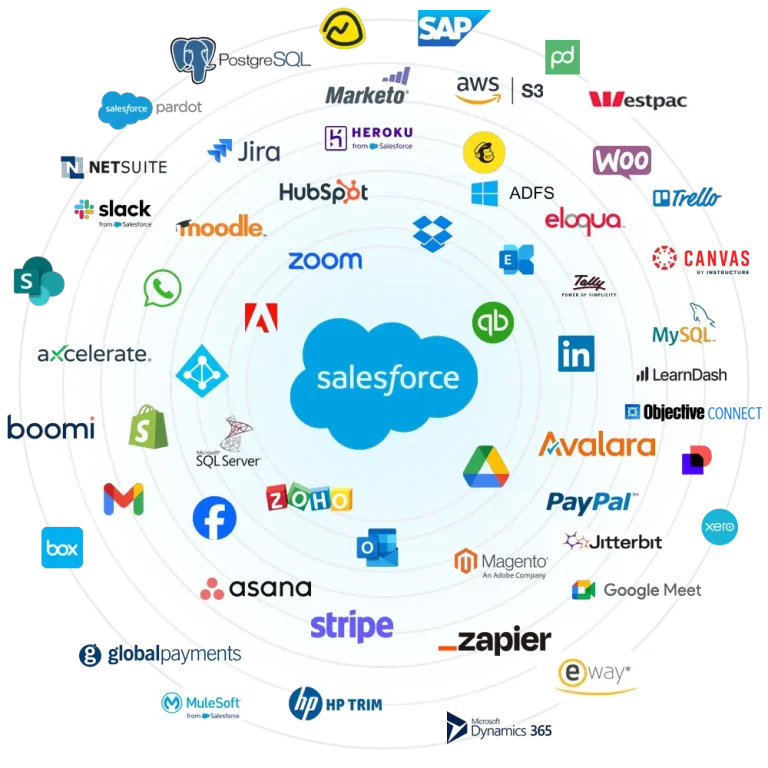
In today’s interconnected business landscape, organizations face a critical challenge: their most valuable asset—customer data—is scattered across dozens of disconnected systems. Sales teams work in CRM platforms, finance operates in ERP systems, marketing runs campaigns from automation tools, and customer service manages tickets in dedicated platforms. This fragmentation doesn’t just slow operations; it fundamentally undermines the customer experience, creating inconsistent interactions and missed opportunities at every touchpoint. The solution lies not in choosing better individual tools, but in orchestrating them into a unified ecosystem where data flows seamlessly and insights become instantly actionable.
Organizations with integrated Salesforce ecosystems capture 36% more revenue opportunities and achieve 35% higher customer satisfaction scores while reducing manual data entry by up to 65%.
THE INTEGRATION IMPERATIVE
Why Fragmented Systems Fail Modern Businesses
When critical business systems operate in isolation, the consequences extend far beyond inconvenience. Sales representatives waste hours manually transferring data between platforms. Marketing campaigns launch without visibility into actual purchase history. Service agents answer customer calls without knowing about recent sales interactions or open opportunities. Each disconnected system becomes a data silo, creating friction in workflows and fragmentation in the customer journey.
The modern Salesforce ecosystem addresses this challenge by serving as a central nervous system for customer operations. When properly integrated, it transforms from a standalone CRM into an intelligent hub that unifies data from every touchpoint—connecting Sales Cloud with ERP systems, synchronizing Service Cloud with marketing automation, and feeding enriched customer profiles back into the tools teams use daily. This architectural shift eliminates redundant data entry, ensures consistency across departments, and creates a single source of truth that powers better decisions at every level.
At Sonix, we’ve observed that successful integration projects share a common characteristic: they treat integration not as a technical checkbox, but as a strategic capability that fundamentally reshapes how organizations operate. The question isn’t whether to integrate, but how to architect integrations that scale with business growth while maintaining data quality and system performance.
THE CENTRAL HUB
How Data Cloud Creates a Unified Customer View
Salesforce Data Cloud represents the evolution of integration architecture—moving beyond simple data synchronization to create a living, intelligent customer profile that updates in real time. Think of it as the brain of your customer operations: it gathers and unifies information from every system, processes it for consistency and accuracy, then feeds enriched profiles back into Sales Cloud, Service Cloud, Marketing Cloud, and any other connected application.
Consider a practical scenario: a sales representative prepares to call a high-value prospect. Before Data Cloud integration, they’d see basic contact information and past purchases. With integration, their Sales Cloud interface now displays that this prospect recently opened a marketing email about a specific product, visited the pricing page multiple times, submitted a support ticket last week, and shows engagement patterns similar to customers who typically purchase within the next 30 days. This contextual intelligence transforms every interaction from transactional to strategic.
INTEGRATION PATTERNS
Choosing the Right Integration Approach for Your Ecosystem
Not all integrations are created equal. The architecture you choose determines performance, scalability, and long-term maintainability. Organizations must select integration patterns based on data volume, latency requirements, system capabilities, and business criticality. Here are the primary approaches that power modern Salesforce ecosystems:
| Integration Pattern | Best Use Case | Key Advantage |
|---|---|---|
| API-Based (REST/SOAP) | Real-time data synchronization, mobile apps, custom integrations | Immediate responsiveness, granular control |
| Middleware (MuleSoft/Boomi) | Complex multi-system orchestration, enterprise-grade reliability | Centralized management, reusable connectors |
| Event-Driven (Platform Events) | High-volume transactions, loosely coupled architectures | Scalability, asynchronous processing |
| Batch Processing | Large data migrations, nightly synchronizations | Resource efficiency, bulk operations |
| Native Connectors | Standard SaaS integrations (marketing, analytics, ERP) | Quick deployment, vendor support |
At Sonix, we typically recommend a hybrid approach: real-time APIs for customer-facing interactions, middleware for complex business processes, and event-driven architectures for high-volume transactions. The goal is architectural flexibility that evolves with your business rather than creating technical debt that compounds over time.
REAL-WORLD APPLICATIONS
Five Integration Scenarios That Transform Business Operations
ERP to Salesforce: Quote-to-Cash Automation
Sales quotes generated in Salesforce automatically flow to ERP systems for order processing. Fulfillment status, inventory levels, and payment information sync back to Sales Cloud in real time, giving sales teams complete visibility without system-hopping. This integration typically reduces order processing time by 40% and eliminates duplicate data entry errors.
Marketing Automation Integration: Closed-Loop Attribution
Marketing platforms like HubSpot or Marketo sync campaign engagement data bidirectionally with Salesforce. Lead scoring models incorporate both marketing engagement and sales readiness signals. Attribution tracking flows from initial campaign touch through closed revenue, enabling accurate ROI calculation and campaign optimization based on actual business outcomes.
Service Cloud to Data Cloud: Predictive Support
Support ticket data flows into Data Cloud where AI models identify patterns predicting customer churn or expansion opportunities. Service agents receive contextual prompts—offering proactive discounts to at-risk customers or suggesting upgrades to satisfied users. This transforms reactive support into strategic customer success management.
E-Commerce Platform Synchronization: Unified Commerce
Online purchase behavior from e-commerce platforms enriches customer profiles in Salesforce. Sales teams see what customers bought online before engaging. Service teams have context about recent orders. Marketing can suppress customers who recently purchased from promotional campaigns. The result: personalized experiences across digital and human channels.
Business Intelligence Integration: Data-Driven Decisions
Salesforce data feeds into BI platforms like Tableau or Power BI for advanced analytics, while insights and forecasts flow back into Salesforce dashboards. Sales leaders see pipeline health in real time. Executives access unified performance metrics across all revenue operations. Strategic decisions are grounded in comprehensive, current data rather than point-in-time reports.
CRITICAL CONSIDERATIONS
Maintaining Data Quality in Integrated Ecosystems
Integration amplifies both the value of clean data and the cost of dirty data. When multiple systems share information, inconsistent, duplicate, or incomplete records propagate across the entire ecosystem, contaminating reports, triggering incorrect automations, and degrading customer experience. Organizations must establish robust data governance before scaling integration efforts.
Establish single source of truth per data type
Implement deduplication rules at integration layer
Create conflict resolution policies upfront
Monitor integration health with automated alerts
Build data validation into ETL processes
Use identity resolution for unified customer records
Document data lineage and transformation logic
Silent integration failures create compounding data quality issues over time. Organizations need comprehensive monitoring strategies: tracking synchronization success rates, measuring data latency, alerting on error thresholds, and maintaining detailed logs for troubleshooting. At Sonix, we implement event-driven monitoring architectures that detect anomalies in real time and automatically trigger remediation workflows before users experience disruption.
BUSINESS OUTCOMES
From Integration to Innovation: Measurable Customer Experience Gains
The ultimate test of any integration strategy is its impact on customer experience. When systems communicate seamlessly, customers feel the difference in every interaction: personalized product recommendations based on browsing history, proactive service outreach before problems escalate, consistent messaging across email, web, and phone channels. Integration transforms customer relationships from transactional encounters to continuous, context-aware journeys.
Consider the customer perspective: they visit your website, add items to their cart but don’t complete the purchase. The next day, they call customer service with a product question. Without integration, the service agent has no visibility into the abandoned cart or recent web behavior. They provide generic information, missing the opportunity to address specific concerns or offer assistance with the items the customer was considering. With proper integration, the agent sees the browsing session, understands purchase intent, and can proactively offer a limited-time discount or answer questions about the specific products in the abandoned cart. The same interaction becomes a conversion opportunity rather than just a support call.
Organizations implementing comprehensive Salesforce ecosystem integrations report transformative results: customers receive relevant communications at optimal times, support interactions resolve faster with complete context, sales conversations build on previous engagements rather than starting from scratch, and every touchpoint feels personalized rather than generic. This consistency across channels and depth of personalization is what separates exceptional customer experiences from merely adequate ones.
Key Takeaways for Business Leaders
| Key Takeaway | Business Implication |
|---|---|
| Integration is strategic infrastructure, not a project | Organizations that treat integration as ongoing capability rather than one-time implementation achieve 3x higher ROI and avoid compounding technical debt. |
| Data quality determines integration value | Without robust governance, integration amplifies inconsistencies across systems, creating worse outcomes than isolated platforms. |
| Hybrid architectures outperform single-pattern approaches | Combining real-time APIs for customer interactions with event-driven patterns for high-volume transactions delivers optimal performance and scalability. |
| Customer experience drives integration priorities | Organizations achieving 35% higher satisfaction scores integrate systems that directly touch customer journeys before optimizing internal operations. |
| Middleware platforms reduce long-term complexity | Point-to-point integrations create exponential maintenance burden as ecosystems grow. Centralized integration platforms like MuleSoft scale more efficiently. |
Salesforce ecosystem integration represents more than technical connectivity—it’s the foundation for delivering seamless customer experiences in an increasingly complex digital landscape. Organizations that architect integration as strategic capability rather than tactical necessity position themselves to adapt quickly as markets evolve, customer expectations rise, and new technologies emerge. The question isn’t whether your systems should integrate, but whether your integration strategy can scale with your ambitions.
At Sonix, we partner with organizations across Japan and globally to design, implement, and optimize Salesforce integrations that transform business operations. Our expertise spans the full integration lifecycle: from architecture design and data governance to implementation, monitoring, and continuous improvement. Whether you’re connecting your first ERP system or orchestrating a complex multi-cloud ecosystem, we bring the technical depth and industry experience to ensure your integration investments deliver measurable business value.
Ready to unify your Salesforce ecosystem and elevate your customer experience? Let’s discuss how strategic integration can unlock new capabilities for your organization.
Sonix — Your success is our happiness.
Leave us your comment