

 Tiếng Việt
 日本語
A multi-channel retail campaign takes three whole days to reconcile stock balances between physical POS registers and online marketplaces; meanwhile, a digital agency burns an entire week reconciling timesheets and securing milestone sign-offs before generating a client invoice. As Customer Acquisition Costs (CAC) surge and service markets face hyper-competition, the divide between market leaders and laggards no longer hinges on creative ideas or oversized marketing war chests. Heading into 2027, the decisive competitive advantage for both agencies and retail chains rests squarely on operational data velocity: information must flow frictionlessly, accurately, and instantaneously across core management systems.
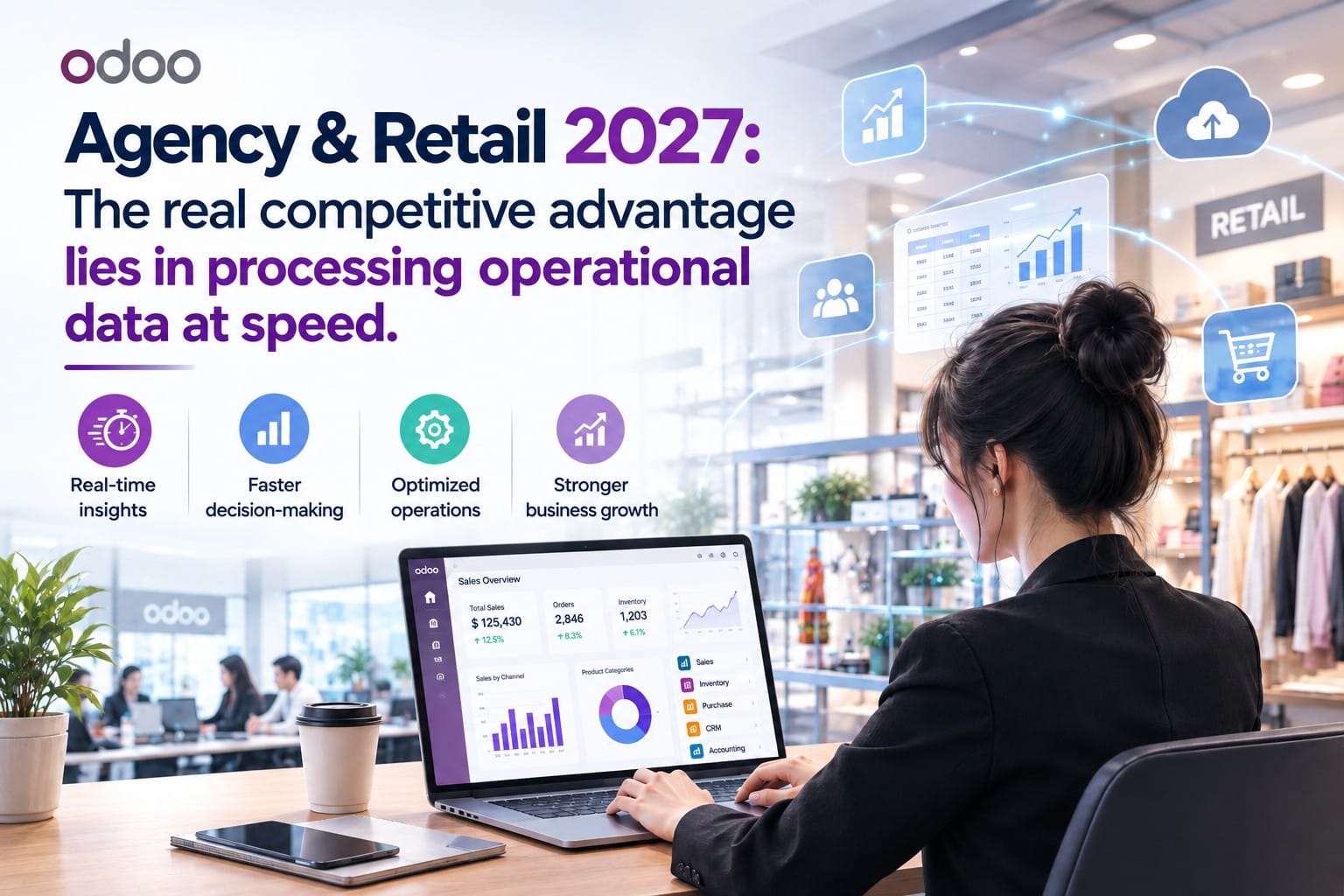
This article analyzes the strategic shift toward 2027 across professional services and retail, illustrating how real-time operational integration within the Odoo ERP ecosystem eliminates decision latency, accelerates working capital cycles, and protects net profit margins.
Table of Contents
- Data Latency: The Invisible Friction Eroding Retail and Agency Margins
- Two Distinct Business Models, One Common Denominator: The Single Source of Truth
- 2027 Operating Infrastructure on Odoo: From Siloed Information to Instant Decisions
- Comparative Benchmark: Batch Sync Latency vs. Native Real-Time Execution
- 4-Step Action Plan to Architect Operational Data Velocity Ahead of 2027
💡 Core Insight: Slow data is dead data. In an era dominated by on-demand services and multi-channel retail, making resource planning or procurement decisions based on last week’s spreadsheets is akin to driving while looking solely through the rearview mirror. Sustainable dominance belongs to organizations whose sales volumes, inventory reserves, and ledger billables synchronize with a single click.
3 Seconds
Inventory reservation speed and data reconciliation across all retail storefronts
85%+
Billable resource utilization rates unlocked by digitized professional agencies
-50%
Reduction in month-end financial closing time and Days Sales Outstanding (DSO)
PART 1
Data Latency: The Invisible Friction Eroding Retail and Agency Margins
Most modern enterprises do not lack software applications—they lack interoperability. When operational platforms fail to exchange transactional signals in real time, data latency accumulates, causing severe financial leakage:
| Sector | Symptoms of Operational Data Latency | Commercial & Financial Fallout |
|---|---|---|
| Retail Chains | Storefront POS transactions take 1 to 4 hours to deduct available balances on marketplace feeds; promotional coupons issued online cannot validate at store checkouts. | Triggers stock collisions, forced cancellations, platform penalty flags, demoted seller rankings, and eroded buyer loyalty. |
| Professional Agencies | Projects finish but formal acceptance documentation languishes; out-of-scope production hours remain buried across personal spreadsheets instead of reaching billing queues. | Cash flow freezes; invoice collection stretches past 60 to 90 days, writing off 5% to 10% in unbilled scope creep. |
PART 2
Two Distinct Business Models, One Common Denominator: The Single Source of Truth
At first glance, physical retail chains and intellectual service agencies appear fundamentally different. Yet beneath the hood, both business models share identical architectural dependencies:
📦 Capacity & Resource Inventory Management
While retailers track physical stock sitting on shelves, agencies track human labor hours. Lacking immediate visibility into “Available Stock” or upcoming “Available Workload Capacity” leads to operational failure: either over-promising followed by missed delivery dates, or rejecting profitable work due to inaccurate visibility.
👤 360-Degree Unified Client Experience
Consumers and B2B clients in 2027 refuse disconnected touchpoints. Retail buyers demand omnichannel loyalty rewards that bridge physical stores with online webstores; agency clients expect project deliverables, change requests, and automated billings visible through a single, transparent client portal.
💰 Instant Cost Recognition & Revenue Settlement
Cash velocity drives operational resilience. When a transaction completes—whether an e-commerce order confirms delivery or a project milestone passes inspection—financial ledgers must instantly generate draft invoices, calculate exact cost of goods or services, and register margins without waiting for month-end chaos.
PART 3
2027 Operating Infrastructure on Odoo: From Siloed Information to Instant Decisions
Leading organizations navigating the 2027 competitive landscape are deprecating brittle API duct-tape in favor of the natively integrated Odoo ERP architecture, creating zero-friction operational workflows:
| Core Operation | Operational Flow on Odoo Retail | Operational Flow on Odoo Agency |
|---|---|---|
| Resource & Inventory Routing | Odoo Inventory & POS: 3-second multi-channel sync. Orders from marketplaces immediately decrement available reserves at regional retail stores for Ship-from-Store delivery. | Odoo Planning & Project: Visual Gantt schedules highlight team workloads with color-coded alerts. PMs rebalance tasks between seniors and juniors via simple drag-and-drop. |
| Client Relationship & Retention | Odoo Loyalty & CRM: 3-second cashier customer lookup via mobile number. Automatically elevates membership tiers and executes RFM lifecycle promotions. | Odoo CRM & Portal: Stakeholders track real-time project milestones, provide direct design feedback, and approve deliverables inside a secure, shared client workspace. |
| Invoicing & Cash Flow Automation | Odoo Accounting: Automatically segments gross sales, platform cuts, return surcharges, and posts daily financial journals chain-wide. | Odoo Invoicing: Completing project milestones or approving employee timesheets instantly flags orders as “To Invoice,” generating clean billing drafts in one click. |
PART 4
Comparative Benchmark: Batch Sync Latency vs. Native Real-Time Execution
The tangible operating divergence between legacy batch-processing systems and real-time unified architecture:
| Operational Metric | Legacy Batch Systems (Delayed) | Native Real-Time System (Odoo) |
|---|---|---|
| Resource / Stock Decision Speed | Grounded in periodic reports (3 to 7 days behind) | Instantaneous (Interactive Live Dashboards) |
| Settlement & Billing Cycle Time | Requires 7 to 15 days following month-end close | Day 1 of the new month (less than 1 hour) |
| Customer Retention Mechanism | Reactive after churn; unsegmented blanket promotions | Automated lifecycle triggers at first churn indicator |
| Overhead & Clerical Headcount | Inflated due to manual reconciliations and data entry | Lean & automated; talent focuses on core deliverables |
PART 5
4-Step Action Plan to Architect Operational Data Velocity Ahead of 2027
To capitalize on efficiency gains during the next economic cycle, forward-thinking operators must establish robust data governance today:
- Step 1 — Eradicate Data Silos: Sunset disjointed files, informal team chats, and point solutions. Consolidate your core product catalog (SKUs) and customer records (CRM) within a single authoritative database.
- Step 2 — Codify Operational Automation Rules: Configure automated inventory decrements across multi-channel marketplaces (for Retail) or automated “To Invoice” status changes upon milestone sign-offs (for Agencies).
- Step 3 — Build Real-Time Logging Discipline: Train retail cashiers to scan member profiles at POS and mandate agency talent to leverage 1-click task timers, converting raw operating actions into instant data assets.
- Step 4 — Leverage Executive Real-Time Dashboards: Deploy centralized Odoo dashboards to monitor net profit margins, billable resource utilization, and inventory turnover weekly without waiting for end-of-month manual rollups.
Explore tailored digital transformation roadmaps and enterprise ERP architectures with Sonix’s certified Odoo Implementation Services.
KEY TAKEAWAYS
| Strategic Pillar | 2027 Value Realization |
|---|---|
| Operational Data Velocity | Drives decisive competitive advantages, capturing market opportunities and mitigating risks ahead of competitors. |
| Single-Platform Operations | Eliminates brittle middleware, preventing discrepancies between front-line production and back-office finance. |
| Automated Cash Cycles | Compresses cash conversion cycles, stabilizing liquidity reserves and protecting bottom-line net profit margins. |
Is your business prepared to lead with operational data velocity by 2027?
Book a 1-on-1 strategic consultation with Sonix ERP specialists to experience unified Odoo architecture: real-time multi-channel retail sync, precise agency capacity modeling, and optimized cash flows.
🚀 Schedule an Odoo Operations Strategy Session
Sonix – Empowering operational excellence and business productivity.
Leave us your comment