

 Tiếng Việt
Odoo ERP for manufacturing is no longer a distant investment — it is the operational backbone that manufacturers across Vietnam and beyond are actively deploying right now. At Odoo Business Show 2026, the Sonix team attended hands-on sessions, technical workshops, and group discussions with a sharp focus on the manufacturing sector, returning with six real-world lessons that go far beyond anything a slide deck can capture.
— Event Snapshot
| Event | Odoo Business Show 2026 |
| Focus Industry | Manufacturing |
| Format | Sessions · Technical Workshops · Group Discussions |
| Published | May 2026 |
| Written by | The Sonix Team |
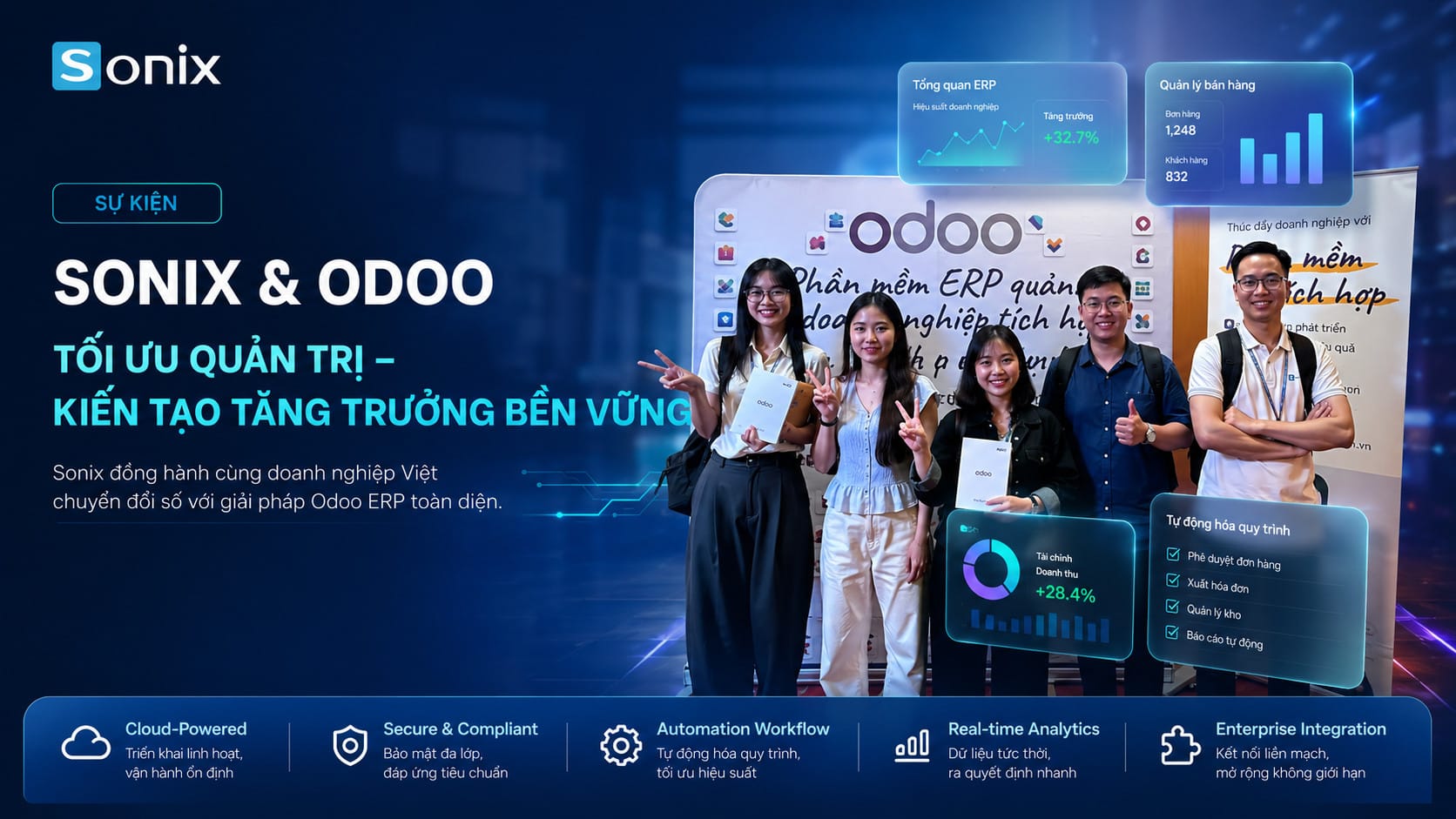
Table of Contents
- Overview: What We Brought Back from Odoo Business Show
- Problem #1: Departmental Data That Cannot Talk
- Problem #2: Planning by Size & Color Variants
- Problem #3: BOM Changes & Approval Workflows
- Problem #4: Managing IoT Devices Directly in Odoo
- Problem #5: Defects Mid-Production
- Problem #6: Missing Raw Materials
- Technologies Covered at the Event
- Closing Thoughts
— Overview
What We Brought Back from Odoo Business Show 2026
Odoo Business Show 2026 wrapped up — and honestly, it was one of those events where you walk out feeling like your brain is running faster than usual. Not because of information overload, but because the very problems you deal with every day on the ground suddenly have names, have solutions, and have other people wrestling with them too.
The Sonix team attended sessions, technical workshops, and group discussions — with a particular focus on manufacturing. This article is what we brought back: not a slide summary, but real-world lessons from companies actively deploying Odoo ERP for manufacturing in live production environments.
— Common Reality
Problem #1 — Departmental Data That Cannot Talk to Each Other
This is the story that nearly every manufacturing business in the room nodded along to: the sales team enters orders into one system, the warehouse logs in Excel, and production runs on a whiteboard and messaging apps. When a decision needs to be made, every department reports a different number.
Odoo addresses this through a unified data architecture: a single record shared seamlessly from Sales → Warehouse → Production → Accounting. When an order is confirmed, the entire downstream chain is triggered automatically — no re-entry needed, no manual notification emails.
Real-world outcome from the event: Several attendees shared that after unifying their data on Odoo, month-end reporting time dropped from 3–5 days down to just a few hours — simply because the numbers were correct from the very start.
— Manufacturing Specifics
Problem #2 — Planning by Size & Color: When “The Same Product” Is Not Really the Same
Apparel is the obvious example, but this is far from an apparel-only problem. At the workshop, it was clear: any business with products that vary by attribute-based variants — size, color, weight, packaging format — will run into serious difficulties when using a standard production planning system.
Take a practical example from an active Sonix project: a Dried Jackfruit product comes in 150g, 250g, and 500g sizes. Each is a distinct SKU with its own Bill of Materials (BOM), yet all three share the same raw material input stream. Managing this in standard Odoo requires configuring Product Variants + BOM by variant.
Important Note
Odoo supports part of this natively, but for industries with complex variant-based material allocation logic, additional customization will be required. This is a point Sonix documented carefully to ensure the right advice is given for each client engagement.
The core insight: no two Odoo implementations are ever exactly alike. Understanding a business’s product characteristics before configuring anything — this is why the Sonix consulting phase always comes before the setup phase.
— Control & Approval
Problem #3 — BOM Changes Nobody Knows About: Why Approval Workflows Matter
The Bill of Materials (BOM) is the heart of manufacturing. When someone edits a BOM without a proper control process, the consequences can ripple far: cost discrepancies, wrong materials issued from the warehouse, or worse — finished products that do not match the original formula.
The most-discussed solution at the event: apply an Approval Workflow for BOM changes — any creation or modification must pass through at least one approval step from a technical manager or production director before taking effect.
Proposed BOM Approval Flow
Combined with Odoo’s Automation Workflow, this entire flow can run automatically — sending notifications, assigning approvers, and logging every change with a full history trail — no manual tracking required. This is a capability many attendees shared they had no idea was already built into Odoo.
— Smart Factory
Problem #4 — Managing IoT Devices Directly in Odoo: This Is Happening Now
One of the most animated discussions at the technical workshop: Odoo IoT Box. This solution allows direct connection of factory hardware — barcode scanners, electronic scales, label printers, temperature sensors — into the Odoo system without any complex middleware layer.
Picture this: a worker scans a completed product at the production line → Odoo updates inventory and production order progress in real time → management sees live data on the dashboard without anyone filing a manual report.
— Handling Production Issues
Problem #5 — Defects Mid-Production: How to Lock, Handle, and Continue in Odoo
No factory runs at 100% perfection. The question raised at the event was very practical: when a defect is discovered mid-way through a run, how should the production order in Odoo actually be handled?
Case 1: Stop and Lock the Order
When a serious defect requires investigation, the production order can be reset to Draft or blocked. Materials already issued are recorded, and the system retains a full history for later traceability and root cause analysis.
Case 2: Continue Partial Production
If the defect only affects part of the batch, you can split the production order — the conforming portion is packed and shipped, while the defective portion is handled separately or assigned a new repair production order.
Key takeaway: every action is fully logged — who did what, when, and why. This forms the foundation for quality reporting, defect root cause analysis, and preventing the same issue from recurring.
— Operational Flexibility
Problem #6 — Missing Raw Materials: Can You Still Start Production?
A question that sounds simple but lands squarely on the pain point of many businesses: urgent order, materials not yet fully arrived — can we open the production order first and handle the shortage later?
The answer from Odoo: yes — but it requires the right configuration. Odoo allows opening a production order even when raw materials are not yet fully available, provided three conditions are met:
Enable “Allow Negative Stock” or configure Replenishment so the system understands the shortage will be covered — not treated as an error.
Odoo will display a visual warning about the shortage quantity — giving the operator full visibility instead of allowing blind confirmation.
Combined with the MRP Scheduler, Odoo can automatically generate purchase suggestions or internal replenishment requests to fill the gap — keeping the supply chain intact and uninterrupted.
Sonix Recommendation
The decision to allow production to start with missing materials should be evaluated per material type and per industry. In food manufacturing, raw input quality directly affects the finished product — stricter controls are warranted compared to simple fabrication environments.
— Tech Stack
Technologies Covered at the Event
All of the above capabilities are part of the Odoo Manufacturing module — a fully integrated ERP platform trusted by over 12 million users worldwide. Sonix deploys and customizes Odoo ERP for manufacturing businesses across Vietnam, Japan, and global markets.
— Closing Thoughts
The Biggest Challenges Are Not in the Technology — They Are in How You Use It
What Sonix brought back from Odoo Business Show 2026 is more than technical knowledge — it is confirmation: the challenges that manufacturing businesses face today are entirely solvable, as long as you have an implementation partner who understands the root of the problem from day one.
Fragmented data, complex product variants, uncontrolled BOM changes, undigitized factory devices, production incidents without a standard resolution process, supply shortages — all of these are challenges that Odoo ERP for manufacturing can handle, when configured correctly.
“Technology doesn’t solve your problems for you — but the right technology, correctly configured, will help you see the problem before it happens.”
The Sonix Team — From Odoo Business Show 2026
Email: info@sonix.vn
Hotline: (+84) 028 3636 0890
Does Your Business Face Any of These Challenges?
Sonix has partnered with 50+ Japanese & Global businesses to transform manual workflows into efficient, digitized systems. Let our specialists map out the right Odoo ERP implementation roadmap for you.
Sonix — Your success is our happiness.
Leave us your comment