

 Tiếng Việt
Let me ask you honestly — and I want an honest answer. After hundreds of conversations with SME business owners, the question of why they haven’t implemented ERP always yields different answers — but they almost always come down to 5 core barriers. If you’re on the fence, this article is for you.
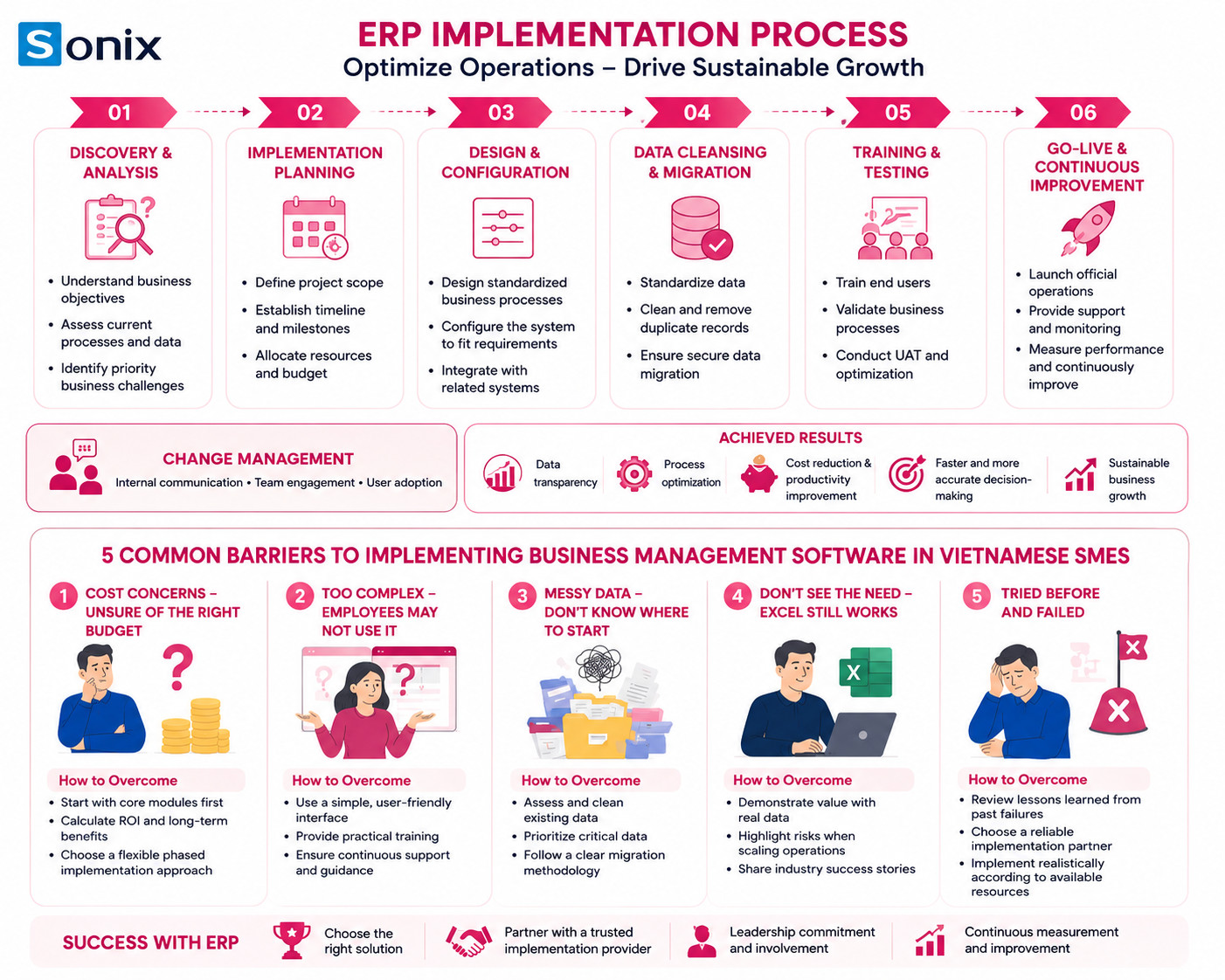 5 most common enterprise software barriers for SMEs in Vietnam
Table of Contents
💡 According to Panorama Consulting, more than 50% of SMEs delay ERP implementation not because of budget constraints — but because of a lack of accurate information about enterprise software barriers.
Barrier #1
Cost — Not Knowing What Budget Is Reasonable
‘ERP is too expensive’ is the phrase I hear most often — but when I ask ‘expensive compared to what number?’, most people don’t have a specific answer. This is more of a psychological barrier than a real financial one, because today’s ERP market spans a wide range of price points to suit businesses of all sizes.
~$6/user
Odoo Community/month (cloud)
3–6 months
Average ROI payback period for SMEs
$0
Initial discovery consultation fee at Sonix
The real issue isn’t ‘ERP is expensive’ — it’s ‘I don’t know what I need yet, so I don’t know how much to invest.’ A 60-minute needs assessment session can fully resolve this question.
Barrier #2
Complexity — Worried Employees Won’t Be Able to Use It
This is the second most common enterprise software barrier — and it’s entirely valid. Implementing ERP without a proper change management plan leads to a very high failure rate. But ‘complexity’ is not a fixed attribute of ERP — it depends entirely on how the implementation is handled.
Start with 1–2 core modules
You don’t need to deploy the entire system at once. Choose the module that addresses your biggest pain point — for example, inventory or accounting.
Train by role, not all at once
Accountants only need to learn the accounting module. Warehouse staff only need the inventory module. This approach reduces the feeling of ‘complexity’ by up to 70% from day one.
Have post-go-live support in place
The first 90 days after go-live are critical. A strong implementation partner will stay closely involved with you during this phase.
Barriers #3 & 4
Data Messy & ‘Excel Still Works’ — Two Barriers That Go Hand in Hand
🗂️ Messy Data — Not Knowing Where to Start
‘My data is spread across 5 different Excel files and I have no idea how to get it into an ERP’ — I hear this almost every week. The truth is: data migration follows a clear, structured process, and a good implementation partner will work through it with you — you won’t have to figure it out alone.
📊 Don’t See the Need — Excel Still Works Fine
Excel works — until it doesn’t. According to Gartner, SMEs typically only recognize the limits of spreadsheets after crossing the 20–30 employee threshold, or when data errors begin causing real financial losses.
| Criteria | Excel | ERP (Odoo) |
|---|---|---|
| Real-time reporting | ❌ Manual | ✅ Automated |
| Data access control | ❌ Limited | ✅ Granular role-based permissions |
| Scalability as you grow | ❌ Slow, error-prone | ✅ Flexible and scalable |
Barrier #5
Tried It Once and Failed — The Hardest Barrier to Overcome
This is the hardest group to convince — and I completely understand why. If you’ve already lost money, time, and trust in a failed ERP implementation, then ‘not wanting to try again’ is a perfectly rational response. The right question to ask is: did that failure come from the product, or from how it was implemented?
Most ERP failures don’t come from the software — they come from unclear scope, lack of leadership commitment, or an implementation partner that wasn’t up to the task. This is exactly why choosing the right partner matters more than choosing the right software the first time around.
📌 Sonix conducts a free needs assessment before recommending any solution — to make sure you don’t repeat the same mistakes.
Summary
Key Takeaways
| Takeaway | What It Means for Your Business |
|---|---|
| Not implementing ERP is usually a knowledge gap, not a resource gap | One well-structured consultation can eliminate most barriers in 60 minutes |
| ERP costs are more flexible than you think | You can start small and scale up gradually based on real business needs |
| The biggest enterprise software barrier is psychological | A phased rollout with the right modules and the right partner significantly reduces risk |
| Messy data is not a reason to delay | Data migration is a structured service — a good partner will handle it alongside you |
| A past failure doesn’t mean ERP isn’t right for you | Choosing the right implementation partner matters more than choosing the right software |
Which barrier resonates with you?
Drop a comment — I read and reply to every one.
If you’re still on the fence about why you haven’t implemented ERP — or you’re ready but don’t know where to start — Sonix can help you get clarity in a free, no-obligation consultation.
Sonix — Your success is our happiness.
Leave us your comment