

 Tiếng Việt
6 months ago, this 5-store retail chain was ‘bleeding’ 40% of its orders every week for one simple reason: inventory across Shopee, WooCommerce, and the POS counter never matched. After deploying Odoo retail with full omnichannel integration, the oversell rate dropped to exactly 0%. This is a real story — with real numbers — from a Vietnamese SME running a multi-channel operation.
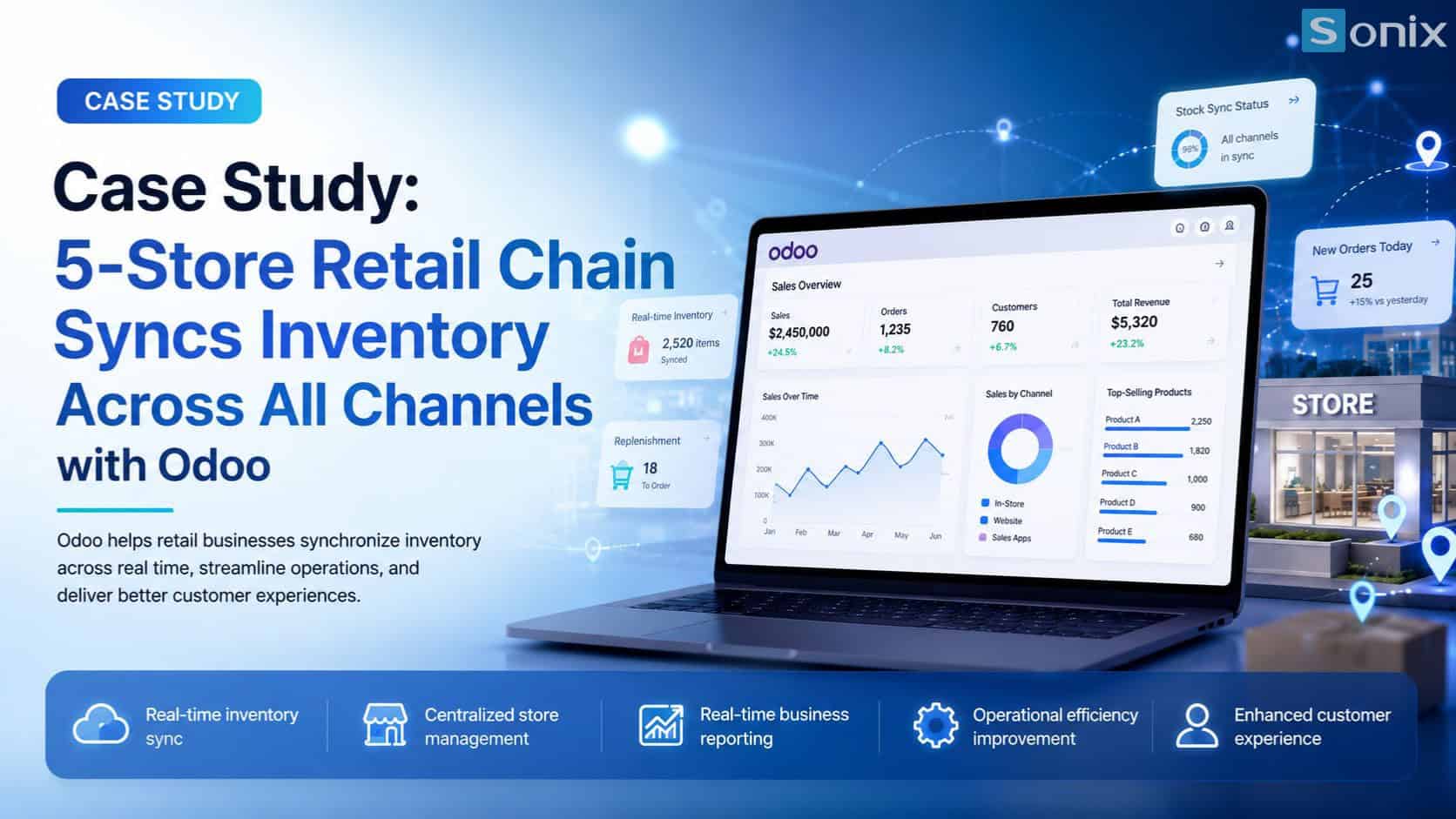
5-store chain syncing inventory in real-time with Odoo Inventory + POS + WooCommerce
Table of Contents
💡 According to Gartner, over 65% of omnichannel retailers experience inventory sync errors in their first year of operation — and most of the damage occurs silently through cancelled orders, returns, and negative reviews.
Background
The Problem: Overselling — The Silent Enemy of Omnichannel Retail
Sonix’s client is a 5-store fashion retail chain in Ho Chi Minh City, selling simultaneously on Shopee, WooCommerce, and an in-house POS system. Each channel maintained its own inventory spreadsheet, updated manually — and that was the root cause of every problem in the traditional Vietnamese retail ERP model.
The result: dozens of orders were cancelled every week due to ‘out of stock after purchase,’ staff spent hours reconciling figures at end of day, and the CEO had no single screen showing a real-time overview of all 5 branches at once.
Even more concerning: according to Statista, order cancellation rates due to inventory errors in Southeast Asian e-commerce markets range from 15–25% — and each cancelled order not only means lost revenue but also drags down shop ratings on marketplaces.
40%
Orders lost to overselling per week
5 channels
Separate, disconnected inventory systems
1 full day
Time required for manual stock counting
Solution
The Solution: Odoo Retail Integrating POS + WooCommerce + Inventory
Sonix deployed the three core modules of Odoo retail: Odoo Inventory as the central hub, Odoo POS for in-store counters, and a WooCommerce/Shopee connector for e-commerce sync. The entire architecture revolves around a single principle: one inventory data source for all channels.
Central Virtual Warehouse — A Single Source of Truth
Instead of each channel maintaining its own inventory table, all 5 stores are mapped into a single central virtual warehouse in Odoo. When an order is confirmed — whether from Shopee, WooCommerce, or an in-store POS — stock quantities are deducted immediately and reflected across all other channels within seconds.
Real-Time Updates Across All Channels
The integration connector pushes inventory data to Shopee and WooCommerce via webhook — no more hourly batch jobs like the old solution. The CEO can open the Odoo dashboard and instantly see: which stores have stock, which are running low, and the total inventory across the entire chain — all on a single screen.
Results
Measurable Results After 3 Months of Deployment
Just 3 months into operating with omnichannel inventory management on Odoo, all 3 core problem metrics were completely resolved. These are real figures from the client’s internal reports — not estimates.
0%
Oversell rate after go-live (down from 40%)
2 hours
Full chain stock count (previously: 1 full day)
1 screen
CEO views all 5 branches in real-time
Beyond the 3 key metrics, warehouse staff reported a significant reduction in end-of-day reconciliation time — from 2–3 hours down to just 20 minutes. This is the direct result of implementing Vietnamese retail ERP correctly: not just digitizing processes, but eliminating manual steps that add no value.
Lessons Learned
Key Lessons for Vietnamese Retail Chains
The biggest lesson from this case study is not about technology — it is about timing. This business waited until it had lost 40% of its orders before deciding to change. With Odoo retail, the implementation cost is far lower than the cumulative losses from overselling and manual labor.
Omnichannel is no longer a ‘nice-to-have’ — according to McKinsey, consumers who shop across 3+ channels spend 494% more than single-channel shoppers. Inventory synchronization is the essential foundation for capturing this opportunity.
What sets Odoo apart from point solutions: instead of purchasing separate POS software, warehouse software, and an e-commerce sync tool — everything lives in a single platform, data stays consistent, operational costs are lower, and scaling to new store locations is straightforward.
| Criteria | Before Odoo | After Odoo |
|---|---|---|
| Inventory sync | Manual, 2–4 hour delay | Real-time, automated |
| Full chain stock count | 1 full working day | 2 hours |
| Oversell rate | ~40% of orders/week | 0% |
| Takeaway | Business Implication |
|---|---|
| Odoo retail = 1 single source of truth | Completely eliminates inventory conflicts between online and offline channels |
| Overselling is a systems problem, not a staffing problem | Fix the process and the tools — not the headcount doing manual checks |
| Real-time omnichannel inventory management | CEO makes decisions based on live data, not end-of-day reports |
| Vietnamese retail ERP must integrate e-commerce marketplaces | Shopee, TikTok Shop, and WooCommerce must be part of the core system — not exceptions |
| Easy to scale when opening new stores | Add new branches to Odoo without rebuilding the entire system from scratch |
Is your retail chain facing similar inventory challenges?
Sonix has deployed Odoo retail for many Vietnamese SME chains — from 2 to 20+ stores. We will provide a free assessment of your current inventory sync status and recommend a tailored roadmap.
📺 Watch the full case study video (3 minutes) on the Sonix YouTube channel
Sonix — Your success is our happiness.
Leave us your comment