

 Tiếng Việt
Many Vietnamese SMBs hesitate to implement Odoo, assuming it will take an entire year — but that is not the case. With a well-structured 90-day ERP roadmap, businesses can fully go-live with Odoo within 3 months without disrupting day-to-day operations. This article outlines the 4-phase digital transformation journey that Sonix has applied in practice for SMB clients across Vietnam.
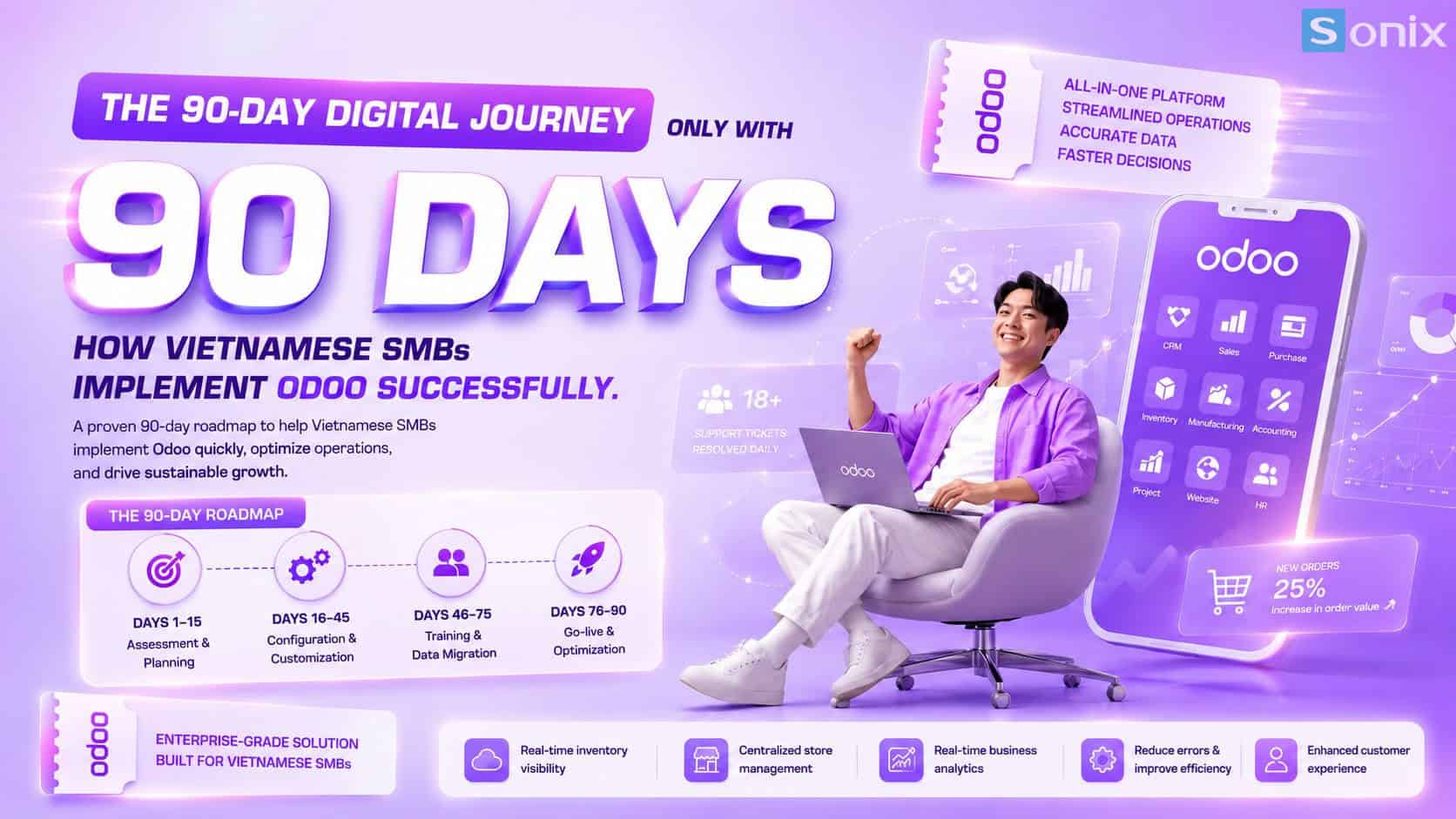
The 90-Day ERP Roadmap — A Practical Digital Transformation Journey for Vietnamese SMBs
Table of Contents
💡 According to Panorama Consulting, more than 53% of ERP projects miss their deadlines — and the primary cause is not the software itself, but the lack of a clear Odoo implementation roadmap from the very beginning.
Context
Why Is a 90-Day Odoo Implementation Achievable?
Many people confuse a full-scale enterprise Odoo deployment with an MVP (Minimum Viable Product) implementation for SMBs. For small and medium-sized businesses, the initial scope is typically limited to 2–4 core modules (Accounting, Sales, Inventory), which significantly reduces the time required.
Odoo officially recommends a phased rollout approach rather than a big-bang deployment — and this is the very foundation of the 90-day ERP roadmap that Sonix applies for Vietnamese SMBs.
90
days to SMB go-live
2–4
initial MVP modules
53%
of ERP projects run late
Phase 1
Phase 1 (W1–2): Discovery — Laying the Right Foundation
The first two weeks are the make-or-break stage of the entire project. The Odoo implementation team works alongside the business to map all current processes (as-is), identify pain points, and outline target processes (to-be). The most critical output of this phase is the MVP scope — the list of modules and minimum features required to go-live.
Process Mapping & Audit
Map current workflows, identify bottlenecks, and determine data to be migrated. Audit the quality of master data (customers, products, inventory).
Define MVP Scope
Finalize the priority module list and eliminate unnecessary customizations. The guiding principle: covering 80% of core business operations is sufficient to go-live.
Kickoff & Team Assignment
Identify the Project Owner on the business side, establish a weekly meeting schedule, and set up official communication channels. Skipping this step is the number one reason projects fall behind.
Phases 2 & 3
Phase 2 (W3–6): Build — Constructing the Real System
This is the core technical phase of the Odoo implementation roadmap: setting up the instance on cloud or on-premise, configuring modules to match business-specific requirements, and importing clean data from Phase 1. In parallel, the pilot team (5–10 key users) begins training in preparation for the testing phase.
The golden rule: clean data first, configuration second. Many projects fail because dirty data is imported into the new system — causing reporting errors and eroding user trust from day one.
Phase 3 (W7–10): Pilot — Real-World Testing & Feedback Collection
The pilot team runs Odoo in parallel with the legacy system for 4 weeks. Any issues that arise or workflows that need adjustment are identified and resolved before the full rollout. This is the ‘safe buffer zone’ — giving the business the confidence it needs before going company-wide.
| Pilot Checklist Item | Pass Criteria | Action If Not Met |
|---|---|---|
| Data accuracy | ≥95% match with legacy system | Re-import & verify mapping |
| Transaction processing speed | No slower than legacy workflow | Optimize workflow, provide additional training |
| User adoption rate | ≥80% of pilot team using daily | Organize Q&A sessions, 1-on-1 coaching |
Phase 4
Phase 4 (W11–12): Full Rollout & Odoo Go-Live
Weeks 11–12 mark the finish line of the 90-day Odoo implementation journey: training all staff, shutting down the legacy system, and officially going live on Odoo. Sonix maintains a dedicated support team for 30 days post-go-live to handle any issues that arise and ensure the operations team feels confident.
According to Gartner, the hypercare phase (intensive post-go-live support) is a critical factor in determining long-term adoption rates — and should never be skipped, even when budgets are tight.
Company-Wide Training (W11)
Pilot team members act as ‘super users’ — guiding their colleagues through the system. Vietnamese-language SOP documentation is prepared in advance for each department.
Official Go-Live (W12)
A specific cutover date is set, the legacy system is switched off, and all transactions run through Odoo. The technical team is on standby 24/7 for the first 3 days.
30-Day Hypercare Support
Sonix provides priority support for 30 days after go-live: resolving bugs, optimizing reports, and coaching users. This is a non-negotiable commitment within the 90-day ERP roadmap.
Summary
Key Takeaways
| Takeaway | What It Means for Your Business |
|---|---|
| A 90-day Odoo implementation is reality, not theory | SMBs do not need to wait 6–12 months if scope is properly controlled from the Discovery phase |
| Clean data is a prerequisite | Investing 2 weeks in data cleansing saves months of fixing errors after go-live |
| The pilot team is the key to adoption | Internal super users help spread skills and reduce change resistance across the entire organization |
| The 90-day ERP roadmap requires post-go-live hypercare | 30 days of focused support after go-live determines whether the system is truly adopted or left unused |
| MVP first, expand later | Launch with 2–4 core modules first, then add features based on real needs — avoid over-engineering in the early stages |
Ready to implement Odoo in 90 days?
Get a free 90-day ERP roadmap template and a 1-on-1 consultation session with a Sonix expert — we will help you define your MVP scope and build a go-live plan that fits your business resources.
Sonix — Your success is our happiness.
Leave us your comment