

 Tiếng Việt
Not every Salesforce project has to take 6–12 months — that misconception is exactly what causes many Vietnamese SMBs to delay digitalization for years. With a 90-day Salesforce implementation, businesses can go from ‘no CRM’ to a real go-live, as long as they have the right roadmap and a committed team. This article shares the 4-phase journey Sonix has battle-tested with numerous SMBs across Vietnam.
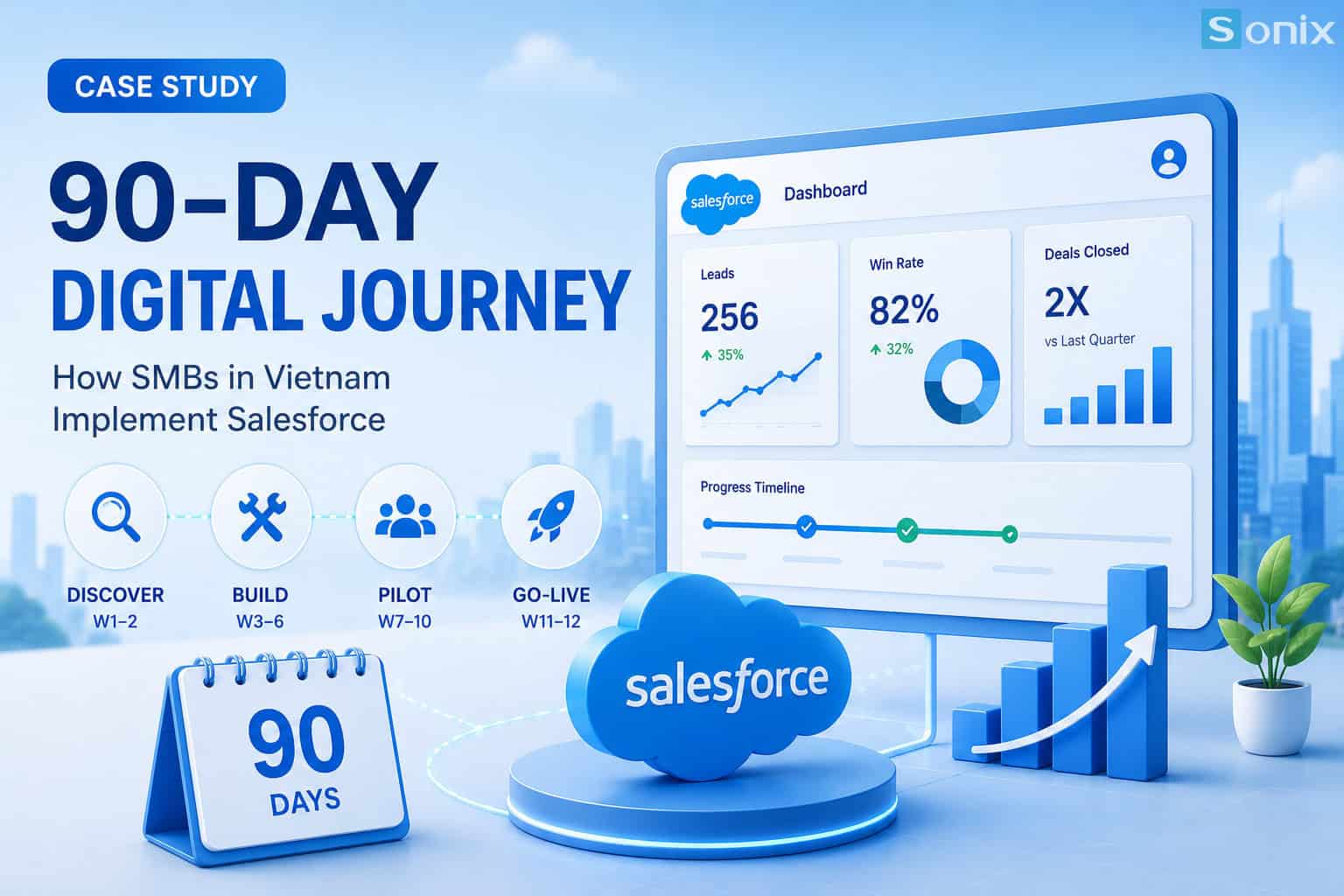 90-Day CRM Roadmap – A Real-World Digital Transformation Journey for Vietnamese SMBs
Table of Contents
💡 According to the Salesforce State of Sales Report, SMBs that implement CRM with clearly defined phases achieve 40% higher adoption rates compared to unstructured rollouts, and reach go-live an average of 35% faster.
Overview
Why Is 90 Days the Ideal Timeframe for a Salesforce Implementation?
CRM projects that drag on too long tend to fail — not for technical reasons, but because they lose momentum: teams burn out, priorities shift, and budgets get cut. The 90-day framework creates positive pressure: short enough to sustain energy, long enough to do things right. According to Panorama Consulting, CRM projects completed in under 6 months achieve positive ROI an average of 2.3x sooner than projects lasting 12+ months.
90
Days from kick-off to go-live
4
Clear, measurable phases
+40%
Higher user adoption rate
Phase 1 – W1–2
Discovery: The Foundation That Determines the Success of Your 90-Day CRM Roadmap
This is the phase many SMBs rush through — and end up paying for it by having to rebuild from scratch two months later. Discovery is not a ‘box-ticking meeting’; it is real technical work: mapping your entire current sales process, auditing existing data quality, and most importantly, defining the MVP (Minimum Viable Product) for your first Salesforce org.
3 Mandatory Deliverables from the Discovery Week
Process Map
Document your actual sales funnel — not the theoretical one. Identify pain points, bottlenecks, and where data ‘falls through the cracks’ in your current process.
Data Audit Report
Assess your existing customer data: how many records exist, what formats are used, what the duplicate rate is, and whether the data is importable.
MVP Scope Document
List exactly what WILL be done within 90 days — and more importantly, what will NOT. Scope creep is the number one enemy of any 90-day CRM roadmap.
Phase 2 – W3–6
Build: Setting Up Your Salesforce Org the Right Way, Not Just the Fast Way
The Build phase is where your Salesforce implementation becomes tangible. The technical team configures the Salesforce org according to the agreed MVP, imports the clean data from Phase 1, and — critically — trains the pilot team: the first 5–10 users who will serve as internal champions for the rest of the company.
| Week | Key Activities | Output |
|---|---|---|
| W3–4 | Org setup, object configuration, basic workflows | Functional Salesforce sandbox |
| W5 | Clean data import, data integrity validation | Data migration report |
| W6 | Pilot team training, internal user guide documentation | Pilot team ready for live usage |
Phase 3 & 4 – W7–12
Pilot → Go-live: From Testing to Company-Wide Salesforce Deployment
The Pilot phase (W7–10) is the real-world stress test: the pilot team uses Salesforce in their daily work, logs friction points, and provides direct feedback to the implementation team. This is the golden window to catch business logic errors before scaling to the entire company.
Collecting Feedback & Iterating: The 2-Week Loop
Each week during the Pilot phase should include a short 30-minute retrospective: the pilot team shares what is working well, what is causing friction, and suggests adjustments. The technical team commits to resolving minor changes within 48 hours. This builds trust and significantly boosts adoption rates.
The Full Rollout phase (W11–12) is not simply ‘flipping a switch’ — it is a genuine change management event. Company-wide training is conducted in small groups (no more than 15 people per session), followed by the official go-live and a committed 30-day post-go-live support period to ensure no one is left behind in the digital transformation journey.
W7–10: Live Pilot
Pilot team uses Salesforce in real work. Structured feedback is collected weekly and minor adjustments are made within 48 hours.
W11–12: Training & Go-live
Company-wide training in small groups, official go-live, and activation of the 30-day post-go-live support package.
Day 90+: Hypercare Support
30 days of priority support after go-live: rapid issue resolution, adoption rate tracking, and Phase 2 planning if expansion is needed.
Summary
Key Takeaways
| Takeaway | What It Means for Your Business |
|---|---|
| A 90-day Salesforce implementation is achievable | SMBs do not need to wait until conditions are perfect — starting with an MVP is enough to generate early value. |
| Discovery determines 70% of your success | Investing 2 weeks in a proper Discovery saves months of costly rebuilding down the line. |
| The pilot team is your adoption multiplier | 5–10 successful early users will bring the rest of the company along. Choose your pilot team members carefully. |
| A 90-day CRM roadmap requires CEO commitment | Without a strong executive sponsor, any CRM project is vulnerable to delays when challenges arise. |
| Go-live is not the finish line | The 30-day hypercare period after go-live determines whether CRM becomes a habit or gets abandoned. |
Ready to Start Your 90-Day Salesforce Implementation Journey?
Sonix has guided dozens of Vietnamese SMBs through a structured 90-day CRM roadmap — from Discovery to Go-live. Book a free consultation to receive a readiness assessment and a custom roadmap template tailored to your business.
Sonix – Your success is our happiness.
Leave us your comment