

 Tiếng Việt
“What does a consultant actually do every day?” is the most common question when a business starts exploring a CRM system. Clients want to know what value their budget will bring, while recent graduates are curious if this is the right career path for them. This article provides a candid and realistic perspective on the industry, without any “black boxes” or empty tech jargon.
A professional Salesforce Consultant is not an IT staff member who installs software and leaves, nor are they someone who just sits and writes theoretical documents. The reality of their job is much more complex and fascinating.
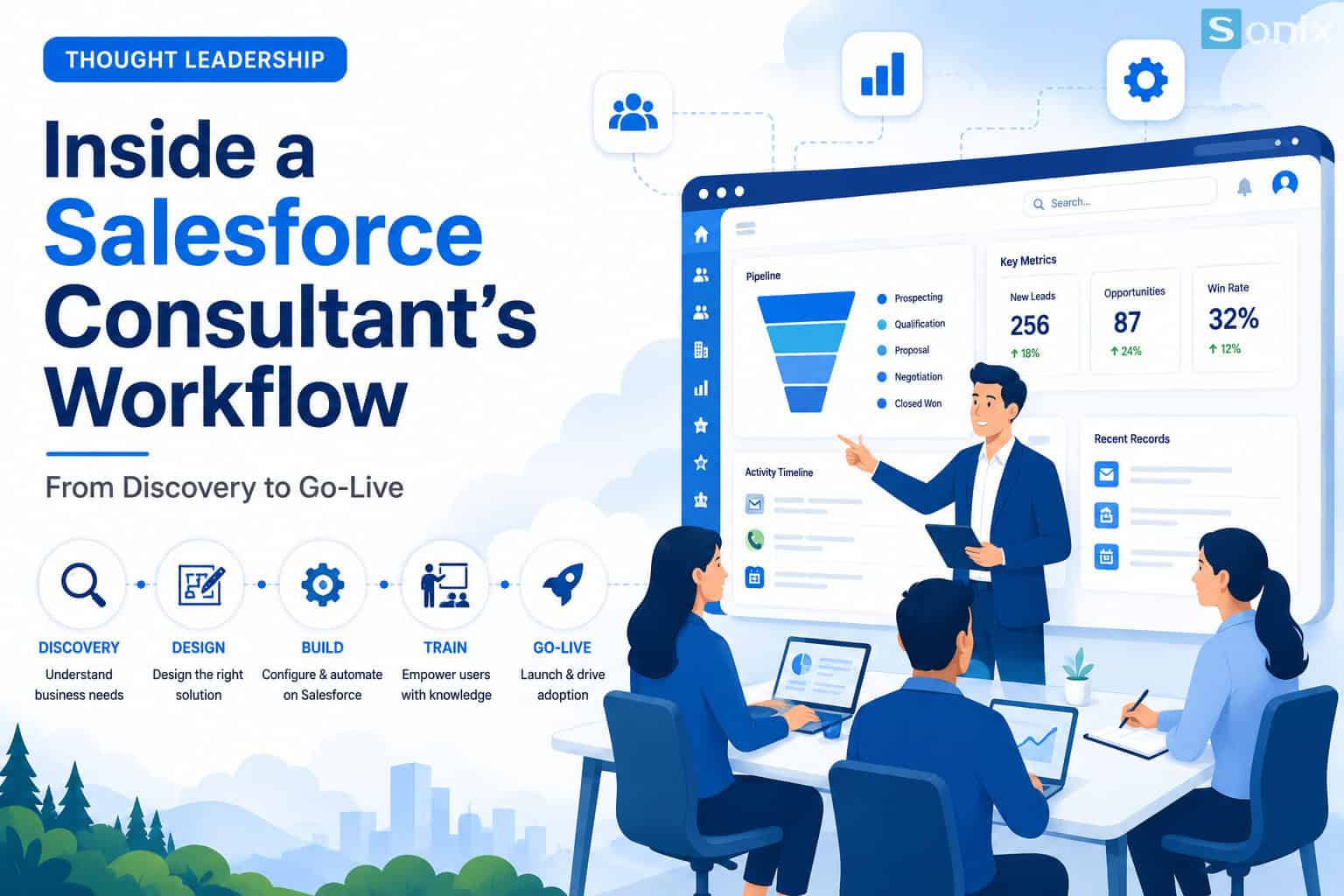 The standard workflow of a Salesforce Consultant: from the initial Discovery phase to project handover
Table of Contents
According to the Salesforce State of Sales Report, many businesses fail in their CRM implementation not because they chose the wrong platform. The root cause is lacking an expert who understands enough to bridge technology with business processes. That is exactly the mission of a Salesforce Consultant.
Redefining the Role
How is a Salesforce Consultant different from a “software installer”?
When a business decides to implement Salesforce, what they truly need isn’t someone who just knows how to navigate the system. They need someone who can sit down, analyze their business problems, and then digitize those problems into specific configurations, automations, and workflows within the CRM.
That is the core difference. If an “IT installer” simply follows a pre-existing list of requirements, a Salesforce Consultant is the advisor who helps create that list. They ask the tough questions, uncover data leaks the client hasn’t even noticed, and propose solutions that thoroughly resolve operational bottlenecks—rather than just sticking to features found in a product brochure.
Software Installation Technician
Receives requests, configures accordingly, hands over, and finishes the job. They rarely ask the reasoning behind a request, seldom propose improvements, and take no responsibility for whether the system actually helps close deals.
Professional Salesforce Consultant
Diagnoses the problem before proposing a solution. They investigate why processes are breaking and design the system to be highly user-friendly for the sales team—not just to look good for management. They measure success by the actual adoption rate once the system goes live.
Industry Process
5 practical tasks of a Consultant in a standard project
In the solution consulting industry, a professional implementation project always goes through 5 core phases. At each stage, the consultant’s role adapts dynamically to keep the system on the right track:
Discovery: Listen before advising
This is the most critical phase. The Consultant works directly with various departments (sales, marketing, customer service) to observe their daily operations. Gathering information from real-world observation is always more accurate than just listening to descriptions, as users tend to describe ideal processes rather than their current, cumbersome manual tasks.
Output: Pain Point Mapping analysis and system diagnostic documentation.
Solution Design: Translating operations into design
From the gathered pain points, the Consultant sketches the system architecture: building the steps in the sales funnel, setting up automation rules, defining necessary data fields, and designing reports for management. Every design decision at this stage requires consensus from the business.
Output: A detailed Solution Design Document.
Build & Configure: Getting hands-on with the system
A great Consultant isn’t just a planner; they directly configure the Salesforce platform. They set up automated workflows (Flows), configure security permissions, and clean old data for import into the new system. For complex integrations, they collaborate closely with Developers to ensure seamless deployment.
Output: A fully functional CRM system in a Sandbox environment, ready for User Acceptance Testing (UAT).
Training: Teaching effective usage, not just button-clicking
The training phase is decisive in a project’s success or failure. The Consultant doesn’t merely show staff how to navigate the software; they explain why the process is designed that way and the importance of maintaining clean data. Training sessions are usually segmented by specific roles to ensure maximum absorption.
Output: Customized user manuals tailored exactly to the business’s workflows.
Handover: Going live and post-launch support
A Consultant’s job doesn’t end on launch day. They continue to monitor the adoption rate during the first few months. If a feature is rarely used, they investigate the root cause to provide retraining or refine the system accordingly. True success is achieved when the client can operate smoothly on their own.
Output: A project closure report and a future optimization roadmap.
Answering Your Questions
Common misconceptions about the CRM consulting role
When researching CRM implementation services, Small and Medium Businesses (SMBs) often have similar concerns. Here are candid answers based on industry standards:
❓ “How long does a standard implementation take?”
Implementation time heavily depends on scale and data complexity. Typically, for an SMB, a structured project lasts between 6 to 10 weeks. Many projects fall behind schedule not due to technical flaws, but because the business needs extra time to align its own internal processes.
❓ “What if employees refuse to use the new system?”
Resistance from end-users is a tale as old as time. However, a low adoption rate usually stems from a system that is overly complex or requires too much manual data entry. A skilled Consultant knows how to design software that genuinely supports an employee’s daily work, making using the CRM the easiest and most beneficial choice for them.
❓ “Will we be dependent on the Consultant forever?”
The ultimate goal of consulting is technology transfer. A project is only deemed successful when a business’s internal admin can independently generate reports, tweak basic features, and train new staff. The expert team should only be needed later on for solving complex integration or scaling challenges.
Career Perspectives
What does it take to follow the Consultant path?
If you’re reading this because you are interested in a career path as a Salesforce Consultant, here are the core skills you need to cultivate.
In terms of certifications, the most common route starts with learning on Salesforce Trailhead to become a Salesforce Certified Administrator, before advancing to specialized certifications like Sales Cloud or Service Cloud. However, certifications are just the first stepping stone.
| Core Skills | Why this skill is crucial |
|---|---|
| Business Process Thinking | Software is merely a tool. The ability to grasp a company’s operational, sales, and marketing landscape is the true core value of a consultant. |
| Analytical & Problem-Finding Skills | The Discovery phase demands the ability to ask the right questions. If you identify the wrong problem, you’ll waste months building a solution no one needs. |
| Communication & “Technical Translation” | Executive boards rarely care about database structures; they care about Return on Investment (ROI). A Consultant must know how to translate technical concepts into business language. |
| Adaptability & Troubleshooting | Very few tech projects go 100% according to the original plan. An exceptional Consultant stays calm and finds optimal workarounds when facing unexpected challenges. |
“Every business is a unique ecosystem. CRM consulting is never boring because every day brings completely new puzzles to solve to help clients grow.”
Salesforce Implementation
Consulting Process
Enterprise Digital Transformation
Sonix Vietnam
Looking for a Salesforce consulting team that truly understands the process?
Whether you’re a business looking to optimize your systems or a candidate eager to join an environment that values professional standards, Sonix is ready to connect and partner with you.
📋 Interested in a Consultant role? Comment “CAREER” below
Or book a free consultation to discuss your business’s operational challenges directly with Sonix experts.
Sonix — Your success is our happiness.
Leave us your comment