

 Tiếng Việt
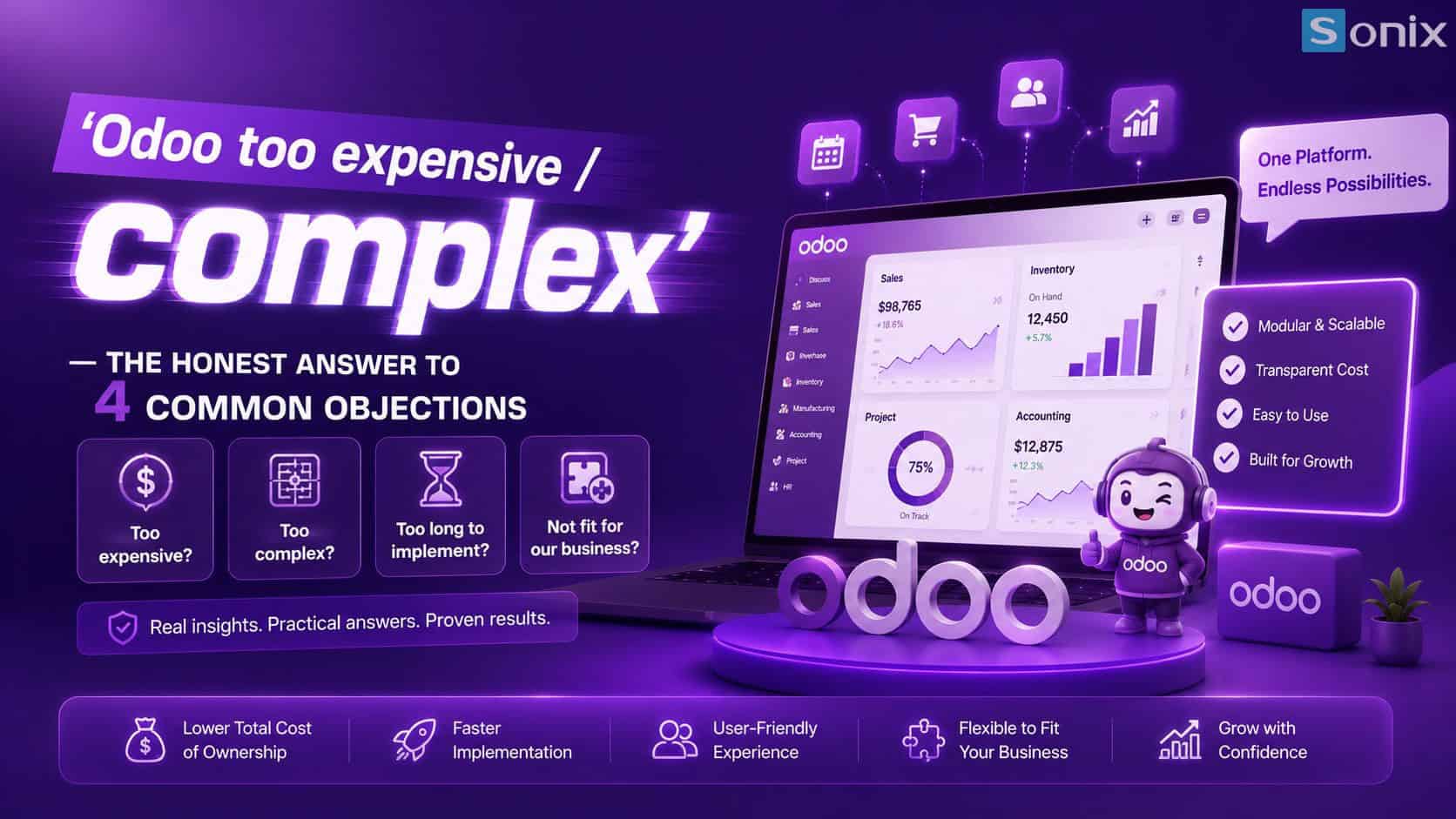
“Is Odoo expensive?” this is the question Sonix hears most often from SMEs before they decide to implement it. The real answer has less to do with the number on the pricing page, and more to do with how well a business understands (or misunderstands) Odoo’s pricing model and rollout path. This article answers “is Odoo expensive” head-on through 4 of the most common objections, based on real data and hands-on implementation experience from Sonix no dodging, no overselling.
In this article
💡 Insight: Most Odoo projects that “run over budget” aren’t caused by expensive licenses they’re caused by businesses over-customizing from day one instead of following a phased rollout.
Context
Is Odoo Expensive? Why This Is a Common Misconception
Odoo is an open-source ERP priced by the number of apps and active users you actually need a completely different model from SAP or Oracle NetSuite, where businesses typically pay for a fixed bundle of modules even if they only use a fraction of them. That’s exactly why the question “is Odoo expensive” rarely has one universal answer for every business.
But this same flexibility is what creates the misconception: many SMEs approaching Odoo for the first time work with implementation partners who lack experience in their local market, which lets project scope balloon far beyond what’s actually needed pushing cost and timeline well past the original estimate. That’s usually the moment “is Odoo expensive” gets answered the wrong way.
At Sonix, working with manufacturing, retail, F&B, and service businesses across Vietnam, we consistently see the same 4 objections come up objections that sit at the root of “is Odoo expensive” and most of them can be resolved simply by understanding how the system actually works, not by avoiding ERP altogether.
Analysis
4 Common Objections When Weighing Whether Odoo Is Expensive
No dodging, no overselling here’s Sonix’s straight take on “is Odoo expensive” for each concern, along with the real-world conditions that decide whether the objection actually holds up.
Is Odoo expensive? “Add up the licenses and it costs as much as foreign software”
Partly true: if a business turns on every app from day one (Sales, Inventory, MRP, Accounting, HR, Helpdesk…) for its entire headcount, monthly per-user subscription costs can add up fast.
But in practice: Odoo lets you pay only for the apps and users that actually need access not a fixed bundle like most traditional ERPs. A garment factory with 50–100 employees typically only needs 10–15 licensed users (Sales, Purchase, Manufacturing, Accounting); everyone else works through the Portal or internal processes that don’t require a license cutting license cost by 60–70% compared to licensing the entire company.
“Implementing Odoo takes a full year, and staff can’t keep up”
Partly true: with a “big bang” rollout every module switched on at once, one massive training session for every department adjustment time drags on and staff are far more likely to fall back on old processes instead of adopting the new system.
But in practice: the right approach is a phased rollout starting with 1–2 core modules (typically Inventory + Sales, or Purchasing + Manufacturing), demoing and training role by role, then expanding gradually. With this model, an SME can typically go live with its first module in 4–8 weeks, not a full year.
“Our team doesn’t have the technical skills to run this ourselves”
Partly true: if a business expects to configure workflows, write Automated Actions, and customize reports in-house without any technical foundation, expecting to “self-operate 100%” from the outset simply isn’t realistic.
But in practice: deep technical work (customization, integrations, module development) belongs to the implementation partner, like Sonix not to day-to-day staff. Staff only need to work with a familiar interface (creating orders, confirming stock moves, approving purchase requests) actions designed to feel close to Excel or the old paper-based process, so real training time for a specific role is usually just 1–2 sessions.
“Excel and our scattered tools are good enough, we don’t need to switch”
Partly true: at a very small scale (under 10–15 people, a single product line), Excel and a handful of disconnected tools can still get the job done switching cost isn’t really justified yet at that stage.
But in practice: Excel’s “hidden” cost isn’t the software itself it’s the time spent manually reconciling data across departments, inventory discrepancies from duplicate data entry, and the risk of losing data when staff leave. Once a business crosses a certain threshold typically once there’s more than one warehouse, more than one branch, or a process that needs cross-department approval the cost of manual operations usually outweighs the cost of an ERP license.
Cost comparison
Real Cost Comparison: Is Odoo Expensive Compared to Other Options?
To answer “is Odoo expensive” accurately, it helps to put it side by side with the other options SMEs are usually weighing. You can also check independent ERP software rankings and cost reviews to cross-reference. The figures below are illustrative actual cost depends on the size and process complexity of each business.
Low
Odoo (per app/user)
Pay only for the modules and users you actually use, expanding in phases
Medium
Scattered tools + Excel
Low license cost, but high hidden cost from manual reconciliation
High
Traditional ERP (SAP/Oracle)
Fixed module bundles, high licensing and implementation cost, built for large enterprises
The core distinction that answers “is Odoo expensive”: an SME can start at a cost roughly comparable to scattered software tools, but with a clear path to grow into a full ERP system without ever needing to rip out and replace the whole platform. Stitching together separate software tools can’t offer that.
This is also why Sonix always recommends starting with a clearly defined scope, measuring real results after go-live, and then deciding on expansion rather than trying to predict and pre-purchase everything for the next 3–5 years.
Discussion
What’s Your Biggest Blocker When Weighing Whether Odoo Is Expensive?
Every business hits a different wall when asking “is Odoo expensive” it could be cost, timeline concerns, or simply not being able to picture how Odoo would change your current process. Tell Sonix what you’re weighing, and we’re happy to break it down specifically for your industry and scale.
📊 What’s your biggest blocker when considering Odoo?
Vote on Sonix’s LinkedIn/Facebook post and share more details about your situation in the comments!
If you want a concrete answer not a generic one tailored to your industry and scale, the Sonix team can walk through it with you directly in a free consultation.
Key takeaways
Still wondering if Odoo is expensive for your specific business?
Sonix breaks down real scope for your industry and scale — no generic quotes, no inflated costs from modules you don’t actually need.
Sonix — Your success is our happiness.
Leave us your comment