

 Tiếng Việt
“Salesforce is too expensive” is the objection Sonix hears most often from SMB owners when the topic of CRM comes up. But after dozens of consulting conversations, we’ve noticed something: most Salesforce pricing objections aren’t really about price. Behind the license fee, there are usually three other fears — fear the team won’t use it, fear it’s not the right time yet, and fear of picking the wrong platform. This post names and answers the 4 most common Salesforce pricing objections, without dodging any of them.
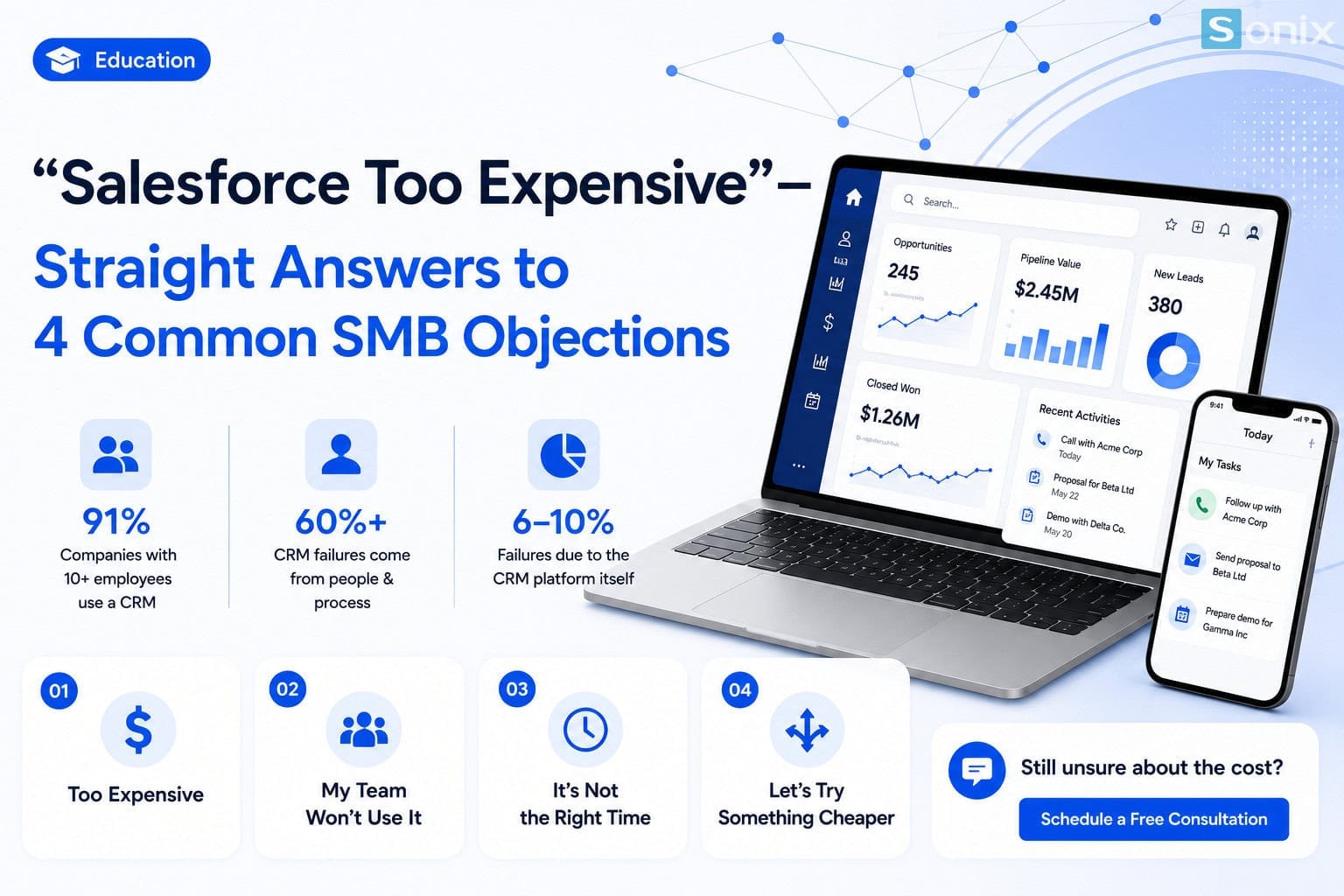 4 common Salesforce pricing objections from SMBs, answered honestly
In this article
Objection #1
“It’s too expensive” — The real question isn’t price
The question worth asking isn’t “Is Salesforce expensive?” — it’s “Is the ROI positive?” For businesses with a B2B deal size above $2,000 and a sales team of 5 or more, the answer is almost always yes. A good CRM means you stop losing leads to missed follow-ups, stop losing deals to pricing mistakes, and finally have the data to know where to put your marketing budget. The license fee is only one side of the equation — the other side, usually the bigger one, is the opportunity cost of not having it at all.
Worth noting: almost every mid-sized company has already been through this stage. According to Gartner research, 91% of companies with more than 10 employees already use some form of CRM. The real question is no longer “should we use a CRM,” but “are we using the right one at the right time.”
Objection #2
“My team won’t use it” — The issue is rarely the UX
This is the most legitimate concern of the four, but the root cause is rarely a clunky interface. According to Vantage Point’s analysis, over 60% of CRM failures come from people and process issues — insufficient training, no executive sponsorship, workflows that don’t match how the team actually works — while only about 6-10% actually come from the platform itself. In other words, switching to an “easier” CRM rarely fixes the problem, because the problem was never how hard the software is to use.
Sales teams don’t fall in love with a new tool automatically. They need to see it help them close deals faster, from week one, and they need real support through the transition — not a single training session and then radio silence.
A good CRM doesn’t create adoption by itself. Adoption comes from how it’s rolled out — role-based training, hands-on support, and close tracking in the first few weeks.
Objection #3
“Not the right time yet” — The cost of doing nothing
“Not the right time” is usually another way of saying “it doesn’t hurt enough yet.” But the cost of NOT having a CRM — leads slipping through the cracks because no one follows up, no one remembering what was promised to a customer, sales reports pieced together in Excel every month-end, managers with no idea where the pipeline is stuck — is usually far higher than the cost of implementation. It just doesn’t show up as a single visible line item, so it’s easy to overlook.
The real question isn’t “should we do this,” it’s “should we do this now, before it gets more expensive to fix later” — once the sales team and customer base have grown well past their current size.
Objection #4
“Let’s try something cheaper first” — The real price of switching later
It sounds reasonable, but the reality usually plays out the opposite way: switching CRMs after 2-3 years on a cheap tool you’ve outgrown is far more painful than investing in the right platform from the start. Customer data doesn’t migrate cleanly, the team has to relearn processes from scratch, and the business loses exactly the amount of time that transition takes — often several months — while competitors keep selling without interruption.
You don’t always need to start with the biggest package. But it’s worth starting with a platform that can scale with you, instead of a tool you’ll have to replace the moment the business grows.
Objection Handling
SME
CRM ROI
Sonix Vietnam
Still have a Salesforce pricing objection we haven’t answered?
Sonix helps you work out the real ROI for your business size before you decide — not just sell you a license.
Sonix – Your success is our happiness.
Leave us your comment