

 Tiếng Việt
 日本語
日本語A lot of decisions to delay CRM implementation aren’t based on any specific fact, they’re based on a misconception passed around for years. These misconceptions aren’t entirely wrong, they usually come from someone’s real experience, but get generalized into a rule that supposedly applies to every case.
This post lists the 5 most common CRM misconceptions that trip up Vietnamese SMBs, and a more realistic take on each one.
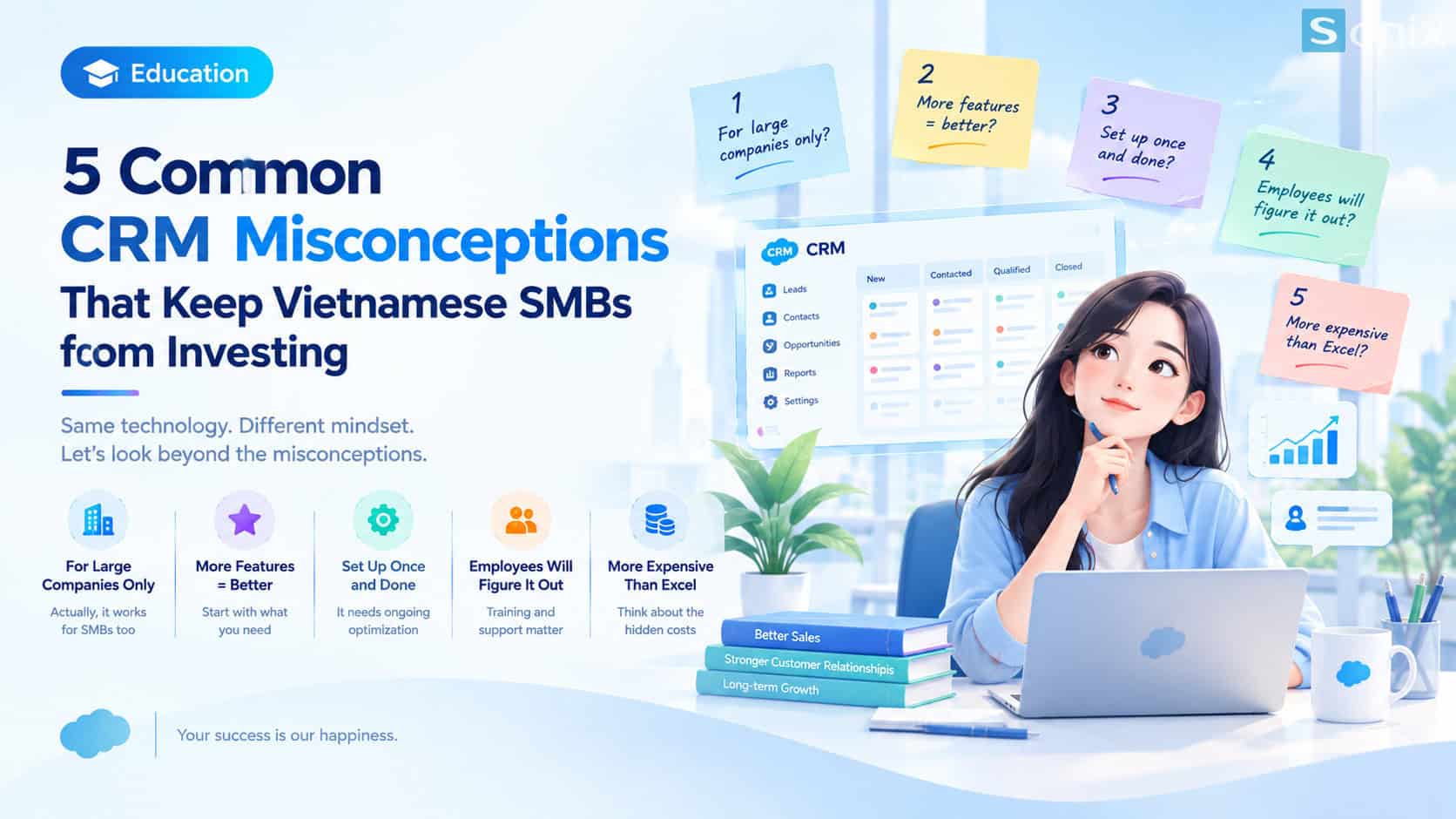
Table of Contents
Misconception 01
CRM is only for large companies
This misconception usually comes from watching enterprise CRM demos, packed with dozens of modules and a dedicated implementation team. Seeing that, a lot of SMB owners assume CRM is built for companies with hundreds of employees.
In reality, most CRM platforms today, Salesforce included, offer plans built for small teams, priced per actual user. A 5 to 7 person sales team can absolutely start with a simple pipeline without buying the full enterprise-grade feature set.
Misconception 02
More features is always better
When comparing CRM platforms, a lot of people tend to pick the plan with the most features, thinking it’s the safer bet for the future. The result is usually the opposite: the team gets overwhelmed by a complex interface, ends up using only 10-15% of what they paid for, and gives up within a few weeks.
A more effective approach is starting with just the features that solve the current problem, like pipeline management and follow-up reminders, then expanding once the team is comfortable. Salesforce’s AppExchange also lets you add features as actual needs arise, instead of picking everything up front.
Misconception 03
Once it’s set up, the job is done
Many businesses treat the initial setup and data import as the finish line of the project, like installing a machine and letting it run on its own. In reality, a CRM system needs ongoing adjustment as the sales process changes, new products launch, or the team expands into new branches.
Businesses that get the most out of CRM tend to review dashboards and workflows every quarter, adjusting pipeline stages or automation rules to match how things are actually running, rather than leaving the configuration untouched since day one.
Misconception 04
Employees will figure it out on their own
Because modern CRM interfaces tend to be intuitive, a lot of managers assume just sending a login link is enough for employees to figure things out on their own. In reality, the hardest part isn’t finding which button to click, it’s changing the habit of logging customer information into a new system instead of a notebook or personal memory.
Without initial training and someone tracking adoption during the first month, most employees revert to old habits the moment they hit a small hiccup, and the data in the CRM quickly becomes patchy and unreliable.
Misconception 05
CRM costs more than Excel, so it’s not worth it
Comparing the monthly cost of a CRM directly against free Excel makes CRM look like an unnecessary expense. But that comparison skips over Excel’s hidden costs: time spent manually compiling reports, leads lost because no one followed up in time, and customer data disappearing when an employee leaves.
Once you account for those hidden costs, especially the revenue lost from leads not handled in time, the monthly CRM cost is usually far smaller than the opportunity value it helps you keep.
All five misconceptions share one thing in common: they push businesses to delay a decision that should have been made sooner, or to implement it the wrong way from the start. If you want to see what a proper evaluation process looks like before implementing, this piece on Einstein AI in Salesforce is a good place to see how the system supports sales teams in practice.
Which of these misconceptions did you believe?
Book a free consultation, the Sonix team will help you see the real picture before deciding whether or not to implement a CRM.
Sonix: Your success is our happiness.
Leave us your comment