

 Tiếng Việt
 日本語
Many SMBs start an ERP project with an unspoken assumption: just “go live” on the system and every operational headache will disappear on its own. After hundreds of implementations, the reality points the other way ERP is not a destination, it’s a tool. And no matter how powerful a tool is, it can never replace a properly designed process or a team that’s ready to change.
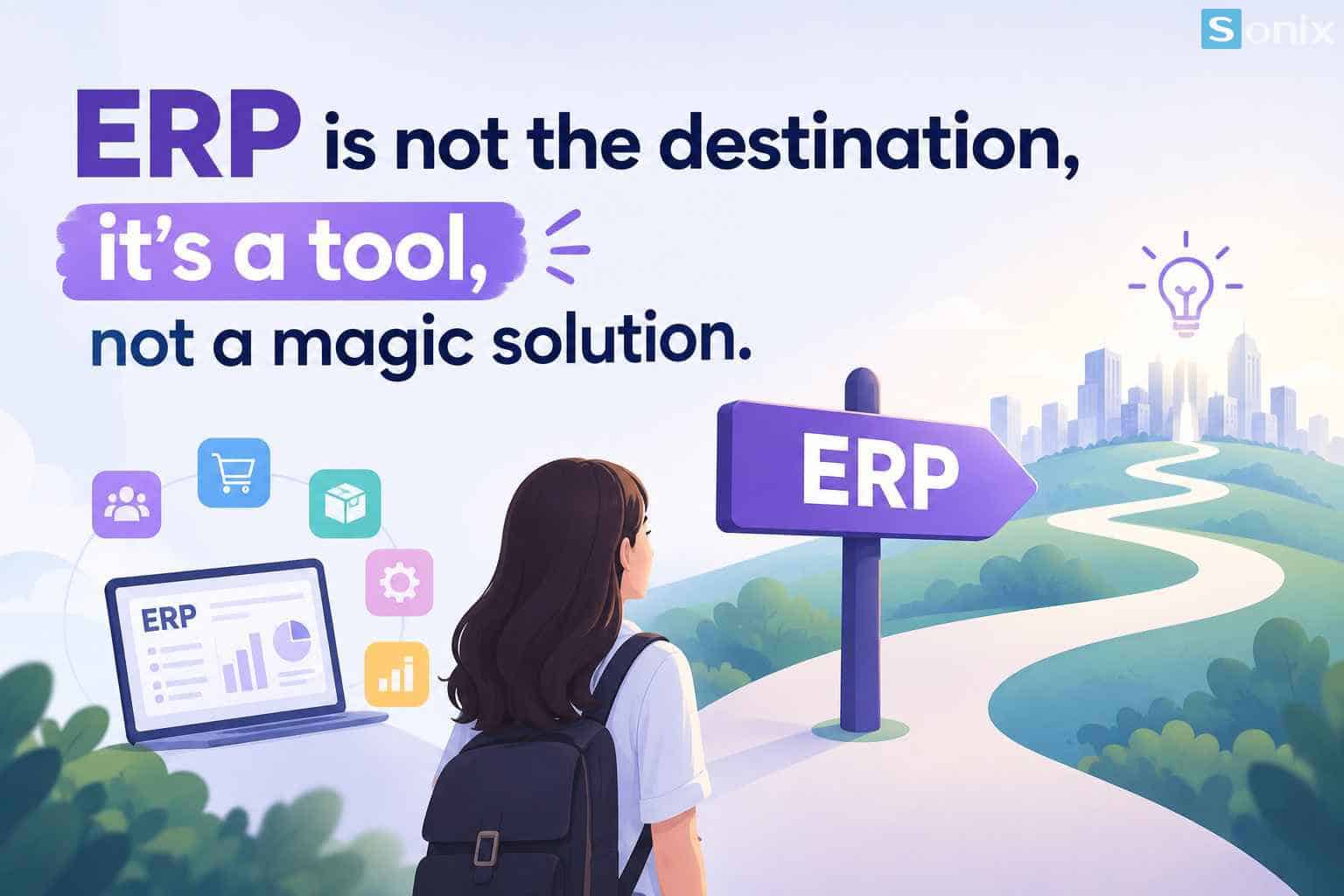
Table of Contents
💡 Core insight: ERP doesn’t fix a bad process it just runs that process faster, breaks it more visibly, and makes it clearer. If the root problem is a process that was never designed properly, the software only amplifies the problem instead of solving it.
PERSPECTIVE #1 — THE WRONG EXPECTATION
The most common misconception when implementing ERP
In early consultation sessions, one question comes up again and again: “How soon after implementation will our data chaos disappear?” It’s a natural question but one that sets a risky expectation: treating ERP like a switch that, once flipped on, makes everything run smoothly.
In reality, the software is just the display layer. If input data is wrong, approval steps are unclear, or each department keeps working in its own disconnected way, ERP will simply record those same problems faster and more visibly. That’s why many businesses feel like “everything got messier” in the first few weeks after go-live not because the software is broken, but because process gaps that already existed are finally being brought into the light.
PERSPECTIVE #2 — WHAT A TOOL CAN’T DO
What ERP actually solves and what it doesn’t
To keep expectations realistic, it helps to separate two categories: what ERP solves directly, and what still requires people and processes to change first.
| ERP handles well | ERP doesn’t fix on its own |
|---|---|
| Consolidating data from multiple departments into one source | Approval workflows that were never formally agreed on |
| Recording transactions in real time, reducing manual errors | Disconnected work habits, everyone doing it their own way |
| Standardizing reports, cutting manual compilation time | Internal disputes over who owns which data |
| Role-based permissions and an audit trail of every action | An unclear business strategy at the leadership level |
PERSPECTIVE #3 — THE REAL DESTINATION
The real destination isn’t new software it’s a better process
If “finishing the ERP rollout” is treated as the destination, a business will stop the moment the system is up and running and miss the most important part: optimizing processes using the data the system now provides. If ERP is treated as a tool instead, the real destination becomes a clear, measurable operating process that keeps improving over time.
This difference shapes how a business reacts when something goes wrong after go-live. Businesses that treat ERP as the destination tend to blame the software and look for a replacement. Businesses that treat ERP as a tool go back and re-examine the process, adjust how they operate, and keep pushing the system to work harder for them.
ANALYSIS
What it takes for ERP to play its proper role as a tool
SUMMARY
Summary: ERP is a tool, not a magic wand
| The assumption | The reality |
|---|---|
| “Once it’s implemented, the problems are over” | Go-live is only the starting point, not the finish line |
| “The software will fix a broken process on its own” | Broken processes need to be reviewed first the software only amplifies what’s already there |
| “Pick the right ERP and you’re done” | People and how they operate decide most of the final outcome |
Want ERP to actually become a tool for your business?
Sonix starts every project by reviewing how the business actually operates before proposing any module so the software serves the way you work, not the other way around.
💬 Book a free consultation with the Sonix team to assess your business’s ERP readiness.
Sonix — Your success is our happiness.
Leave us your comment