

 Tiếng Việt
 日本語
In many small factories with 20-50 workers, equipment maintenance still runs on a “fix it when it breaks” basis: as long as a machine runs fine, nobody touches it – only when it starts making strange noises or grinds to a halt does a technician step in. This approach seems to save effort since there’s no schedule to maintain, but it quietly wears down the production line: machines break down right when a rush order is due, spare parts have to be ordered on an emergency basis at higher prices, and equipment lifespan shrinks with every “firefighting” repair.
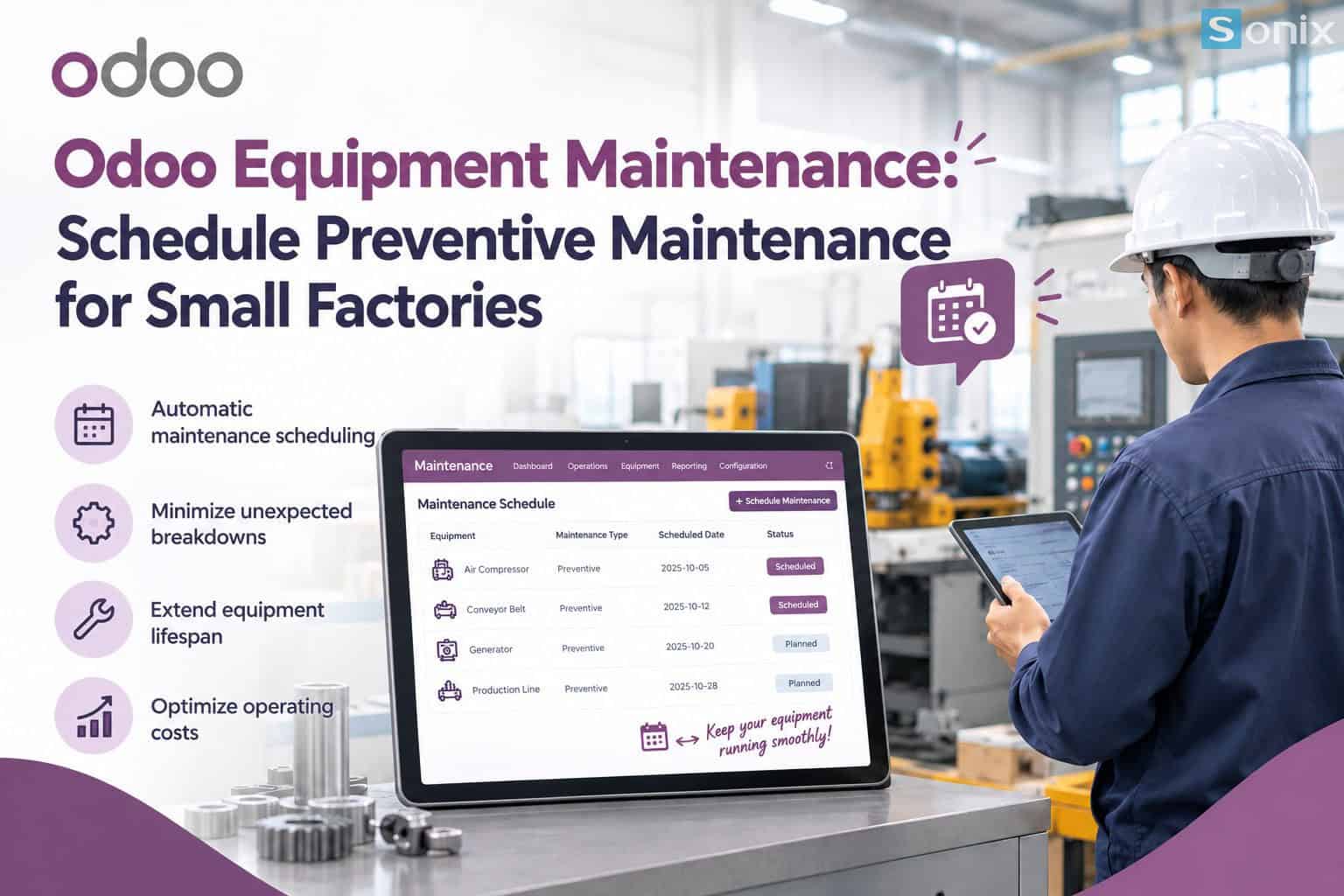
This article introduces how Odoo’s Maintenance module helps small factories shift from reactive to preventive maintenance – automatically scheduling maintenance based on time or operating hours, instead of waiting for a machine to signal a breakdown before taking action.
Table of Contents
💡 Insight: The biggest problem isn’t a shortage of maintenance staff – it’s that no one is tracking when a machine actually needs maintenance before it stops running. And an unexpected breakdown always costs far more than a maintenance visit that was scheduled in advance.
CURRENT STATE
Why “fix it when it breaks” is quietly wearing down small factories
The maintenance schedule lives in one technician’s head, not in a system
Many small factories have only 1-2 technicians responsible for all machinery. They remember which machine is “due soon” purely from experience. When that person takes leave or resigns, the maintenance schedule effectively disappears with them.
No one knows a machine is due for maintenance until it stops working
With no advance warning, breakdowns tend to happen right when the line is running a rush order. Emergency repair downtime is usually far longer than a maintenance visit that was scheduled ahead of time.
Replacement parts always end up being rush-ordered at a premium
Because nobody knows in advance when a part will need replacing, the warehouse doesn’t stock it ahead of time. By the time the machine breaks, parts are ordered on rush terms – paying a premium and waiting for delivery – when knowing the schedule in advance would have allowed buying at a better price early on.
No historical data to show which machines break down most, or why
Repair history is scattered across notebooks or stuck in someone’s memory, so the factory can’t answer a basic question: which machine is deteriorating fastest, and should it be replaced rather than repaired again?
COMPARISON
Reactive vs. preventive maintenance: a direct comparison
Shifting from reactive to preventive maintenance with Odoo brings a clear change across 5 operational areas:
| Operational area | Reactive maintenance (before) | Preventive maintenance with Odoo (after) |
|---|---|---|
| Maintenance schedule | Scattered notes in notebooks/Excel, dependent on individual memory | Automatic schedule based on a fixed time cycle or operating hours |
| Early warning before failure | None – only known once the machine has already stopped | System automatically creates a maintenance request ahead of the due date |
| Equipment history | Scattered, dependent on a technician’s memory | Full repair history and parts used stored per piece of equipment |
| Replacement parts | Rush-ordered once the machine has already failed, at a higher price | Stock planned ahead based on the known maintenance schedule |
| Measuring maintenance performance | No concrete measurement – just a sense that “this machine breaks a lot” | Reports on time between failures and repair time for each piece of equipment |
HOW-TO
How to set up a preventive maintenance schedule in Odoo
Odoo’s Maintenance module is tightly linked with Manufacturing and Inventory – meaning equipment data, spare parts, and the production schedule all live on the same platform, instead of each department keeping its own separate file.
The first step is registering each piece of equipment in the system: machines are categorized by production line or area, and assigned a responsible technician and primary operator. Each piece of equipment gets its own record, storing the full repair history from the day it went into operation.
The next step is setting up a preventive maintenance schedule for each machine, in one of two ways: a fixed time cycle (e.g. every 3 months) or a usage threshold (e.g. every 500 operating hours). When the due date arrives, Odoo automatically creates a maintenance request and assigns it to the right technician, displayed on a Kanban board so the whole team can track progress.
Once a maintenance job is complete, the technician logs it directly in the system: parts used, actual downtime, and technical notes if any. This data automatically updates the equipment’s record and deducts the corresponding parts from Inventory – no manual notes that then have to be re-entered into another file.
With data accumulated over time, the factory can view consolidated reports to see which equipment is deteriorating fastest, how long the maintenance team takes to resolve each issue, and which machines should be prioritized for replacement budget.
If your factory is looking to standardize its equipment maintenance process, you can check out Sonix’s Odoo implementation service.
KEY TAKEAWAYS
| Key point | What it means for your business |
|---|---|
| Automatic scheduling based on time or operating hours | No longer dependent on a single technician’s memory. |
| Maintenance requests auto-generated before the due date | Proactive handling before a machine stops, reducing unexpected downtime. |
| Centralized equipment history | Know exactly which machines fail most often and should be replaced. |
| Direct link to spare parts inventory | Parts are stocked ahead of time instead of rush-ordered at a premium. |
Is your factory maintaining equipment on a schedule, or waiting for a machine to “sound off” before fixing it?
Book a 30-minute discovery call so Sonix can review your current equipment setup with you and design a preventive maintenance schedule suited to your factory’s scale.
Hundreds of businesses using Odoo in Vietnam have already started this journey.
Sonix – Our customers’ success is our joy.
Leave us your comment