

 Tiếng Việt
 日本語
日本語In a contract garment factory, it’s common to run 10-15 orders in parallel every month, each from a different client – each with its own style code, colorway, material consumption, and delivery date. When all of this is managed through Excel and a supervisor’s notebook, mixed-up colors, missing trims, or not knowing which order is falling behind aren’t exceptions – they’re the norm.
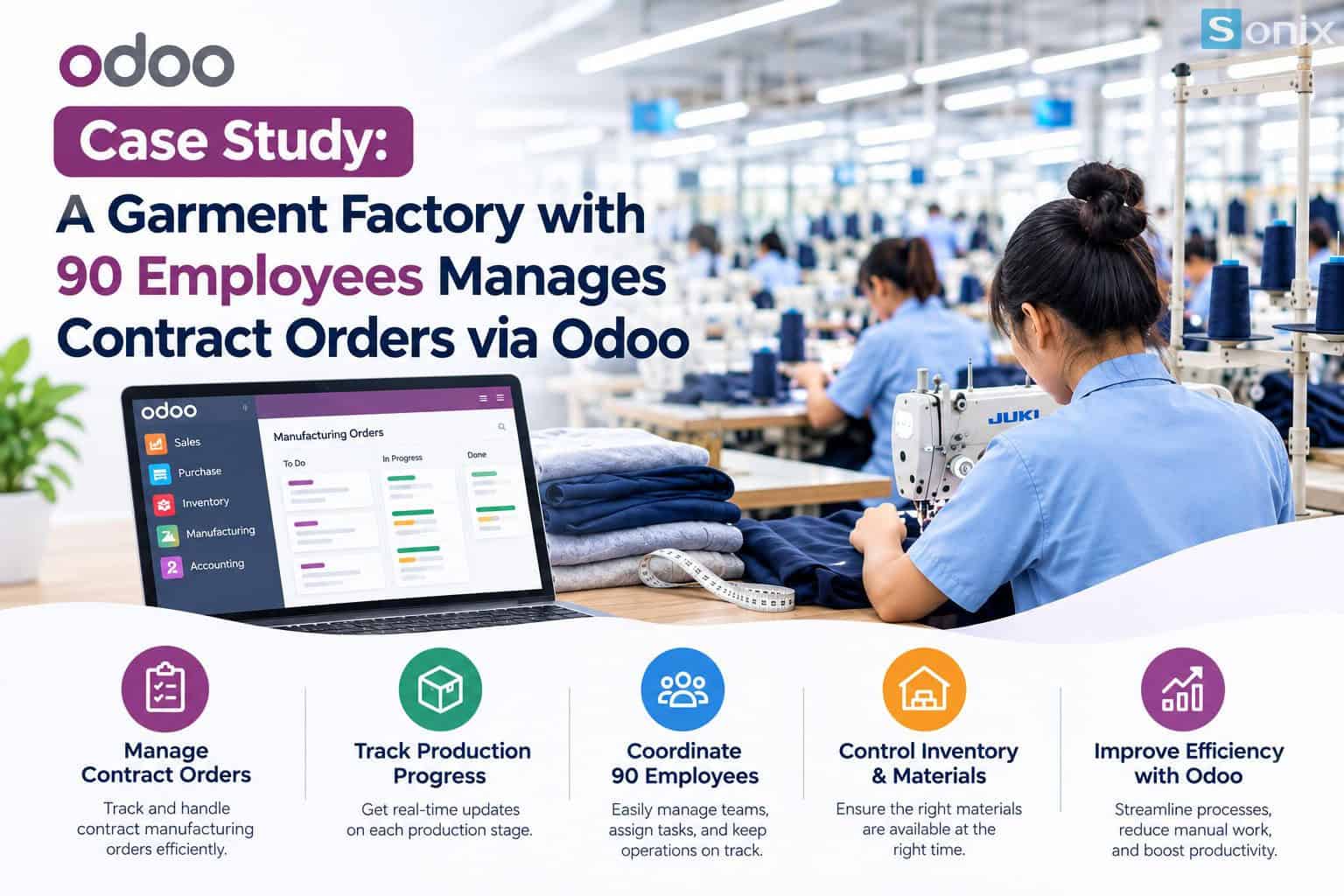
This is the story of a garment factory with 90 workers, specializing in export and domestic apparel orders under the CMT (Cut – Make – Trim) model. After implementing Odoo, the factory brought its entire workflow – from order intake, bill-of-materials breakdown, stage-by-stage progress tracking, to per-order costing – into a single system.
Table of Contents
💡 Insight: In contract manufacturing, a garment doesn’t sit still – it moves through cutting, sewing, ironing, and packing, each handled by a different team. If the system only records “order received” and “order shipped” without tracking which stage an order is actually in, management ends up walking the floor to ask each line supervisor for the real status.
90
workers running multiple sewing lines in parallel
12-15
contract orders running concurrently each month
4 stages
cutting – sewing – ironing – packing, each run by its own team
BEFORE IMPLEMENTATION
The Problem: Managing Contract Orders with Excel and Notebooks
Before implementing Odoo, the factory managed orders the way many small and mid-sized contract garment factories do: one Excel file per order, material consumption calculated by hand, and line progress updated by asking supervisors directly.
🧵 Hand-calculated material consumption, prone to error
Each style code has its own consumption table for fabric, thread, buttons, and zippers by size and quantity. When calculated by hand in Excel, one wrong formula means a whole batch runs short or over on materials – usually discovered mid-cut.
📋 No visibility into which stage an order is at
Progress was logged per line in a notebook, but summarizing “is order A still cutting or already at sewing” meant asking each supervisor directly. When a client called for a status update, the answer was usually a step behind what was actually happening on the floor.
💸 No real per-order costing
Material costs, labor by stage, and fabric waste were scattered across different files. By the time an order was closed out, the factory only found out whether it made money after shipment – too late to adjust pricing for the client’s next order.
📦 Fabric and trim inventory out of sync with records
Leftover fabric from previous orders and surplus trims weren’t clearly recorded, leading to duplicate or short purchase orders right before cutting – forcing rush handling that delayed shipments.
THE SOLUTION
The Solution: Each Order as a Self-Contained Flow in Odoo
The factory implemented Odoo with Sales, Manufacturing (MRP), Purchase, and Inventory, connected into a single flow for each contract order – from intake to packed shipment.
- A Sales Order per client order: each contract order is its own Sales Order, tied to a style code, size/color breakdown, and committed delivery date – no more lumping multiple orders into one file.
- A Bill of Materials (BOM) per style: fabric, thread, button, and zipper consumption is defined once per style code; the system multiplies it automatically by order quantity, removing manual calculation errors.
- Manufacturing Orders by stage: production orders are split by Work Center (cutting – sewing – ironing – packing), with each team updating completion status right on the floor instead of waiting for an end-of-day report.
- Purchasing tied to actual shortfalls: when the BOM shows a material shortfall against stock on hand, a purchase request is generated automatically, avoiding duplicate or short orders right before cutting.
As a result, material costs and labor time by stage are recorded directly against each order, making it possible to track costing close to real time instead of waiting until final settlement.
COMPARISON
Results: Before and After Implementation
| Category | Before (Excel + notebooks) | After (Odoo) |
|---|---|---|
| Material consumption | Calculated by hand per order, formula errors common | Defined once via BOM, auto-scaled by quantity |
| Progress tracking | Ask each line supervisor directly | Updated by stage directly in the system |
| Purchasing materials | Manual, prone to duplicate or short orders before cutting | Auto-generated purchase requests based on actual shortfall |
| Order costing | Profit/loss known only after shipment | Costs tracked while production is underway |
| Answering client status requests | Lagging behind actual floor status | Order status looked up instantly |
LESSONS
Lessons for Other Contract Garment Factories
In a contract manufacturing model, the biggest value isn’t digitizing each order individually – it’s defining each style code and its consumption once and reusing it for every future order from the same client. The more orders that flow through the system, the more accurate the consumption and costing data becomes.
If your cutting – sewing – ironing – packing stages are still tracked through notebooks or scattered Excel files, this is usually the most sensible place to start digitizing – before expanding into other areas like HR or accounting.
KEY TAKEAWAYS
| Key Point | What It Means for Your Factory |
|---|---|
| BOM per style replaces manual calculation | Eliminates consumption errors, auto-scales with order quantity. |
| Production orders split by stage | Know exactly which order is cutting, sewing, ironing, or packing. |
| Auto purchase requests from shortfalls | Avoid duplicate or short material orders right before cutting. |
| Real-time costing | Know profit/loss while production is happening, not after shipment. |
Still managing contract orders in Excel?
Book a 30-minute discovery call so Sonix can review your factory’s actual cutting – sewing – packing workflow and propose the right BOM setup in Odoo.
Sonix – Our customers’ success is our joy.
Leave us your comment