

 Tiếng Việt
 日本語
Picture two companies of 50 people each, both wanting to “digitize operations”. One sells time and expertise; the other sells goods across the counter and online. If both pick the same set of Odoo modules on a “install everything just in case” basis, the result is usually a bloated system, reluctant users, and data that still lives in scattered Excel files.
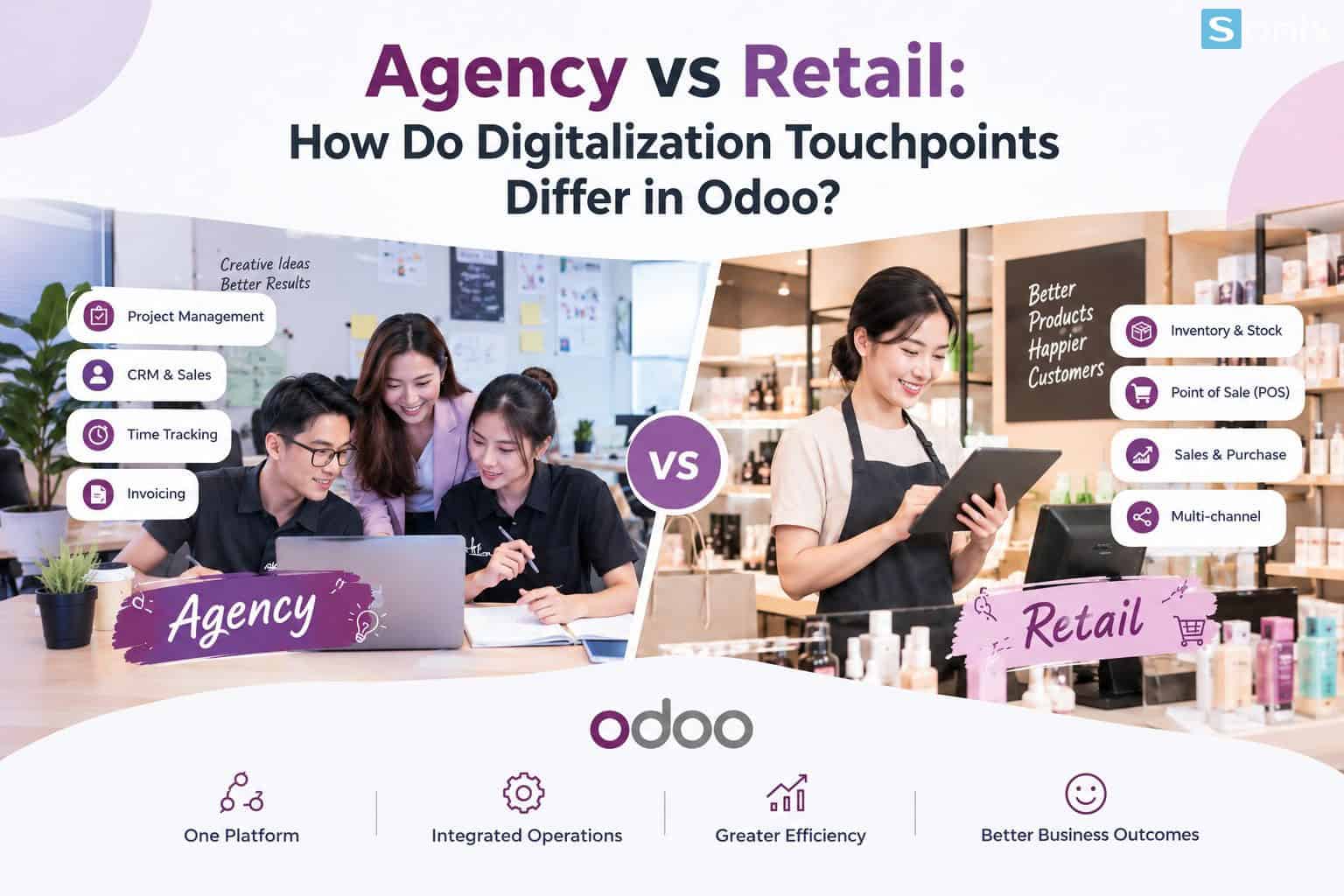
This article compares how a service Agency and a Retail business digitize operations on Odoo: which touchpoints each model has, which modules to prioritize first, and the one thing both models cannot do without.
Table of contents
💡 Insight: An Agency “sells” time and progress, so its digital touchpoint is capturing hours worked and turning them into invoices. A Retailer “sells” goods and availability, so its touchpoint is the checkout counter and stock at each point of sale. Choosing the right first touchpoint matters more than installing many modules.
2 models
Service Agency and Retail, two different ways of operating
3 core modules
Each model starts from its own three priority modules
1 common ground
Centralized financial data for real-time decision-making
PART 1
ERP for Agency vs Retail: two operational challenges that differ from the root
Before talking about modules, look at what each model actually manages every day. The table below summarizes the differences:
| Criteria | Service Agency | Retail |
|---|---|---|
| What is “sold” | Time, expertise, project outcomes | Goods, shopping experience |
| First digital touchpoint | Projects and timesheets | Point of Sale (POS) and stock at each outlet |
| Core Odoo modules | CRM, Sales, Project, Timesheet, Invoicing | Point of Sale, Inventory, Barcode, Purchase |
| Key metrics | Billable hours, margin per project | Stock levels, inventory turnover, revenue per store |
| Common risks | Doing more work than has been paid for, forgetting to invoice | Stockouts, stock mismatches between outlets, shrinkage |
| Payment rhythm | By milestone or by actual hours worked | Instant at the counter, reconciled per shift |
The pattern is clear: the Agency worries about “work done but not yet billed”, while the Retailer worries about “sold but the stock doesn’t match”. These two worries lead to two very different Odoo implementations.
PART 2
Odoo for Agency: Project, Timesheet and milestone-based invoicing
For an agency, the biggest asset is the team’s time. The goal of digitization is to know which project every hour is spent on, whether it has been billed, and whether the project is profitable or losing money.
🎯 From opportunity to project
An opportunity in CRM becomes a quotation, and a confirmed quotation can create the corresponding project and tasks. The delivery team does not re-enter information the sales team has already collected.
⏱️ Time tracking tied to each task
Team members log hours directly on the tasks they work on. Managers see hours used versus hours sold, which gives an early warning when a project is at risk of exceeding its budget.
🧾 Invoice by milestone or by hours
Depending on the contract, invoices can be issued on completed milestones or on actual hours recorded. Hours are no longer “forgotten” at month-end because accounting already has the data.
Signs an agency should prioritize this group of modules: at month-end you have to collect timesheets from several files to calculate billing, or nobody knows exactly which project is losing hours.
PART 3
Odoo for Retail: POS, Inventory and Barcode for multi-location stock control
In retail, every transaction happens at the counter and immediately affects stock. The goal of digitization is for the sales counter, the warehouse and accounting to look at the same number.
- Point of Sale: sell at the counter and accept multiple payment methods; each transaction automatically deducts stock and records revenue.
- Multi-warehouse, multi-location Inventory: track stock per store and in the main warehouse, transfer goods internally and set replenishment rules.
- Barcode: scanning when receiving goods, counting stock and shipping reduces manual entry and errors.
- Purchase: propose purchases from actual stock levels instead of guesswork.
Signs a retailer should prioritize this group of modules: the store says an item is in stock but the customer arrives to find it sold out, or period-end stock counts never match the books.
Note: some features (for example the Barcode and Planning apps) are part of the Enterprise edition. Please confirm the feature scope for your Odoo version before finalizing the solution.
PART 4
What Agency and Retail share: centralized financial data on Odoo
Whichever direction they start from, both models need the same thing at the end of the chain: a single source of financial data so leaders can make decisions in real time.
| Leadership question | Agency answers with | Retail answers with |
|---|---|---|
| Where does profit come from? | Margin by project and by client | Margin by product and by store |
| Where is cash tied up? | Receivables and hours not yet invoiced | Slow-moving inventory and supplier payables |
| What needs action now? | Projects about to exceed their hours budget | Best-selling items about to run out at an outlet |
When hours worked, sales invoices, stock movements and payments all flow into the accounting module, reports no longer have to be stitched together by hand from multiple sources. This is also why it pays to choose one unified platform instead of letting each department use its own tool.
ROADMAP
Which Odoo modules first? A roadmap for your business model
Instead of rolling everything out at once, start with the touchpoint that hurts most, then expand step by step:
| Phase | Service Agency | Retail |
|---|---|---|
| Step 1 | Project + Timesheet | Inventory + POS |
| Step 2 | Sales + Invoicing by milestone or hours | Barcode + Purchase + replenishment rules |
| Step 3 | CRM + project margin reporting | Accounting + reports by store and sales channel |
Many businesses are hybrids, for example a design company that takes on projects and also sells products. In that case, start with the side that generates more revenue or carries more risk. If you would like help deciding the order of priorities, Sonix can support you. Learn more about our Odoo implementation services.
KEY TAKEAWAYS
| Key point | What it means for leaders |
|---|---|
| Agencies start with Project, Timesheet and Invoicing | Hours are recorded accurately and turned into invoices, nothing slips through. |
| Retailers start with POS, Inventory and Barcode | The counter, warehouse and accounting see the same stock and revenue figures. |
| Both need centralized financial data | Decide in real time instead of waiting for month-end reports. |
| Implement in order of priority | Start from the most painful touchpoint and expand gradually so your team adapts easily. |
Is your business model leaning toward Services or Retail?
Book a 30-minute discovery call so Sonix can help you decide which Odoo modules to implement first and a roadmap that fits how your business operates.
Sonix – Our customers’ success is our joy.
Leave us your comment