

 Tiếng Việt
 日本語
When evaluating an ERP implementation, the first question Managing Directors and agency CFOs ask is always: “If we commit thousands of dollars to deploy Odoo, how quickly will we break even, and where does the actual bottom-line return come from?” Many service executives still mistakenly assume ERP is strictly designed for heavy manufacturing or retail chains managing physical warehouses.
In reality, within a business model that sells expertise and billable hours, Odoo’s ROI (Return on Investment) is not measured in raw physical materials. It is measured by recapturing leaked billable hours, dramatically increasing billable utilization rates, and eliminating bloated SaaS and operational overhead.
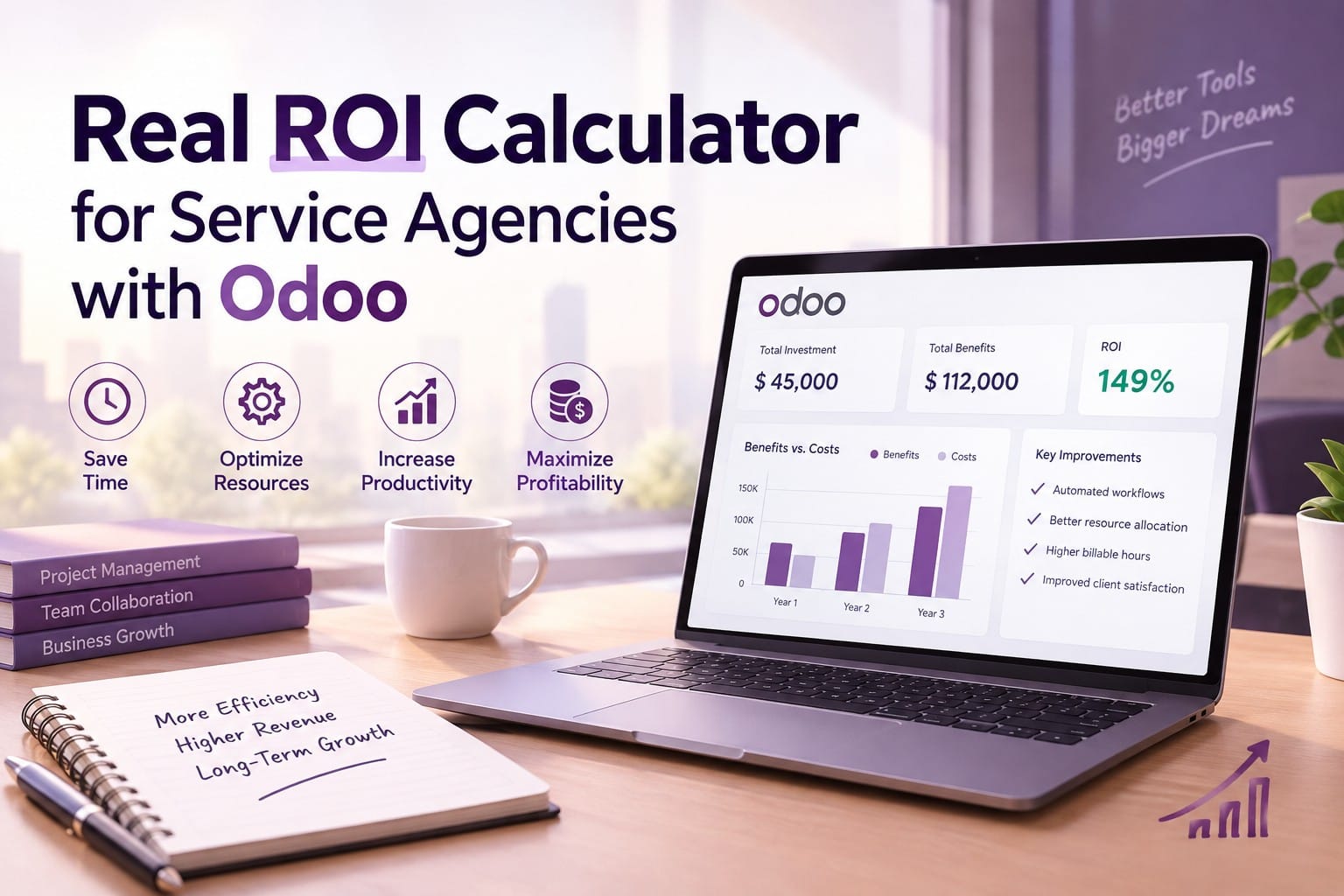
This article breaks down a real-world ROI calculation model drawn from agency case studies spanning 30 to 60 employees. It provides an honest analysis of capital expenditure, hidden operational cost savings, and actual payback timelines achieved through Odoo Professional Services Automation (Project, Timesheet, Planning, Invoicing).
Table of Contents
💡 Core Insight: For an agency with 40 staff, if each creative or technical consultant leaks just 2 hours of unbilled scope creep per week, the business forfeits over $25,000 in net profit every year. Deploying Odoo is not an expensive IT expense; it is a capital restructuring investment engineered to pay for itself within the very first fiscal year.
320%
Average cumulative ROI realized across 24 months of Odoo operations
6.5 Months
Average verified implementation break-even point
+25%
Net project margin expansion by eliminating unbilled out-of-scope work
PART 1
3 Invisible Cash Leaks Quietly Draining Agency Margins
Before computing newly generated upside, agency leadership must directly confront three hidden financial leaks caused by ad-hoc spreadsheets, disparate project boards, and chat app coordination:
| Invisible Cash Leak | Operational Cause in Agency Routine | Direct Financial Consequence |
|---|---|---|
| Unbilled Scope Creep Hours | Clients request out-of-brief design changes and revisions; talent hesitates to track them or account managers lack data to negotiate contractual addendums. | Represents 8% to 15% of total annual payroll that the agency absorbs without client reimbursement. |
| Unproductive Bench Time (Low Billable Rate) | Uneven allocation: key senior staff face burnout while junior roles sit idle waiting for assignments due to the lack of capacity scheduling (Workload Gantt). | Billable utilization lingers at 50% to 60%, meaning 40% of payroll expenditure generates zero revenue. |
| Working Capital Drag from Slow Billing (High DSO) | Delayed milestone sign-offs and drawn-out timesheet disputes push invoice dispatches back by 15+ days, postponing client payment terms by 30 to 60 days. | Cash flow dries up, requiring bank overdraft facilities and interest expenses to cover routine payroll. |
PART 2
Total Cost of Ownership (TCO) Structure for a Service Agency
To evaluate ROI accurately, agencies must account for the full Total Cost of Ownership (TCO) across a dedicated implementation setup (modeled on a 40-user deployment):
| Investment Category | Scope of Deliverables | Estimated Budget (VND / Equiv.) |
|---|---|---|
| 1. Odoo Enterprise Licensing | Official user subscription covering all core applications (Project, Timesheet, Planning, Invoicing, CRM, Documents) for 40 seats/year. | ~115,000,000 đ / year |
| 2. Consultation & Implementation (Sonix) | Process analysis, WBS standardization, real-time project P&L setup, e-invoicing gateway connection, and full user training (one-off fee). | 150,000,000 đ |
| 3. Managed Cloud Hosting & Security | Odoo.sh or high-availability cloud dedicated hosting, automated daily backups, and encrypted enterprise data storage. | ~35,000,000 đ / year |
| TOTAL YEAR 1 OWNERSHIP (TCO) | Comprehensive baseline expenditure to fully stabilize ERP operations | 300,000,000 đ |
PART 3
Financial ROI Simulation for a 40-Person Agency
Consider a Digital & Creative Agency of 40 employees, with an average monthly payroll of 800,000,000 đ (approx. 20,000,000 đ / employee / month = ~120,000 đ internal cost per hour). Here is the annual value recaptured:
| Financial Value Engine | Odoo Operational Calculation Mechanism | Recaptured Value / Year |
|---|---|---|
| 1. Scope Creep Billing Recovery | Automated task timesheets linked to Sales Orders capture an average of 1.5 extra billable hours per staff/week (40 staff × 1.5h × 50 weeks × 150,000 đ billing rate). | +450,000,000 đ |
| 2. Billable Utilization Lift | Odoo Planning empowers project managers to balance assignments, raising billable utilization from 55% to 75% by slashing idle bench time. | +380,000,000 đ |
| 3. Fragmented SaaS Consolidation | Retiring redundant third-party subscriptions: standalone project tools (~$10/user), timesheet trackers (~$10/user), and standalone accounting software into one unified Odoo setup. | +110,000,000 đ |
| 4. Administrative Labor Savings | Reduces internal reconciliation meetings by 80%; milestone billing eliminates the need for two finance personnel spending days on month-end spreadsheets. | +120,000,000 đ |
| TOTAL ANNUAL VALUE GENERATED | Additional Recaptured Revenue + Tangible Cost Deductions | +1,060,000,000 đ |
📊 First-Year Financial ROI Summary:
• Net First-Year Financial Benefit: 1,060,000,000 đ – 300,000,000 đ = 760,000,000 đ
• Year 1 ROI Rate: (760,000,000 / 300,000,000) × 100% = 253%
• Theoretical Payback Period: 300,000,000 / (1,060,000,000 / 12) = ~3.4 months (Practical conservative timeline accounting for change management: 5 to 7 months).
PART 4
Financial Benchmarks: Before vs. After ERP Payback
The agency’s balance sheet stabilizes significantly when transitioning from gut-feel management to automated operational controls in Odoo:
| Operational Financial Indicator | Pre-Odoo Baseline (Manual Spreadsheets) | Post-Odoo Implementation |
|---|---|---|
| Billable Utilization Rate | 50% – 55% average | 75% – 85% (maximized staff billability) |
| Out-of-Scope Leakage Rate | 8% – 12% revenue lost to unbilled rework | 0% (unapproved tasks flagged instantly) |
| Days Sales Outstanding (DSO) | Averages 65 – 80 days (slow sign-offs) | Reduced to 35 – 40 days (milestone billing triggers) |
| Project Net Margin Visibility | Delayed until post-quarter manual accounting | Real-time P&L calculated per task and milestone |
PART 5
3-Stage Strategic Roadmap to Break Even Under 7 Months
To achieve an ROI above 250% without triggering friction among creative talent, agencies should follow a progressive, phased adoption:
- Stage 1 (Months 1 – 2) — Core Project & Timesheet Onboarding: Transition active projects into Odoo Project. Establish simple 1-click Start/Stop task timers to immediately capture true underlying labor delivery costs.
- Stage 2 (Months 3 – 4) — Resource Planning & Milestone Invoicing: Implement Odoo Planning to balance departmental workloads by Friday afternoon; automate milestone-based invoicing to shorten cash collection cycles.
- Stage 3 (Month 5 Onward) — Project P&L Analytics & Rate Card Refinement: Utilize Project Profitability reports to pinpoint high-margin service offerings and refine rate cards for upcoming client proposals.
Request a tailored financial structure review and custom ERP implementation blueprint via Sonix’s certified Odoo Implementation Services.
KEY TAKEAWAYS
| Core Value Pillar | Sustained Financial Impact |
|---|---|
| Plugging Scope Creep Leakage | Directly recovers $18,000 – $25,000 in unbilled billable work annually for mid-sized agencies. |
| Billable Capacity Expansion | Expands retained client bandwidth by 20% without needing to hire additional full-time headcount. |
| Rapid Capital Payback (5 – 7 Months) | The ERP solution generates positive operating cash flow that fully offsets deployment costs within Year 1. |
Want to see your agency’s exact ROI forecast and payback timeline?
Book a 1-on-1 strategy consultation with Sonix ERP specialists to run a customized ROI calculation model calibrated to your headcount, payroll base, and billable targets.
🚀 Get Your Custom Agency ROI Model
Sonix – Empowering operational excellence and business productivity.
Leave us your comment