

 Tiếng Việt
 日本語
Peak holiday shopping during Black Friday and the Lunar New Year surge: shoppers pack retail showrooms while thousands of online checkouts clear every minute. Yet, a classic retail tragedy strikes: top-selling SKUs sell out completely within three hours, leaving tens of thousands of dollars in lost sales on the table, while stockrooms remain flooded with obsolete inventory that freezes valuable working capital.
In high-stakes seasonal retail, victory does not belong to whoever burns the biggest ad budget, but to businesses running an intelligent supply chain where every SKU is routed in real time through automated Reordering Rules.
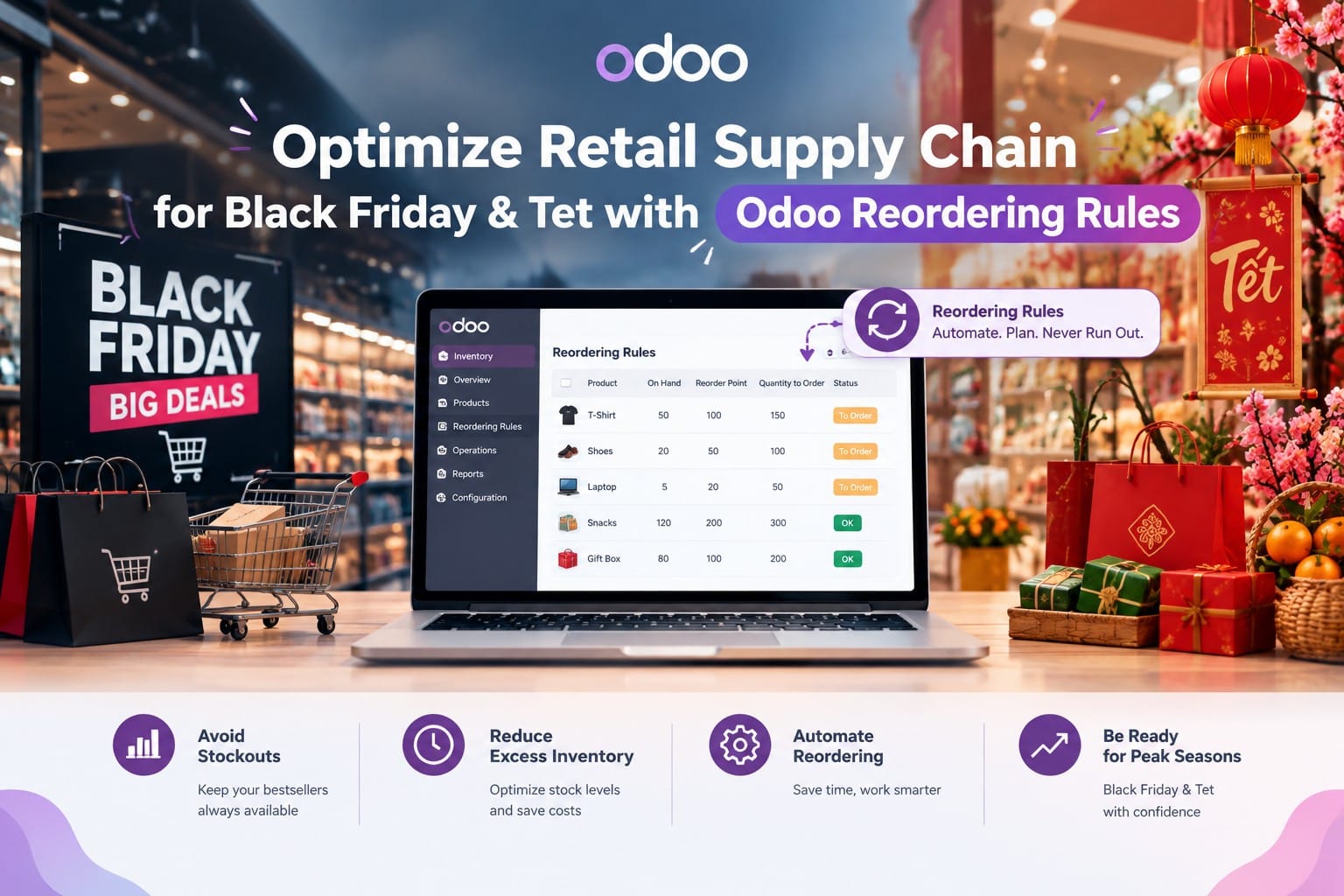
This article analyzes how multi-location retail chains leverage Odoo Inventory & Purchase to automatically generate purchase orders (POs), calculate seasonal safety buffers, and eliminate stockouts and post-holiday deadstock during peak year-end retail cycles.
Table of Contents
- 3 Inventory Paradoxes That Cripple Retailers During Peak Season
- Odoo Reordering Rules: Automating Dynamic Min/Max Thresholds
- Formulas for Seasonal Lead Times and Safety Stock
- Measurable Operational Impact: Before vs. After Odoo Reordering Rules
- 4 Steps to Prepare Your Retail Supply Chain for Year-End Surges
💡 Core Insight: Ordering on gut feeling during Black Friday and festive shopping peaks is a dangerous gamble. Over-ordering locks up working capital in post-holiday deadstock, while under-ordering hands ready customers directly to competitors. Odoo Reordering Rules convert replenishment from reactive guessing into automated execution: tracking real sales velocity, factoring in vendor lead times, and triggering draft purchase orders the instant inventory crosses safety thresholds.
0%
Stockout rate across high-velocity flagship SKUs during peak holiday rushes
-35%
Post-holiday surplus stock through dynamic ceiling adjustments
100%
Purchase Orders automatically generated and clustered by approved vendor
PART 1
3 Inventory Paradoxes That Cripple Retailers During Peak Season
The final two months of the calendar drive 30% to 40% of annual retail revenue, but this condensed period also presents the greatest risk of operational supply chain collapse:
| Operational Paradox | Store & Warehouse Reality | Financial Bottom-Line Impact |
|---|---|---|
| Stockout Collisions | Hero sizes and colors sell out entirely on day one. Flagship urban stores run dry while peripheral branches hold excess stock with no automated inter-company transfer rules. | Squanders expensive ad spend used to acquire buyers, driving frustrated shoppers straight to rival brands. |
| Post-Holiday Deadstock Trap | Fearing stockouts, buyers make large emotional purchase orders. Once the holiday passes, customer demand plunges, leaving pallets sitting idle on shelves. | Traps vital working capital, inflates holding costs, and forces massive 50% to 70% discount liquidations at negative margins. |
| Vendor Lead Time Blindness | Purchase orders are submitted too late; manufacturers and regional couriers are already overwhelmed or closed early for seasonal holidays. | Replenishments arrive after the shopping frenzy has concluded, incurring expensive express delivery surcharges for unsellable stock. |
PART 2
Odoo Reordering Rules: Automating Dynamic Min/Max Thresholds
Reordering Rules in Odoo operate as a 24/7 automated procurement assistant, continuously balancing physical inventory between defined Minimum and Maximum parameters:
🛡️ Minimum Quantity Threshold (Min Rule)
This represents your critical safety floor. The moment a product’s Forecasted Quantity falls below the Min threshold, Odoo flags the deficit immediately, triggering replenishment workflows without requiring staff to count stock manually.
🎯 Maximum Stock Capacity Target (Max Rule)
This defines the optimal storage ceiling for each warehouse or branch location. When a reorder triggers, Odoo calculates the exact quantity required to return stock to the Max level (Order Quantity = Max – Current Stock – Inbound POs), preventing over-purchasing and tied-up capital.
🤖 Automated RFQ and Purchase Order Generation
Instead of creating manual orders line by line, Odoo clusters all SKUs hitting their Min levels from the same vendor into a single consolidated Draft PO, applying pre-negotiated tiered volume pricelists and estimated arrival dates. Procurement teams review and approve with one click.
PART 3
Formulas for Seasonal Lead Times and Safety Stock
To keep automated procurement accurate during holiday surges, retailers cannot rely on standard off-season metrics. Parameters must be adjusted for seasonal volatility:
| Parameter | Odoo Configuration Method | Operational Safeguard |
|---|---|---|
| Seasonal Vendor Lead Time | Vendors requiring 3 days off-peak may take 7 to 10 days during seasonal factory crunches and logistics jams. Update the Vendor Lead Time on product forms accordingly. | Triggers purchase orders earlier than usual, ensuring shipments dock at warehouses right before storefront shelves run bare. |
| Sales Velocity Multiplier | Sales velocity spikes 3x to 5x normal rates during promotional waves. Apply seasonal multipliers to your Min thresholds to establish early safety alarms. | Prevents morning campaign launches from selling out by noon, maintaining uninterrupted order processing across channels. |
| Automated Internal Replenishment | Set store-level reordering rules to pull from your Central Distribution Center rather than issuing separate purchase orders to external vendors. | Automatically generates internal transfer pickings to restock high-performing retail stores daily without disrupting cashiers. |
PART 4
Measurable Operational Impact: Before vs. After Odoo Reordering Rules
Observed operational benchmarks from a fashion and accessories retail chain operating 12 stores after deploying Odoo’s automated replenishment system:
| Supply Chain Metric | Pre-Odoo Baseline (Manual / Spreadsheets) | With Odoo Reordering Rules |
|---|---|---|
| Lost Sales Due to Out-of-Stock | 15% to 20% potential seasonal revenue lost | Reduced below 1.5% (steady replenishment flow) |
| Procurement Planning & PO Creation Time | 2 to 3 days checking stock across 12 locations | 15 minutes reviewing automated PO drafts in Odoo |
| Post-Holiday Excess Deadstock | ~25% of purchased inventory value stranded | Under 6% (timely lowering of Max limits) |
| Chain-Wide Inventory Accuracy | 75% – 80% (frequent physical vs. ledger variance) | Above 98% via barcode scanning at all points |
PART 5
4 Steps to Prepare Your Retail Supply Chain for Year-End Surges
To ensure supply chain operations handle high order volumes smoothly, retailers should complete these 4 preparation steps at least 4 to 6 weeks before major campaigns begin:
- Step 1 — Perform ABC Inventory Classification: Identify your Class A items (the top 20% of SKUs generating 80% of peak holiday revenue). Prioritize strict, automated Reordering Rules for this high-impact group.
- Step 2 — Lock In Vendor Lead Times and Volume Allocations: Secure contractual SLA terms, tiered volume price sheets, and seasonal delivery agreements with primary suppliers within Odoo Purchase.
- Step 3 — Deploy Two-Phase Seasonal Reordering Rules:• Ramping Phase (October – December): Raise Min/Max limits to build up inventory buffers for Black Friday and Christmas.• Tapering Phase (2 Weeks Before Holiday Shutdown): Lower Max thresholds to cease new purchases, selling down existing floor inventory to finish the season lean.
- Step 4 — Execute a Full Physical Count via Odoo Barcode: Conduct a rapid barcode cycle count right before promotional waves launch, ensuring system records match physical inventory with 100% precision.
Learn more about advanced warehouse workflows and full retail enterprise deployments through Sonix’s certified Odoo Implementation Services.
KEY TAKEAWAYS
| Operational Pillar | Commercial Value Realization |
|---|---|
| Automated Min/Max Thresholds | Eliminates stockout risks, ensuring no peak seasonal revenue opportunities are lost. |
| Seasonal Lead Time Modeling | Ensures purchase orders trigger early enough to arrive smoothly before supplier holiday shutdowns. |
| Eliminating Post-Holiday Deadstock | Dynamic ceiling adjustments protect working capital, starting the new quarter with clean balance sheets. |
Is your retail chain prepared with automated replenishment for this year’s seasonal rush?
Schedule a 1-on-1 strategy consultation with Sonix supply chain specialists to see Odoo Reordering Rules live: automated safety buffers, multi-location replenishment, and working capital protection during peak seasons.
🚀 Schedule an Odoo Supply Chain Consultation
Sonix – Empowering operational excellence and business productivity.
Leave us your comment