

 Tiếng Việt
 日本語
日本語When SMB owners decide to implement an ERP, many start with a very natural calculation: “Instead of paying a partner, let’s just hire an IT person and save money.” It sounds reasonable, but the math usually counts only one line – the monthly salary – and misses most of the rest: insurance contributions, recruiting, training, the time spent “learning the ERP,” and the risk that comes when the only person who understands the system leaves.
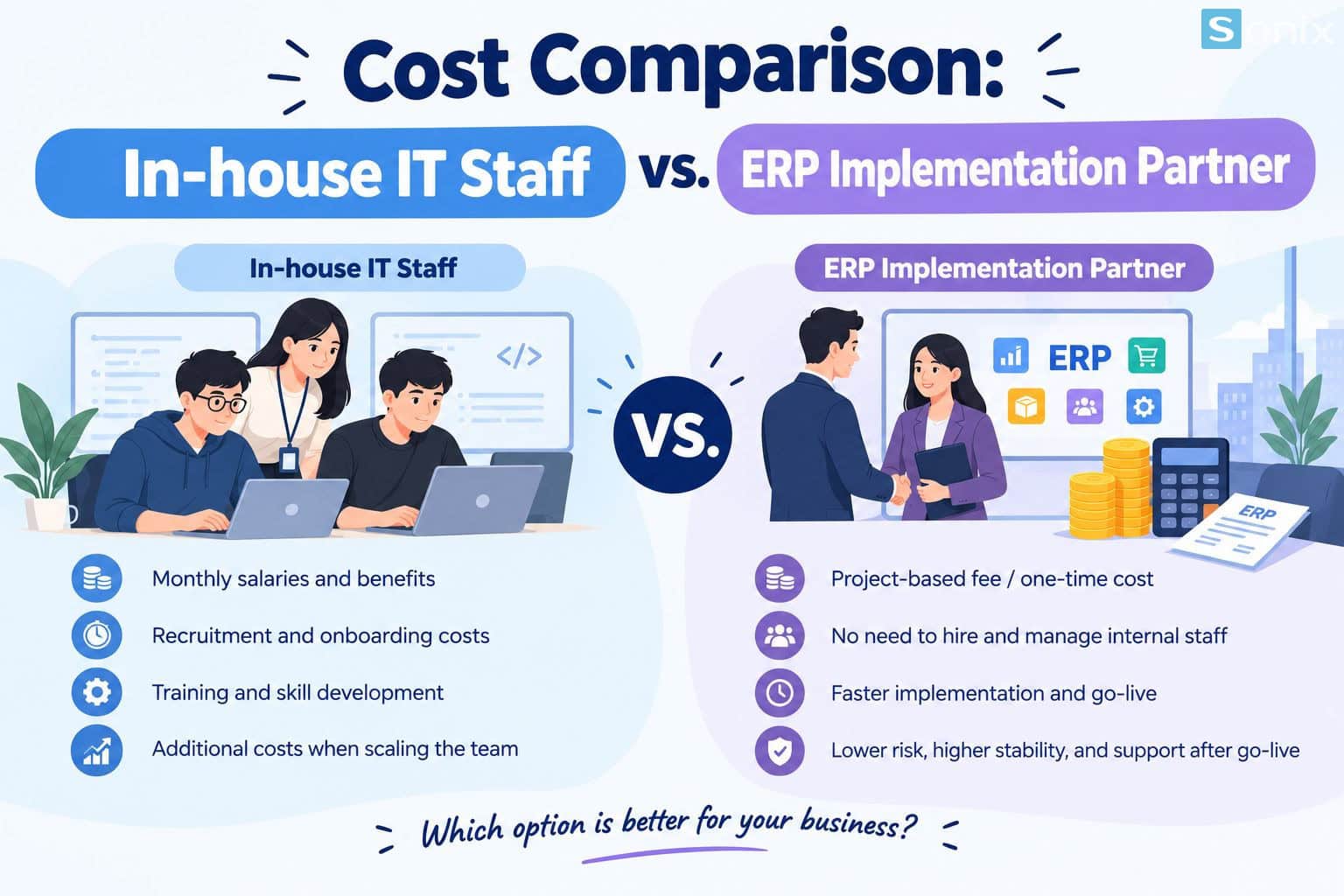
This article puts the two options side by side: hiring in-house IT staff and working with an ERP implementation partner. We don’t aim to declare one “cheaper” for every company – the answer depends on your size, process complexity and growth plans – but to help you count the full, real cost so you can decide for yourself.
Table of Contents
💡 Insight: One IT hire cannot replace an entire implementation team. An ERP rollout needs at least three skill sets – business process consulting, system configuration/development and project management. When all three are handed to one person, companies usually pay for it with delays or with total dependence on that person.
3 skill sets
required: business, technical, project management
21.5%
employer social, health and unemployment insurance contributions, added on top of salary
3 years
a reasonable window for comparing total cost of ownership (TCO)
OPTION 1
The Real Cost of an In-House IT Team: It’s Not Just Salary
When calculating the cost of hiring in-house IT staff to implement and run an ERP, split it into two groups: direct costs (easy to see) and hidden costs (easy to miss).
💰 Salary and related costs
Gross salary, employer insurance contributions (around 21.5% of insured salary), bonuses, allowances and benefits. In practice, the total cost of an employee is usually higher than the salary agreed at hiring.
🔎 Recruiting and waiting time
Professionals with hands-on Odoo or general ERP experience are not plentiful in the market. Companies often spend several weeks to a few months finding the right person – and the project stands still in the meantime.
📚 Training and “learning on a live project”
An IT person who is strong in infrastructure doesn’t necessarily understand accounting, warehouse or production processes. The time spent learning the business, studying modules and making first mistakes is a cost too – and it often lands on the system your company is already running on.
🧩 Extra costs: equipment, tools, management
Hardware, development tools, test environments, and the time managers spend guiding and evaluating IT work – items that rarely appear in the initial spreadsheet.
⚠️ The risk of depending on one person
If the only person who understands the configuration, customizations and data history leaves, the company has to hire and train again – sometimes rebuilding part of the system. This is the hardest cost to quantify, yet it may be the largest.
OPTION 2
The Cost of Working with an ERP Implementation Partner
With an implementation partner, costs tend to be clearer because they are quoted against a defined scope. You still need to understand every line item to compare fairly:
- Implementation fee (one-time): process discovery, configuration, data migration, user training and go-live support. Usually quoted per package or per man-day.
- Licenses and infrastructure: Odoo licenses (if you use Enterprise) and hosting. These exist in both options, so include them on both sides of the comparison.
- Support and maintenance (recurring): bug fixes, updates and advice on adjusting processes after go-live.
- Customization (when needed): special requirements outside the original scope, quoted separately item by item.
The biggest difference is that you get a team, not one person: business consultants, developers and a project manager working together, with methods and experience drawn from many similar projects. You also pay only for the work actually needed, rather than carrying a fixed monthly cost once the project has stabilized.
COMPARISON
Cost Comparison Table: In-House vs. Partner Over 3 Years
The table below compares each cost category and risk level. To arrive at concrete figures for your company, add up every item across 36 months rather than comparing only the first month.
| Category | In-house IT | ERP implementation partner |
|---|---|---|
| Cost structure | Fixed monthly cost (salary, insurance, benefits), incurred whatever stage the project is in | One-time implementation fee + recurring support fee, tied to scope of work |
| Start-up cost | Recruiting, training, time to learn the business and modules | Team, methodology and industry templates already in place |
| Time to go-live | Longer: hire first, learn the system, then implement | Shorter: package-based roadmap built on many similar projects |
| Range of expertise | Depends on the experience of 1-2 people | Business consulting, technical and project management in one team |
| Staff turnover risk | High if knowledge sits with one person | Lower: documented work and several people who know the system |
| Cost after go-live | Full salary continues even as workload drops | Moves to a support plan, pay only when needed |
| Level of control | High: your own employee with deep knowledge of internal context | Requires managing scope and agreeing a clear point of contact |
Note: items such as Odoo licenses and hosting exist in both options, so don’t count them for only one side. When requesting a partner quote, ask for each item to be itemized (implementation, training, support, customization) so you can check it against your in-house cost table.
IN PRACTICE
When to Go In-House, When to Choose a Partner, and When to Combine Both
Instead of asking “which is cheaper,” ask “which stage of the project needs which kind of expertise?”
🏠 Lean toward in-house IT when
The company already has a stable IT team, has highly specific processes that need continuous development, or is large enough that an internal team has steady work all year round.
🤝 Lean toward an implementation partner when
This is your first ERP rollout, you have no IT staff who know Odoo, you need to go live within a few months, or you want costs tied to scope of work rather than a long-term fixed cost.
🔀 Choose a hybrid model when
A partner leads the implementation phase and transfers knowledge to an internal “key user” or system administrator, then moves to an on-demand support plan. For many SMBs, this balances speed, cost and long-term self-reliance.
A quick checklist before deciding: (1) Has anyone at the company implemented an ERP before? (2) What is the go-live target in months? (3) After go-live, will there be enough IT work for one full-time person? (4) If the person in charge leaves, who takes over? If two or more answers are “no” or “not sure,” an implementation partner is usually the safer starting point.
If you’d like an estimate sized to your company, take a look at Sonix’s Odoo implementation services – we usually start with a short discovery session to define the scope before preparing a detailed quote.
What about your company? Are you leaning toward building an in-house IT team or working with an implementation partner? Share your thoughts in the comments below.
KEY TAKEAWAYS
| Key point | What it means for your business |
|---|---|
| In-house IT cost is more than salary | Add insurance, recruiting, training, equipment and turnover risk to the calculation. |
| A partner brings a team, not one person | Business, technical and project management skills work together, shortening time to go-live. |
| Compare over 36 months, not month one | Fixed costs and scope-based costs only show their real difference over the long term. |
| A hybrid model suits many SMBs | Partner implements, an internal key user takes over, then support on demand. |
Which option saves more for your company?
Book a 30-minute discovery call and Sonix will help you build a 3-year cost comparison based on your company’s actual size and processes.
Sonix – Our customers’ success is our joy.
Leave us your comment