

 Tiếng Việt
Almost every business owner in Vietnam agrees that digital transformation is something they “have to do.” But when Sonix pulled together the latest surveys and reports on Vietnamese SMBs and ERP, the state of business management today reveals a fairly wide gap between intention and execution: a lot of businesses are “interested” in technology, but only a small fraction actually put it to work.
This report pulls together data from official government surveys and ERP market reports in Vietnam to paint the most realistic picture of where Vietnamese SMBs actually stand on their ERP journey and what’s causing nearly half of them to try and then quit.
In this report
The big picture
Vietnamese SMB ERP: State of Business Management 2026
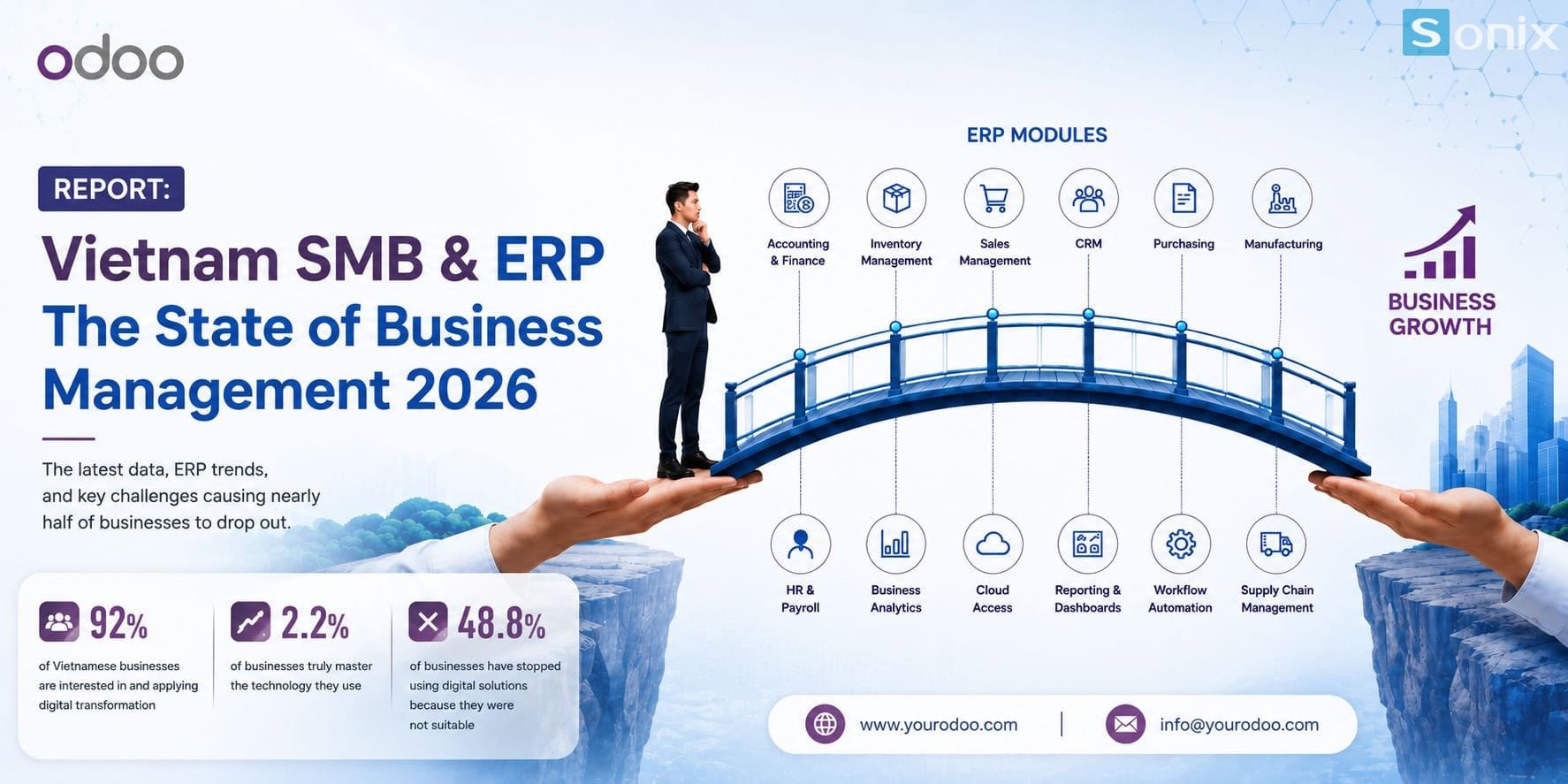
According to a survey by the Agency for Enterprise Development (Vietnam Ministry of Science and Technology), the vast majority of Vietnamese businesses 92% have already engaged with and applied digital transformation to their operations. You can review the full survey at the Ministry of Science and Technology’s portal. That’s an encouraging number it shows awareness of technology is no longer the main barrier. However, only just over half of those businesses keep using their digital solutions after some time in production, meaning nearly half of them started, then stopped somewhere along the way.
By mid-2024, roughly 1.22 million business-visits had been logged through Vietnam’s National Digital Transformation Program, with more than 333,950 small and medium enterprises using the digital platforms the program provides. That scale of reach is significant but “reach” and “operating effectively” are two very different stories.
Closer look
The gap between “interested” and “mastering” the technology
More granular figures from the same survey show exactly where the gap lies: only 2.2% of SMEs actually have full command of the technology they use, 6.2% have clearly defined digital transformation goals, and just 7.6% have a concrete implementation plan. In other words, most businesses are transforming digitally in an ad hoc way buying software because it feels necessary, rather than following a roadmap tied to clear business goals.
| Metric | Share | What it means for SMBs |
|---|---|---|
| Engaged with / applied digital transformation | 92% | Awareness is no longer the main barrier. |
| Still using it after some time | >50% | Nearly half drop off somewhere along the way. |
| SMEs that fully master the technology | 2.2% | The real problem is operational capability, not the tool itself. |
| Have a concrete digital transformation plan | 7.6% | A missing roadmap is the root cause of most drop-offs. |
What the businesses in that 2.2% “mastery” group tend to have in common isn’t more expensive software it’s a central system (usually ERP) that connects data across departments, instead of a patchwork of disconnected tools that don’t talk to each other.
Market trends
Where Vietnam’s ERP market is heading in 2026
According to analysis from OCD Vietnam (citing Statista), Vietnam’s ERP market in 2026 is estimated at roughly USD 50-60 million, growing at a compound annual growth rate (CAGR) of 6-10%. More notable than the market size is the shift underneath it: 2026 is being treated as the year the market moves from “deploying tools” to “operating on real data and applied AI,” with cloud, AI, and IoT integration spreading fast from FDI enterprises down into the domestic SME segment.
Globally, digital transformation spending is projected to reach around USD 3.4 trillion in 2026 per Statista, and enterprise software statistics show that over 30% of organizations pick ERP mainly for better financial management, while another 30%-plus cite growth support as their top reason for implementing ERP not simply digitizing whatever process already exists.
The key takeaway: the biggest gap right now isn’t whether businesses want digital transformation 92% already do. It’s the missing central system and clear roadmap needed to turn that intention into real, working operations.
Sonix’s perspective
Why nearly half of businesses try ERP and then give up
Through years of implementing Odoo for SMBs across Vietnam, Sonix has found that the 48.8% drop-off rate is rarely about “the technology being bad.” It usually comes down to three recurring causes: picking disconnected tools that can’t share data across departments, rolling out a system without a specific business goal attached to it, and having no one assigned to track and measure results after go-live.
That’s also why a unified ERP system where sales, inventory, accounting, and manufacturing all sit on one data platform tends to have a much higher retention rate than stitching together several disconnected pieces of software. When data doesn’t need to be re-entered manually across systems, businesses eliminate exactly the kind of friction that causes so many digital transformation projects to stall out after a few months.
Digital Transformation
Vietnam SMB
Industry Report
Where does your business fit into this picture?
Drop your industry and headcount in the comments, and Sonix will send you a quick assessment of how ready your business is for ERP.
💬 Comment your industry + headcount below
Sonix will reply directly with a readiness assessment and a suggested roadmap.
Sonix – Your success is our happiness.
Leave us your comment