

 Tiếng Việt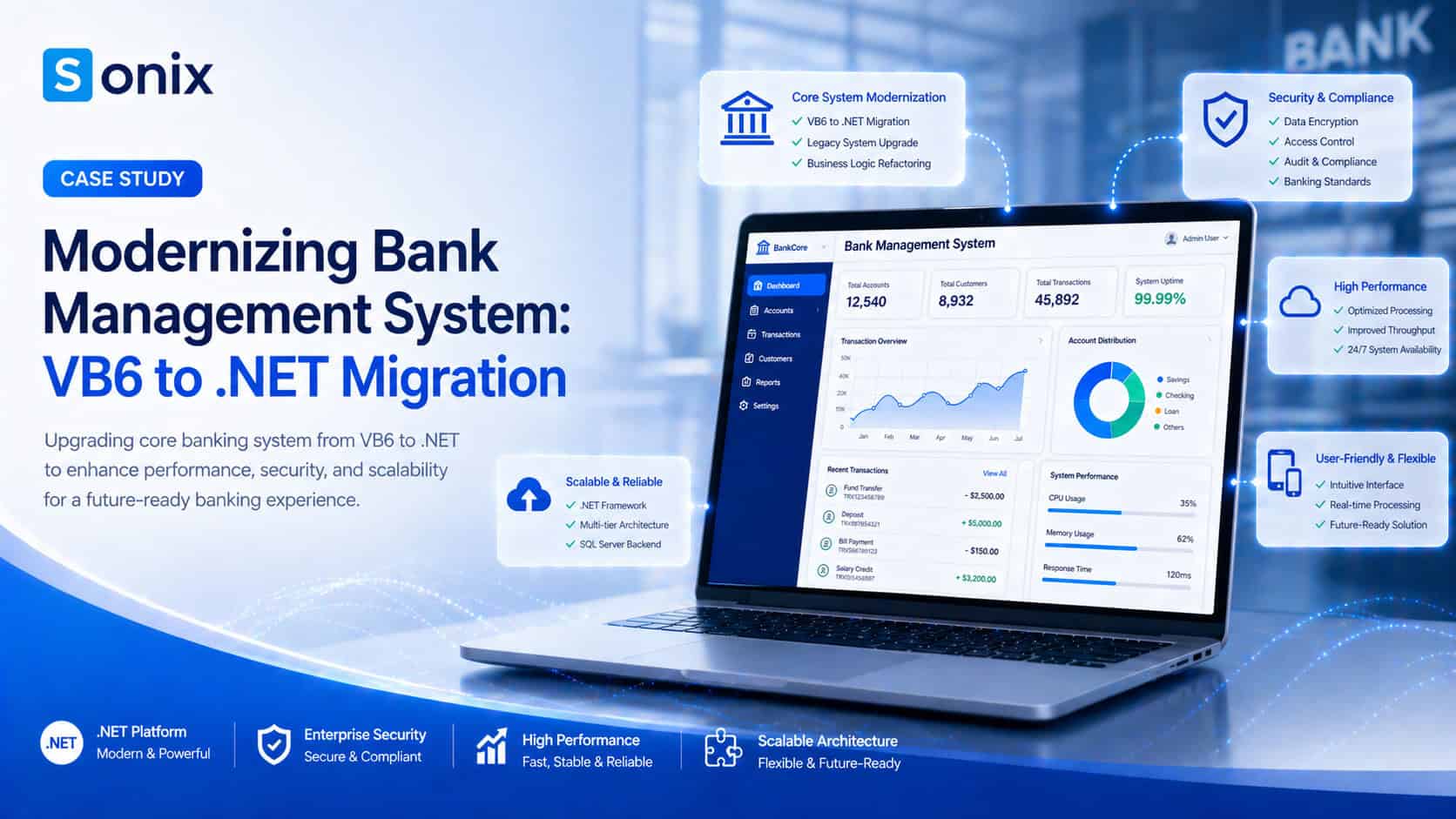
— Project Snapshot
At a Glance
| Client | M Co., Ltd. |
| Industry | Technology / Financial Systems |
| Category | Software Outsourcing — Legacy Migration |
| Location | Japan |
| Team Size | 40 professionals |
| Phase | Coding & Unit Testing |
| Project Year | 2023 |
— Overview
Project Overview
Sonix led a two-phase modernization of a mission-critical bank management system for a Japanese financial technology company, migrating the codebase from legacy Visual Basic 6 (VB6) all the way to .NET Framework 4.5. The engagement required deep analysis of decades-old business logic, careful refactoring to preserve operational integrity, and a disciplined upgrade path that kept the client’s core banking workflows uninterrupted throughout the transition.
— Why Sonix
Why the Client Chose Sonix
Legacy .NET Expertise
Sonix engineers have hands-on experience migrating large-scale VB6 codebases to modern .NET frameworks — a niche skill set the client could not source locally at the required scale.
Japan-Facing Bilingual Team
With a dedicated Japan-market focus and bilingual project management, Sonix ensures precise requirements communication — critical when working with financial domain logic.
Structured Migration Process
Sonix follows a phased, risk-controlled upgrade methodology with rigorous unit testing at each milestone — minimizing disruption to live systems throughout the migration lifecycle.
— Challenge
The Challenge
The client’s bank management platform had been built on Visual Basic 6 — a runtime environment Microsoft officially retired in 2008. Running a financial system on an unsupported, decades-old stack posed compounding risks: security vulnerabilities with no official patches, incompatibility with modern operating systems and Oracle database versions, and a growing inability to recruit developers who understood the legacy codebase.
The system was complex, deeply customized, and embedded with years of accumulated business logic — not a candidate for a simple automated conversion. Any regressions in financial calculations, reporting outputs, or data access layers would carry serious operational and compliance consequences.
Furthermore, the migration could not be a single-step leap. The client required a controlled, two-stage journey: first stabilizing the codebase on .NET Framework 3.5 using Visual Studio 2008, then advancing to .NET Framework 4.5 — each phase validated before proceeding to the next.
— Our Approach
How We Approached It
Legacy Codebase Analysis & Risk Mapping
Before writing a single line of new code, the Sonix team performed a thorough audit of the VB6 source — cataloguing deprecated APIs, third-party control dependencies (GrapeCity SpreadSheet, Crystal Reports), Oracle data access patterns, and areas of high business-logic density. This analysis formed the risk-ranked migration backlog that guided all subsequent work.
Phased Migration with Continuous Validation
The migration was executed in two controlled phases. Phase 1 ported the system from VB6 to .NET Framework 3.5 via Visual Studio 2008, preserving functional equivalence while restructuring the codebase to follow modern .NET patterns. Phase 2 advanced the platform to .NET Framework 4.5, adopting improved APIs and performance optimizations — with unit tests gate-keeping every module promotion between phases.
Performance Optimization & Long-Term Maintainability
Rather than a mechanical code conversion, Sonix refactored the architecture to leverage .NET 4.5 capabilities — improved async patterns, better memory management, and cleaner separation of data access concerns. The result is a codebase that not only runs on a supported, modern runtime but is also structured to support future developers without deep legacy context.
— Solution
The Solution
Sonix delivered a fully migrated bank management system on .NET Framework 4.5 — retaining 100% of the client’s existing business logic while running on a secure, vendor-supported platform. The front-end layer was rewritten in VB.NET with Visual Studio tooling, retaining GrapeCity SpreadSheet 6.0 for the familiar spreadsheet-style interfaces that operations staff rely on daily. Crystal Reports 8.5 was integrated under the new runtime to preserve the client’s existing suite of financial reports without requiring report redesign.
Oracle database connectivity was re-architected using updated .NET data providers, improving query performance and eliminating brittle legacy ODBC dependencies. The new platform supports modern Windows Server environments, aligning the client’s infrastructure roadmap with mainstream enterprise support cycles — and giving their internal IT team a codebase they can confidently maintain and extend going forward.
— Technologies
Technologies Used
Crystal Reports 8.5GrapeCity SpreadSheet 6.0
— Results
Outcomes & Impact
2-Phase
Controlled migration path — zero business-logic regression across both upgrade milestones
Supported
Platform fully aligned with Microsoft’s active support lifecycle — eliminating legacy security risk
30-Person
Large, experienced team — enabling high throughput across a complex, multi-module codebase
— Key Features
Key Features Delivered
| Feature | Description |
|---|---|
| Full Business Logic Preservation | All existing financial rules, calculation routines, and workflow sequences were validated and preserved verbatim through both migration phases. |
| Two-Stage Upgrade Path | Structured migration from VB6 → .NET 3.5 → .NET 4.5, with independent unit testing and sign-off at each stage before progression. |
| Oracle Database Re-integration | Legacy ODBC connections replaced with modern .NET Oracle data providers, improving connection stability and query throughput. |
| Crystal Reports Compatibility | Existing Crystal Reports 8.5 report suite integrated under the new runtime without requiring report redesign — protecting the client’s reporting investment. |
| GrapeCity SpreadSheet UI | SpreadSheet 6.0 controls retained in the migrated UI, preserving the familiar data-entry experience for operations staff without retraining overhead. |
| Refactored Architecture for Maintainability | Codebase restructured to follow .NET best practices — cleaner separation of concerns, improved async handling, and reduced coupling to facilitate future feature development. |
— Client Testimonial
What the Client Said
“
Our system had been running on VB6 for many years and we knew the risks, but migrating a live bank management platform is not something you can afford to get wrong. Sonix structured the entire process in clear phases and validated every module before moving forward — we always knew exactly where things stood. The end result is a platform that runs cleanly on current infrastructure, and our team can now maintain and extend it without needing to dig through legacy code. The professionalism and technical depth of the Sonix team made this possible. We have continued working with them on subsequent projects and that trust has only grown stronger.
— IT Director, M Co., Ltd. · Japan
Sonix — Your success is our happiness.
Contact Us For Your Next Project