

 Tiếng Việt
 日本語
日本語Most Salesforce examples you’ll read revolve around B2B: deal pipelines, long sales cycles, multiple decision-makers within the same buying company. If your business sells directly to end consumers, a natural question comes up: is Salesforce still a fit, or is this a tool built exclusively for B2B?
The short answer: yes, Salesforce works for B2C too, but how well it fits depends on the complexity of your customer journey, not on whether you sell to businesses or consumers.
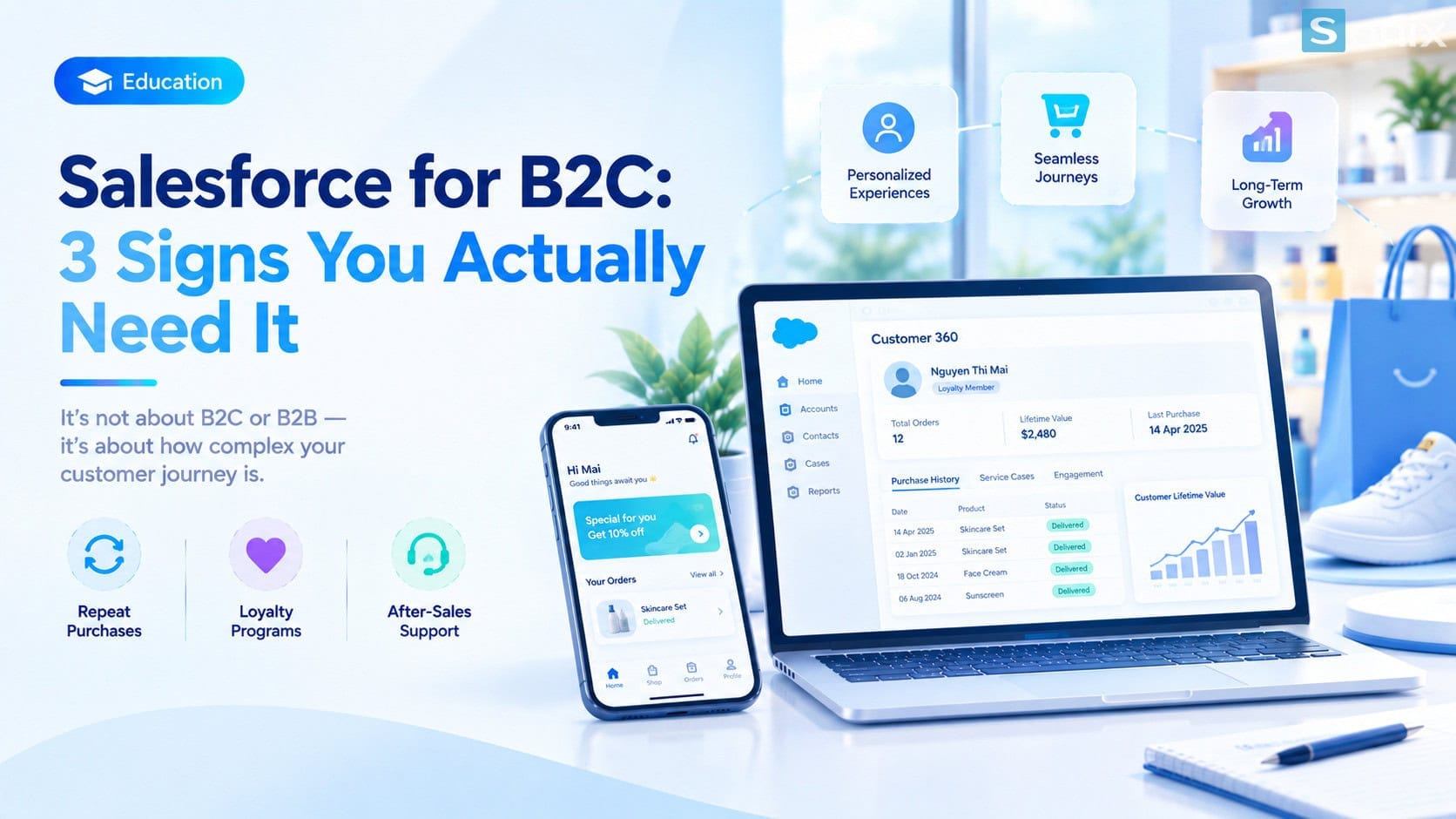
Table of Contents
Context
Why Most Salesforce Content Is Written For B2B
Salesforce grew up and thrived most in a context where B2B sales teams needed to manage complex deal pipelines, multiple approval steps, and several people involved in the same transaction. Most documentation, case studies, and even implementation consultants are consequently most fluent in B2B language and processes.
This leaves a lot of B2C businesses feeling out of place when researching Salesforce: examples about “deal management” or “multi-stage approval funnels” don’t sound like their problem, even though the platform is fully applicable, just configured differently.
The real factor
What Actually Determines Fit Isn’t B2B Or B2C
The right question isn’t “who do I sell to,” it’s “how complex is my customer journey, and do I need to track it across multiple interactions.” A B2C business with a repeat purchase cycle, a loyalty program, or extended after-sales service actually has a customer journey just as complex as a mid-size B2B deal.
Conversely, a B2B business selling one simple product, once, with no further interaction after delivery, has far less complexity to manage than its “B2B” label suggests. Business model is just a reference point, not the deciding factor.
When it fits
When B2C Genuinely Needs A Full CRM Like Salesforce
If your product or service has a repeat purchase cycle, say customers come back monthly or quarterly, tracking purchase history and individual behavior lets you personalize outreach instead of sending the same message to your entire customer list.
A loyalty program is another clear signal: when you need to track points, membership tiers, and redeemed offers across multiple purchases, a centralized system like Salesforce prevents customer data from being scattered across different sales platforms.
Extended after-sales service, product warranties, technical support after purchase, or ongoing customer care programs, are also cases where B2C needs to track each customer across multiple touchpoints over time, exactly the core strength Salesforce was built to handle.
When it doesn’t yet
When One-Time-Purchase B2C Doesn’t Need Salesforce Yet
If your business model is one-time purchases, low chance of repeat customers, and no long-term care program after the transaction closes, a full-featured CRM like Salesforce could be more investment than you actually need.
In that case, simpler tools focused on order and inventory management, or the basic CRM features already built into your e-commerce platform, are usually enough to run the business without a separate system.
Self-check
How To Self-Assess Your Own Business Model
A quick test: try counting how many times a typical customer interacts with your business within 12 months, starting from the first purchase. If that number is just one, you likely don’t need a full CRM like Salesforce yet. If it’s three or more, investing in a centralized tracking system starts to make sense.
If you’re in retail or consumer goods and want to see specifically how Salesforce can support your industry, this Sonix retail solutions page is worth checking out, or if you’re just getting started with Salesforce, the Salesforce Sales Cloud setup guide in 10 minutes is a good place to try it hands-on before deciding.
The right question isn’t “is Salesforce for B2C,” it’s “is my customer journey complex enough to need a centralized tracking system.” Answering that correctly matters far more than labeling your business B2B or B2C.
Is your business B2B or B2C?
Book a free consultation, the Sonix team will help you assess whether your customer journey actually needs Salesforce.
Sonix: Your success is our happiness.
Leave us your comment