
 Tiếng Việt
 日本語
Midnight during the 11.11 Mega Sale: incoming orders pour in relentlessly across Shopee, TikTok Shop, and Lazada, pushing warehouse teams into emergency triage. Workers scramble across four browser consoles copy-pasting order codes manually, while on the retail floor, a walk-in customer purchases the very last dress at the physical POS checkout while it remains active online. The nightmare of “booming sales followed by seller penalties, forced cancellations, and out-of-stock ratings” is the steep price multi-channel retailers pay when managing e-commerce channels manually instead of using real-time system integration.
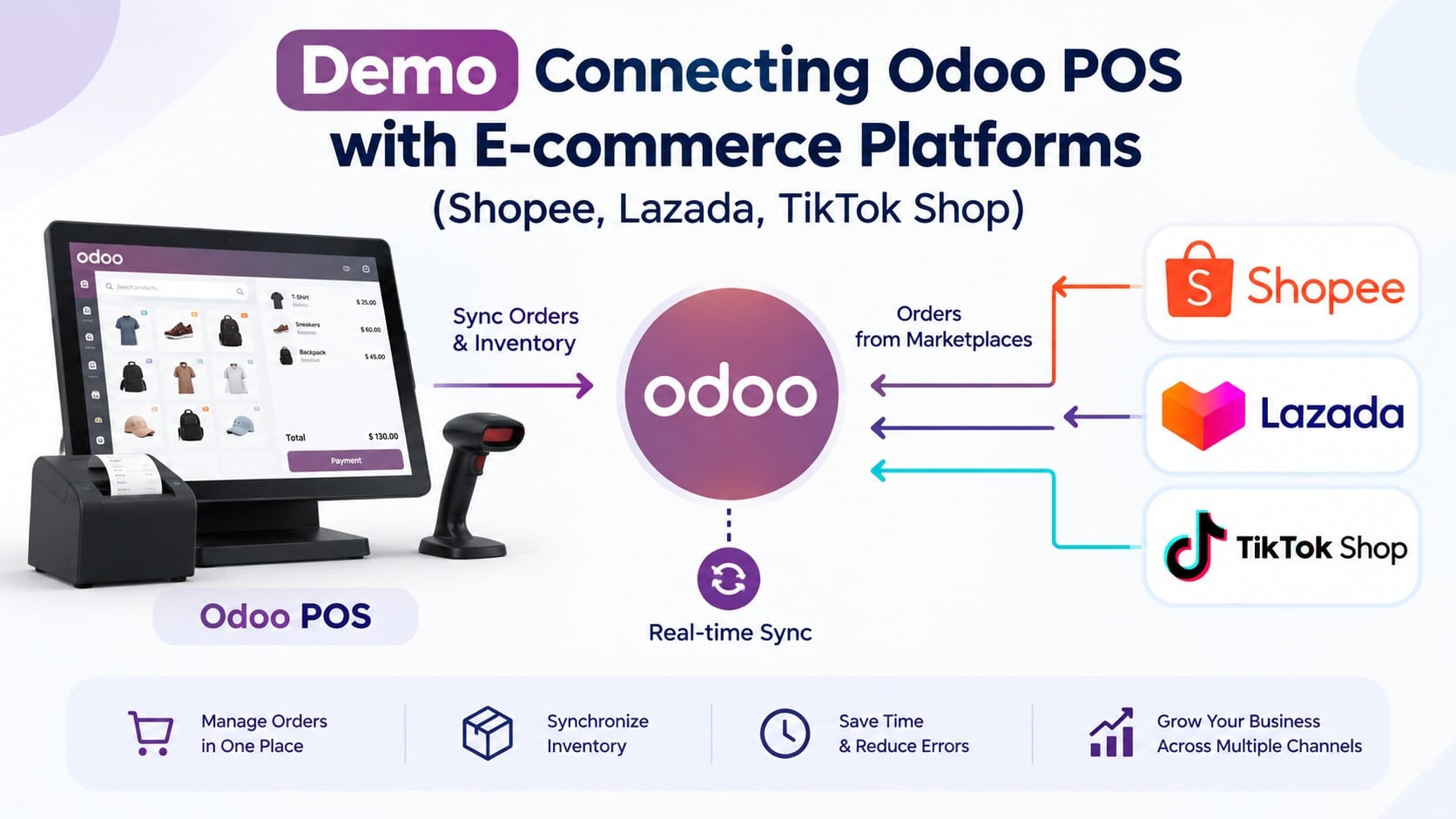
This article analyzes how integrating Odoo POS & Inventory directly with leading e-commerce marketplaces (Shopee, Lazada, TikTok Shop) centralizes multi-channel orders, locks physical stock levels in real time, and automates settlement fee accounting on a single unified ERP core.
Table of Contents
- The Nightmare of Manual Multi-Channel Management: Delays, Overload, and Seller Penalties
- Odoo Marketplace Connector Architecture: One Central Warehouse for Thousands of Outlets
- Live Operational Workflow: Automated Orders, Fast Barcode Picking, and Real-Time Stock Decrements
- Measurable Business Impact: Manual Siloed Operations vs. Integrated Odoo Sync
- 4 Steps to Standardize Multi-Channel Infrastructure Without Service Interruptions
💡 Core Insight: True multi-channel retail is not about splitting stock into disconnected micro-buffers across marketplaces and trapping valuable working capital. It is about pooling all available inventory into a single real-time source of truth on Odoo. Whenever an item is bought anywhere whether swiped at a physical POS register or purchased on a TikTok Shop livestream available stock across every other channel must decrement instantly within seconds.
0%
Overselling rate and peak-hour stock discrepancy order cancellations
3 Seconds
Average inventory sync latency from Odoo to Shopee, Lazada, and TikTok Shop
-80%
Processing time spent generating pick lists, air waybills, and financial reconciliations
PART 1
The Nightmare of Manual Multi-Channel Management: Delays, Overload, and Seller Penalties
Expanding across e-commerce marketplaces is essential for retail scale, but relying on browser seller centers and manual spreadsheets exposes operators to severe commercial bottlenecks:
| Operational Bottleneck | Store & Warehouse Reality | Business & Financial Impact |
|---|---|---|
| Inventory Overselling | Only 2 units remain: an in-store buyer purchases 1 at POS, TikTok Shop takes 2, and Shopee takes 1 before inventory counts can be manually revised. | Forced order cancellations trigger seller penalty points, lower product search visibility, and waste marketing budget. |
| Fragmented Packing & Waybill Printing | Staff log in separately to Shopee Seller Centre, Lazada Seller Center, and TikTok Shop Partner to confirm orders and print shipping labels. | Delays courier handoffs, causes mixed-up shipping tags across platforms, and results in mis-deliveries and high Return-to-Origin (RTO) rates. |
| Disorganized Financial & Fee Reconciliation | Each platform has differing payment cycles, commission structures, affiliate cuts, and subsidized vouchers that accountants manually match over weeks. | Obscures net margins per channel and risks revenue loss from unrecognized deductions, chargebacks, or lost returns. |
PART 2
Odoo Marketplace Connector Architecture: One Central Warehouse for Thousands of Outlets
The Odoo Marketplace Connector functions as a centralized data coordination hub, integrating official Open APIs from Shopee, Lazada, and TikTok Shop directly with Odoo POS and Inventory:
⚡ Two-Way Real-Time Stock Synchronization
When a sale completes at an in-store Odoo POS counter, the store inventory decrements immediately, pushing new stock quantities across Shopee, TikTok Shop, and Lazada within seconds. Conversely, when an online order arrives, Odoo automatically marks inventory as Reserved so physical stores do not sell the reserved item.
📦 Centralized Multi-Channel Order Queue
Orders from all connected channels pull automatically into Odoo Sales & Delivery modules under standardized pick-and-pack formats. Warehouse operators manage fulfillment from a single desktop dashboard or mobile Odoo Barcode scanner without navigating multiple seller tabs.
📊 Automated Platform Fee Breakdown & Financial Posting
When platform settlement payouts reach bank accounts, Odoo matches gross revenues and categorizes commissions, payment gateway surcharges, and promotional subsidies to dedicated expense accounts, showing true net margin by channel.
PART 3
Live Operational Workflow: Automated Orders, Fast Barcode Picking, and Real-Time Stock Decrements
The automated end-to-end processing pipeline for marketplace orders operates smoothly across 4 structured phases:
| Stage | Odoo System Automation | Operational Outcome |
|---|---|---|
| 1. Customer Orders on Marketplace | Webhooks from TikTok Shop, Shopee, or Lazada push order payloads into Odoo within 2–3 seconds, generating Sales Orders and Delivery Orders automatically. | Available inventory across physical store POS counters and competing online shops updates downward instantly. |
| 2. Wave/Batch Picking with Barcode | Warehouse staff use handheld Odoo Barcode terminals to pick items by warehouse zone or shelf (Wave/Batch Picking). | Audio-visual scanning cues alert pickers if an incorrect size, color, or product variant is scanned. |
| 3. One-Click Automated Waybill Printing | Odoo requests tracking numbers via marketplace APIs and triggers thermal printers to generate standardized platform waybills directly. | Packing speeds triple without manual data exports, spreadsheets, or third-party middleware. |
| 4. Courier Handover & Completion | When carriers scan packages, Odoo shifts status to “In Transit”. Upon delivery confirmation, orders finalize for accounting settlement. | Full tracking transparency; returns immediately trigger restock transfers back into active inventory. |
PART 4
Measurable Business Impact: Manual Siloed Operations vs. Integrated Odoo Sync
Operational benchmarks from an omnichannel fashion retailer operating 8 brick-and-mortar stores and 5 marketplace storefronts after migrating to Odoo:
| Operating Metric | Manual Disconnected Baseline | Integrated Odoo Marketplace System |
|---|---|---|
| Inventory Synchronization Latency | 30 minutes to several hours (manual updates) | Real-time within 3 seconds (Direct API) |
| Peak Campaign Order Capacity | Max 500–700 orders/day before bottlenecks occur | 5,000+ orders/day smoothly handled without adding headcount |
| Packing and Picking Error Rates | 3% – 5% mismatch on variants/sizes | Reduced below 0.2% via barcode verification |
| Platform Settlement Reconciliation | 5 to 7 days per settlement cycle | Under 30 minutes via automated journal postings |
PART 5
4 Steps to Standardize Multi-Channel Infrastructure Without Service Interruptions
To ensure unified multi-channel operations run reliably from day one, retailers should adopt this 4-step implementation roadmap:
- Step 1 — Standardize Master SKU and Barcode Catalog: Map every product and variant code across Shopee, Lazada, and TikTok Shop so identifiers match Odoo’s master product catalog with 100% precision.
- Step 2 — Define Inventory Routing Rules: Configure fulfillment logic to allocate online orders either from regional central distribution hubs or directly from nearest retail stores (Ship-from-Store).
- Step 3 — Establish Safety Buffer Stock Thresholds: Set automated buffer thresholds (e.g., if true stock is 5 units, display 3 on marketplaces) to protect against peak flash sale concurrent checkout spikes.
- Step 4 — Conduct High-Volume Packing & Barcode Load Tests: Run simulated stress tests of 50–100 orders covering the complete cycle from webhook intake to barcode picking, thermal label printing, and courier scans before launching public sales.
Explore advanced retail workflows and multi-channel ERP integration architectures through Sonix’s certified Odoo Implementation Services.
KEY TAKEAWAYS
| Core Capability | Tangible Business Benefit |
|---|---|
| Real-Time Multi-Channel Stock Synchronization | Eliminates overselling risks, enabling confident sales expansion across multiple marketplaces concurrently. |
| Unified Order Intake & Waybill Printing | Reduces fulfillment handling time by 80%, expediting handoffs to logistics partners. |
| Automated Revenue & Platform Fee Accounting | Maintains clear visibility over channel net profit margins while preventing unnoticed payment leakages. |
Is manual order processing and multi-channel stock maintenance slowing your business down?
Book a 1-on-1 consultation with Sonix ERP specialists to see a live demonstration of Odoo integrated with Shopee, Lazada, and TikTok Shop: automated order imports, real-time stock deductions, and unified batch shipping.
🚀 Schedule an Odoo Marketplace Integration Demo
Sonix – Empowering operational excellence and business productivity.
Leave us your comment