

 Tiếng Việt
 日本語
A loyal VIP customer purchases a designer dress through the brand’s online store, choosing in-store pickup, only to be told upon arrival that the sales floor sold the final unit earlier that morning. Meanwhile, an in-store shopper demands the 20% flash promotion advertised on the brand’s social feed, but the checkout cashier declines because “that promo is exclusively reserved for the e-commerce team.” The friction between online and brick-and-mortar channels does not stem from uncooperative personnel it is caused by fragmented software infrastructure that isolates sales channels into disconnected data silos, competing over stock allocations and destroying customer goodwill.
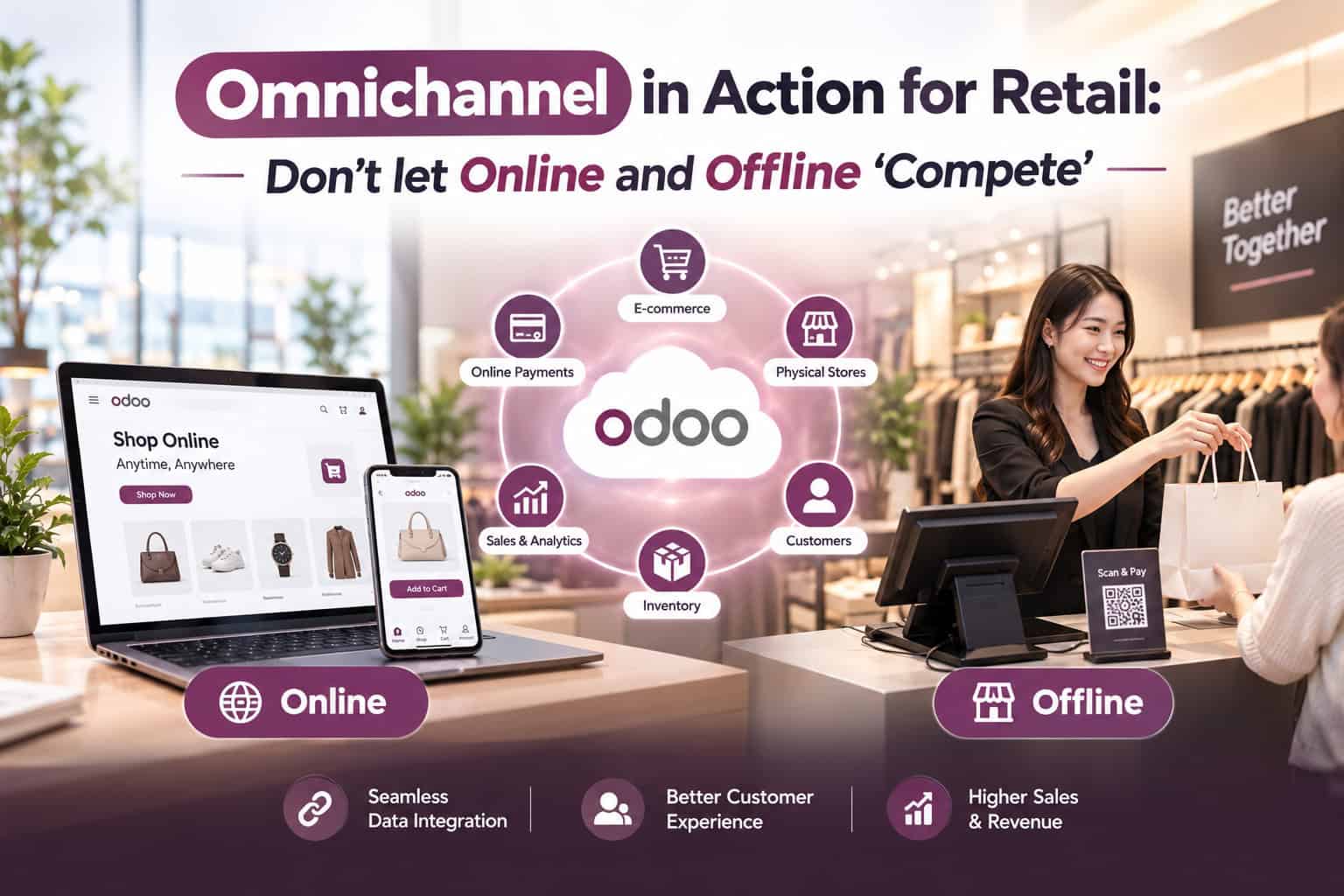
This article analyzes how modern retail chains eradicate channel cannibalization through an integrated Omnichannel architecture built on Odoo (POS, eCommerce, Inventory, and CRM), synchronizing real-time pricing tiers, unified loyalty accounts, intelligent inventory routing, and automated financial journals on a single operational database.
Table of Contents
- 3 Structural Bottlenecks Causing Online and Offline Channels to Clashes
- Odoo Omnichannel Architecture: One Single Source of Truth Across Touchpoints
- 4 Real-World Operating Workflows: BOPIS, Ship-from-Store, and Cross-Returns
- Measurable Operational Impact: Siloed Multi-Channel vs. Unified Odoo Omnichannel
- 4-Step Phased Roadmap to Deploy Omnichannel Without Retail Downtime
💡 Core Insight: Customers do not care whether they are interacting through an “online division” or an “offline branch”—they recognize only one singular brand. True actionable omnichannel retail is not about launching disjointed sales fronts to chase vanity top-line figures, but about maintaining one consistent customer identity, one shared pool of inventory, and uniform pricing governance across every touchpoint.
0%
Overselling rate during simultaneous flash sales run on Web and retail POS registers
100%
Customer tier levels, vouchers, and loyalty points synced instantly chain-wide
-40%
Last-mile fulfillment costs and delivery delays via regional Ship-from-Store routing
PART 1
3 Structural Bottlenecks Causing Online and Offline Channels to Clash
When growing retail brands hastily scale touchpoints using unlinked third-party tools (standalone POS software, separate web store frameworks, and manual customer lists on spreadsheets), three systemic conflicts invariably arise:
| Bottleneck | Frontline Operational Friction | Brand & Commercial Impact |
|---|---|---|
| Unsynchronized Stock Collisions | Only 1 unit remains: an online customer completes checkout while an in-store shopper purchases the same dress because stock quantities fail to decrement in real time. | Forces painful order cancellations, triggers 1-star reviews, and erodes trust among loyal shoppers. |
| Conflicting Pricing & Promos | Web stores run deep promotions unavailable in physical branches; digital promo vouchers cannot be scanned at POS; store cashiers refuse to support online buyers. | Shoppers feel misled and penalized; internal sales and e-commerce teams clash over commission allocation. |
| Fragmented CRM & Loyalty Data | A customer spends thousands of dollars across e-commerce channels, yet store registers treat them as a first-time visitor with zero point-redemption capability. | Wasted marketing retention spend, failed personalization efforts, and sharp drops in customer retention rates. |
PART 2
Odoo Omnichannel Architecture: One Single Source of Truth Across Touchpoints
Rather than maintaining fragile middleware connectors and buggy API pipelines between disparate platforms, Odoo provides a natively unified platform where all operational modules share the exact same database engine:
📦 Automated Inventory Reservation Engine
The moment an online order reaches confirmed checkout, Odoo immediately creates an inventory reservation against the designated warehouse location. Store clerks opening their POS registers instantly see the “Available Quantity” adjust downward in real time, preventing concurrent double-sales.
👤 360-Degree Unified Customer Identity
A single customer identifier (such as a validated mobile number or email address) connects the consumer’s complete profile. Lifetime spend, tier status (Silver/Gold/VIP), and active reward points update concurrently across POS and digital stores within Odoo CRM.
🏷️ Centralized Multi-Channel Pricelist Rules
Commercial managers configure pricelists, seasonal vouchers, and buy-one-get-one promotions once from head office. Leadership can selectively roll out promotions chain-wide or allocate tailored incentives while accounting monitors standardized product margins automatically.
PART 3
4 Real-World Operating Workflows: BOPIS, Ship-from-Store, and Cross-Returns
The true value of an omnichannel model is determined by how smoothly it executes real-life shopping journeys across touchpoints:
| Omnichannel Journey | Underlying Odoo Workflow | Tangible Operational Benefit |
|---|---|---|
| BOPIS (Buy Online, Pick Up in Store) | The shopper places an order on the web store selecting store collection. Odoo automatically routes a pick-and-pack task to that store. The cashier validates handover simply by scanning the customer’s QR order confirmation. | Drives qualified foot traffic into stores, enabling up-selling and cross-selling accessories right at the physical service counter. |
| Ship-from-Store Routing | Web orders intelligently route delivery fulfillment to the retail shop nearest to the delivery destination rather than routing from distant central distribution hubs. | Compresses delivery turnaround from days into hours while cutting last-mile carrier fees by 30% to 50%. |
| Cross-Channel Returns & Exchanges | A customer orders online but swaps sizing at any brick-and-mortar branch. The cashier scans the digital order slip on Odoo POS; the system updates ledgers, handles price variations, and restocks inventory. | Eliminates online return friction, improves conversion confidence, and preserves accounting consistency without manual interventions. |
| Endless Aisle (In-Store Digital Order) | A physical store lacks the specific color requested by a shopper: the cashier places an order directly on POS fulfilled by the central DC with next-day home delivery. | Protects walk-in sales from leaving to competitor alternatives while appropriately crediting store staff for the assisted sale. |
PART 4
Measurable Operational Impact: Siloed Multi-Channel vs. Unified Odoo Omnichannel
How core retail metrics transform when shifting from disconnected multi-channel systems to Odoo’s native omnichannel ecosystem:
| Operating Metric | Siloed Multi-Channel Baseline | Unified Odoo Omnichannel |
|---|---|---|
| Inventory sync latency | 1 to 4 hours (batch sync via third-party APIs) | Real-Time (0 seconds) on a shared database |
| Internal sales friction | Store teams refuse online support due to lost commission | Flexible commission allocation based on pick/fulfill locations |
| Customer return process | Online orders must be mailed back to central hub | Any store handles returns instantly via electronic barcode lookups |
| Financial reconciliation cycle | 2 to 3 days of manual cross-checking spreadsheets | Automated journal entry posting across all channels daily |
PART 5
4-Step Phased Roadmap to Deploy Omnichannel Without Retail Downtime
To build a dependable omnichannel retail ecosystem without interrupting current store operations, businesses should execute deployment in four structured phases:
- Step 1 — Master Data Consolidation: Cleanse and standardize product SKUs, unified barcode formats, units of measure, and customer tier hierarchies directly in Odoo.
- Step 2 — Warehouse Network & Fulfillment Routing: Map out central distribution hubs and store locations, setting automated stock reservation rules to handle online orders gracefully.
- Step 3 — Synchronize POS and eCommerce Channels: Deploy Odoo POS in store locations alongside Odoo eCommerce (or verified marketplace connectors), establishing unified gift cards, vouchers, and loyalty points.
- Step 4 — Refine KPI & Staff Incentive Schemes: Realign commission governance to reward store teams that handle fulfillment, packaging, or click-and-collect customer handoffs.
Discover more about designing modern enterprise architectures through Sonix’s certified Odoo Implementation Services.
KEY TAKEAWAYS
| Core Capability | Tangible Business Benefit |
|---|---|
| Single Source of Inventory Truth | Permanently stops overselling and maximizes inventory turnover velocity across physical and digital stores. |
| Unified Customer Profiles & Loyalty | Delivers uninterrupted customer experiences, allowing point accumulation and voucher redemption across any touchpoint. |
| Distributed Fulfillment Models | Transforms retail branches into localized fulfillment micro-hubs for faster shipping and painless returns. |
Are your Online and Brick-and-Mortar teams still working against each other?
Book a 1-on-1 strategy consultation with Sonix ERP specialists to see how Odoo Omnichannel unifies inventory reservations, centralizes pricelists, and merges customer records across your retail chain.
🚀 Schedule an Odoo Omnichannel Demo
Sonix – Empowering operational excellence and business productivity.
Leave us your comment