
 Tiếng Việt
 日本語
Scaling from 3 boutique showrooms to a 15-store nationwide chain is a dream milestone for any retail fashion brand. Yet beneath top-line growth often lurks an operational nightmare: central distribution bottlenecks, choked replenishment transfers, and bloated warehouse labor costs paired with skyrocketing picking error rates. However, a designer apparel brand running 15 regional outlets defied this industry pattern: quintupling its physical footprint while keeping its central distribution headcount unchanged, all while lifting order accuracy to an unprecedented 99.8%.
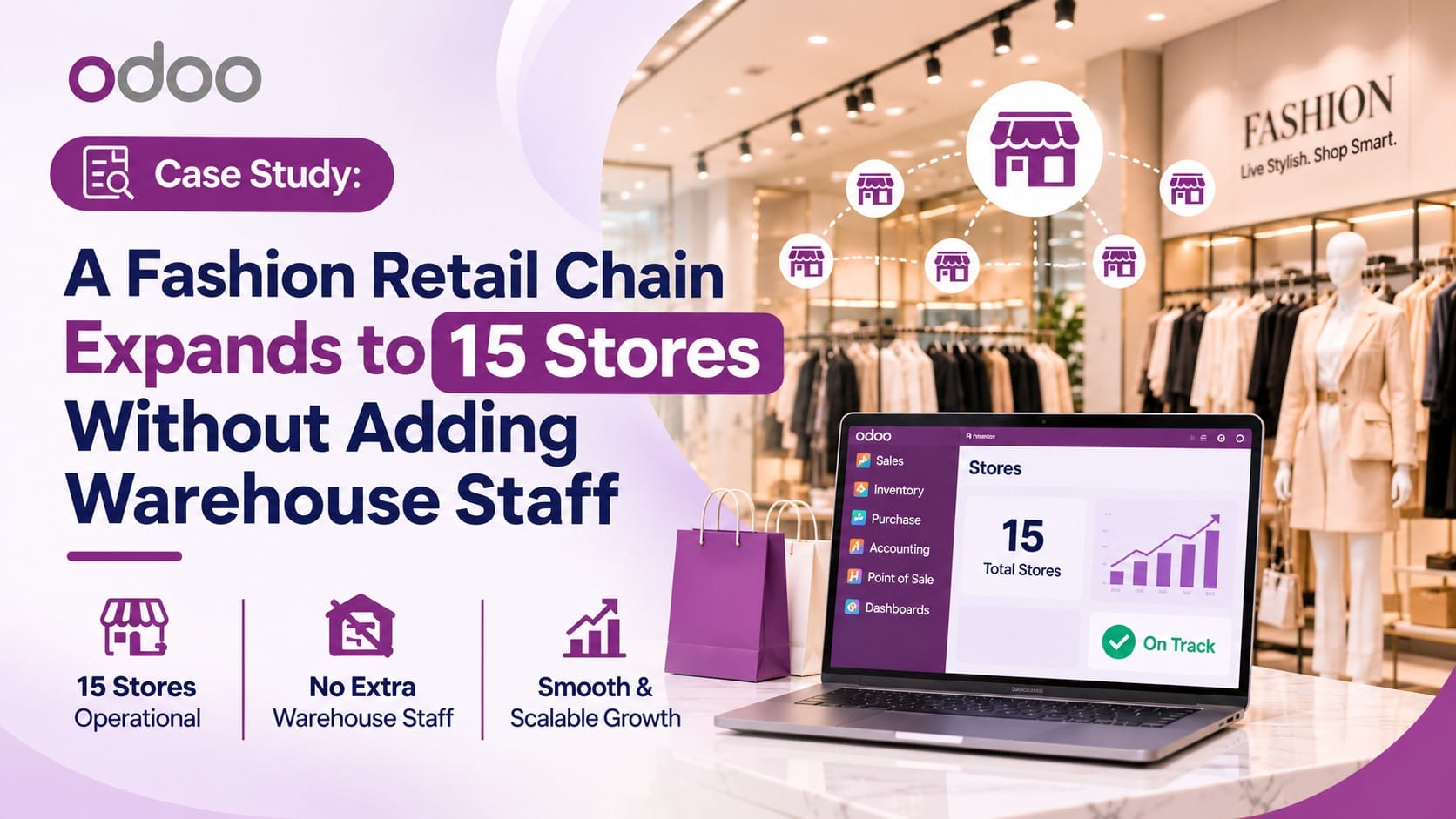
This case study dissects the operational modernization journey delivered on Odoo Inventory, Barcode & POS, detailing how automated multi-warehouse routing, structured variant-matrix locations, and wireless barcode scanning kept logistics lean, accurate, and scalable.
Table of Contents
- The Scaling Dilemma: The Cost Trap of Linear Warehouse Headcount Expansion
- Multi-Location Odoo Architecture: One Central DC Automatically Feeding 15 Outlets
- Digital Fulfillment: Accelerating Transfers via Odoo Barcode and Wave Picking
- Measurable Transformation: Before vs. After Supply Chain Overhaul
- 3 Practical Takeaways for Retailers Preparing for Chain-Wide Expansion
💡 Core Insight: Fulfillment throughput does not scale by hiring more warehouse workers to wander warehouse aisles—it scales with data precision. When bin locations, SKU variants (Color/Size), and inter-branch transfers are guided digitally via wireless barcode scanners on Odoo, teams eliminate wasted search times and cut up to 70% of redundant picking footwork.
3 → 15 Stores
Expanded network footprint over 18 months while maintaining a lean 6-person DC staff
99.8%
Fulfillment and dispatch accuracy across regional branches via Odoo Barcode
-65%
Turnaround cycle time for packing and dispatching store replenishment shipments
PART 1
The Scaling Dilemma: The Cost Trap of Linear Warehouse Headcount Expansion
Operating just 3 boutique outlets in Ho Chi Minh City, the retailer managed operations through standalone POS terminals and ad-hoc Excel spreadsheets. Six warehouse workers manually inspected garments from contract factories, applied price tags, and boxed inventory for delivery. Once regional expansion kicked off with new storefronts in Hanoi and Da Nang, severe operational bottlenecks emerged:
| Operational Bottleneck | Retail & Storefront Reality | Direct Commercial Damage |
|---|---|---|
| Complex SKU Variant Chaos (Size/Color) | A single dress design spanned 3 colorways and 4 sizes (12 distinct SKUs). Staff picked items visually from paper slips, frequently swapping Size S for M or mistaking subtle shade variations. | Picking error rates hit 4.5%. Mismatched stock triggered round-trip return shipping freight and disappointed retail shoppers. |
| Disconnected Inter-Store Transfers | Store supervisors coordinated stock swaps informally over chat groups. The central warehouse lacked real-time visibility into whether inventory was on retail shelves or in transit. | Ghost inventory flourished on paper ledgers, causing untracked shrinkage and up to a 15% physical-to-system count discrepancy. |
| Reflexive Headcount Bloat | Initial expansion projections assumed that opening 15 stores would require hiring 10 to 12 additional full-time warehouse operators to keep up with packing volume. | Inflated payroll burdens would wipe out operating profits across newly opened storefronts during their ramp-up phase. |
PART 2
Multi-Location Odoo Architecture: One Central DC Automatically Feeding 15 Outlets
Instead of adding payroll to paper-based chaos, leadership deployed Odoo Inventory as an end-to-end data core unified with 15 Odoo POS checkout stations:
🏢 Multi-Warehouse Hierarchical Bin Structuring
The system clearly maps 1 Central Distribution Center (DC) alongside 15 satellite retail store stockrooms. The main DC implements a multi-step flow: Receiving (Input) > Organized Storage Bins (Aisle/Rack/Shelf/Bin) > Packing Zone > Shipping Bay (Output). Pickers are guided directly to specific slots (e.g., Aisle A – Rack 2 – Shelf 3).
🔄 Automated Internal Replenishment (Min/Max Rules)
Each retail branch has pre-set automated reordering rules. When cashiers sell a Medium dress at an outlet, dropping its local count below the safety minimum (Min: 3), Odoo generates an Internal Transfer picking slip at the DC to replenish up to target capacity (Max: 10) without manual manager requests.
🚚 Real-Time Inter-Branch Cross-Fulfillment
If central stock is depleted for a trending garment, in-store cashiers look up live inventory across neighboring branches directly on their Odoo POS screens. A cross-store delivery transfer is created with a single click, saving sales on the spot.
PART 3
Digital Fulfillment: Accelerating Transfers via Odoo Barcode and Wave Picking
The structural breakthrough that enabled 6 employees to fulfill volume for 15 busy retail locations was switching paper-based tasks to Odoo Barcode:
| Legacy Procedure (Paper & Excel) | Odoo Barcode & System Automation | Operational Impact |
|---|---|---|
| Single-Order Store Picking | Wave & Batch Picking: Odoo aggregates replenishment demands from 5 to 10 stores into an optimized single-pass route. Workers pass each aisle once to collect total demand for all locations. | Reduces warehouse travel distance by 60%, tripling order fulfillment speed. |
| Visual Verification with Checklists | Mandatory Barcode Validation: Workers use mobile devices or handheld scanners. Scanning an item verifies correct color/size; an invalid item sounds an immediate audible and visual error alert. | Virtually eliminates wrong-size, wrong-color, and incorrect-quantity packing errors. |
| Manual Line-by-Line Store Receiving | 1-Click Master Carton Receiving: Outbound crates are sealed with a master tracking barcode. Receiving store staff scan one label to instantly receive all 50 enclosed items into POS stock. | Cuts retail crate intake from 45 minutes of manual checking down to 2 minutes. |
PART 4
Measurable Transformation: Before vs. After Supply Chain Overhaul
Key operational benchmarks verified after 18 months of digital transformation powered by Odoo:
| Performance Metric | 3-Store Scale (Legacy Systems) | 15-Store Scale (Odoo Multi-Warehouse) |
|---|---|---|
| Central Warehouse Staff | 6 operators (serving 3 outlets) | 6 operators (serving all 15 outlets) |
| Picking & Dispatch Error Rate | 4.5% of internal transfer shipments | Reduced to 0.2% via barcode verification |
| Periodic Cycle Count Variance | 12% – 15% discrepancy | Over 99.5% inventory accuracy in real time |
| Transfer Fulfillment Cycle Time | 4 – 6 hours per request | Under 45 minutes with automated wave batches |
| Annual Avoided Payroll Costs | — | ~$50,000 / year (avoided hiring 10 operators) |
PART 5
3 Practical Takeaways for Retailers Preparing for Chain-Wide Expansion
This success story highlights three universal operational rules for growing retail chains:
- Takeaway 1 — Standardize Master SKUs and Barcodes Before Opening Store #5: Do not wait for footprint sprawl to organize catalog data. Codify master fashion SKUs systematically (e.g., [Product_Code]-[Color]-[Size]) and apply barcode labels upon production intake.
- Takeaway 2 — Architect Structured Bin Locations from Day One: Barcode-label every rack, bay, and bin regardless of warehouse footprint. Granular shelf mapping is mandatory for ERP route optimization algorithms.
- Takeaway 3 — Replace Human Memory with System Automation: People forget inventory review routines during peak seasons; software does not. Let automated reordering rules calculate daily replenishment needs so operators focus purely on picking, scanning, and dispatching.
Discover tailored inventory management architectures and unified omnichannel retail systems through Sonix’s certified Odoo Implementation Services.
KEY TAKEAWAYS
| Core Capability | Practical Business Impact |
|---|---|
| Multi-Warehouse Logistics Engine | Enables rapid branch growth from 3 to 15+ locations without internal logistics gridlock. |
| Precision Barcode Fulfillment | Eliminates 99% of size/color mismatches while tripling per-worker picking throughput. |
| Capped Distribution Headcount | Saves substantial recurring payroll overhead, directly protecting operating margins. |
Is your retail business gearing up for new branch openings?
Book a 1-on-1 strategy consultation with Sonix supply chain specialists to explore Odoo Inventory: automated multi-warehouse replenishment, smart wave picking, and lean headcount scalability.
🚀 Schedule an Odoo Warehouse Strategy Demo
Sonix – Empowering operational excellence and business productivity.
Leave us your comment