

 Tiếng Việt
You’ve heard about CRM. You know it matters. Yet the system still isn’t in place — and the reason usually isn’t that you don’t want it. CRM implementation barriers among Vietnamese SMBs are more varied than you might think, and most of them are entirely solvable. This article distills real-world insights from 50+ consulting sessions to help you look the problem straight in the eye.
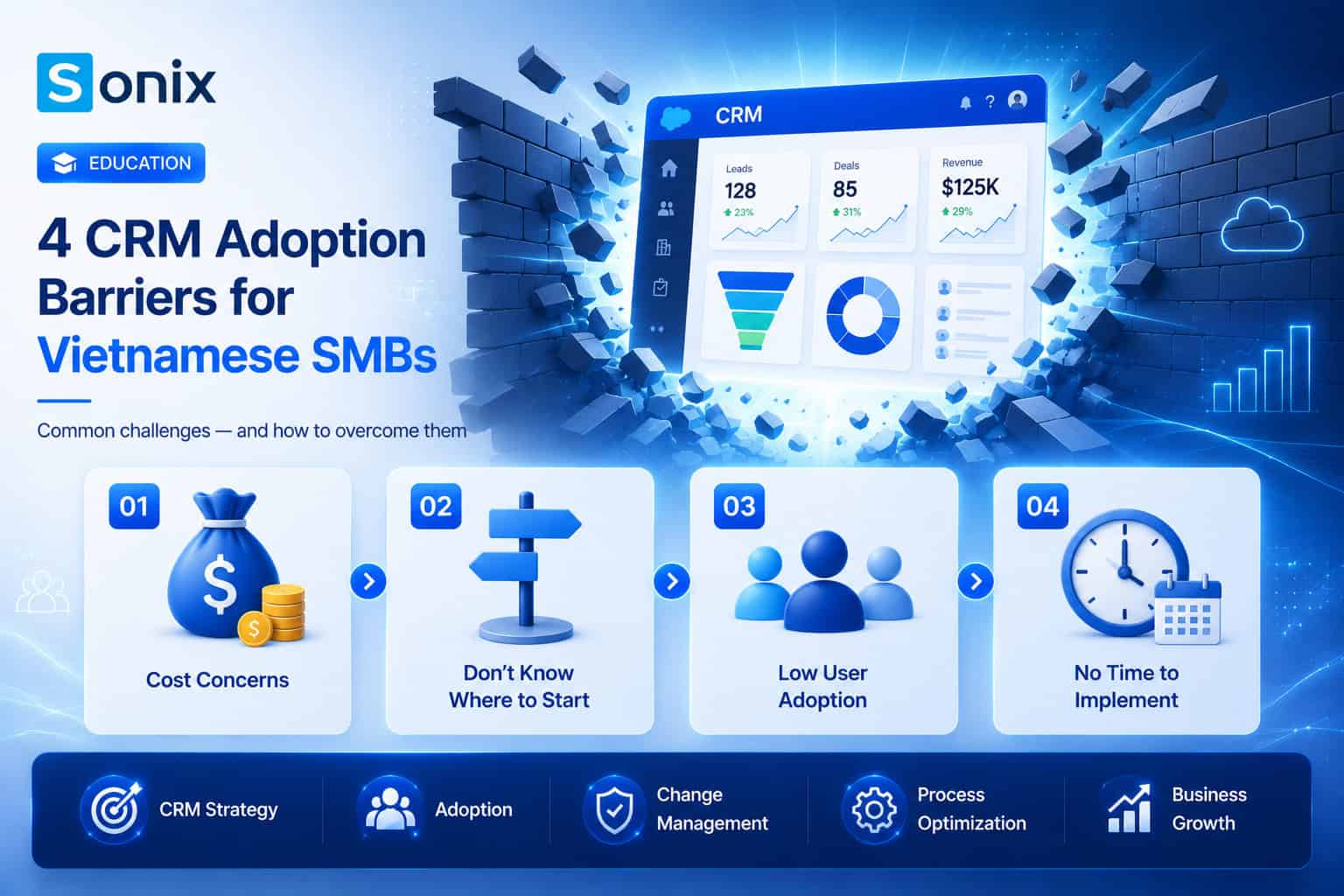
Table of Contents
💡 Insight from 50+ SMB consulting sessions: No CRM implementation barrier is ‘wrong’ — but every single one has a solution when you ask the right questions.
BARRIER #1
Cost Too High — or Just No Clear ROI?
This is the CRM implementation barrier cited most often — but when you dig deeper, the real issue is usually: ‘I haven’t seen any concrete numbers proving CRM is worth the investment.’ According to Salesforce Research, businesses that implement CRM effectively report an average revenue increase of 29% and a 34% boost in sales productivity. Cost isn’t the barrier — the lack of data to make a decision is the real problem.
Many SMBs compare CRM costs against the price of standalone software, when they should really be comparing against opportunity cost: how many deals are lost because there’s no tracking system? How many hours do employees waste on manual data entry every week?
+29%
Revenue Growth
+34%
Sales Productivity
$8.71
ROI per $1 Invested
BARRIER #2
Not Knowing Where to Start — The Most Common Reason SMBs Don’t Implement CRM
‘Not knowing where to start’ is the top reason SMBs don’t implement CRM, appearing in over 60% of Sonix’s consulting sessions with Vietnamese SMBs. The market offers hundreds of solutions — Salesforce, HubSpot, Odoo, Zoho — with no clear guidance tailored to the context of small and medium-sized businesses in Vietnam. The result: no decision gets made, so nothing gets done.
The solution isn’t to research more — it’s to start with your single most pressing business problem. According to Gartner, successful CRM projects always begin with one clearly defined use case, not with selecting a technology.
Identify One Specific Sales Problem
For example: ‘Deals are falling through because no one follows up on time.’ This is the ideal starting point.
Choose a Solution That Fits Your Scale
For SMBs under 50 people: Salesforce Starter or Odoo CRM are practical choices — no enterprise license required.
Run a 30-Day Pilot Before Scaling
Test with one small team, measure results, then decide whether to scale — this reduces risk and increases your chances of success.
BARRIER #3
Fear That Employees Won’t Adopt It — The Human Side of CRM Implementation
This concern is entirely valid. According to McKinsey, 70% of digital transformation projects fail not because of technology — but because of people and process change. Sales employees are especially sensitive: they fear being monitored, dread the time spent on data entry, and see no personal benefit in using a CRM.
The key isn’t to force adoption — it’s to show employees that CRM helps them sell more easily, rather than adding to their workload. When the sales team voluntarily uses the system because they see results, adoption rates rise naturally.
| Approach | Real-World Outcome |
|---|---|
| Force the entire team to use it immediately | High resistance, dirty data, project failure |
| Pilot with an internal ‘CRM champion’ | Organic adoption that spreads from within |
| Training + quick wins demonstrated in the first 2 weeks | Employees see the benefit and continue using it proactively |
BARRIER #4
‘No Time’ — Why Businesses Haven’t Adopted Salesforce or Any CRM Yet
‘We’re too busy — we haven’t had time to implement it’ — Sonix hears this every week. But the paradox is: the reason businesses haven’t adopted Salesforce or any CRM is often precisely because they’re too busy handling the exact tasks a CRM could automate. Companies don’t have time to implement a CRM because they don’t yet have a CRM to save them time.
The practical solution: you don’t have to implement it yourself. An experienced implementation partner can cut go-live time down to just 4–6 weeks with an SMB-appropriate configuration, instead of the 6–12 months typical of enterprise projects. The upfront time investment pays for itself within the first quarter.
SUMMARY
Key Takeaways
| Takeaway | What It Means for Your Business |
|---|---|
| Cost isn’t the real barrier | The issue is not seeing ROI — calculate opportunity cost before ruling out CRM |
| Start with one specific problem | CRM implementation barriers disappear when you have a clear use case instead of choosing technology first |
| People matter more than technology | 70% of projects fail due to human factors — invest in change management before investing in a license |
| ‘No time’ is a self-reinforcing loop | Use an implementation partner to cut go-live to 4–6 weeks instead of spending 6 months doing it yourself |
| There are no wrong answers | Every reason for not implementing CRM has a solution — what matters is having the courage to face the barrier head-on |
Which CRM implementation barrier are you facing?
Whether it’s cost, time, or adoption concerns — Sonix has helped 50+ Vietnamese SMBs overcome exactly these barriers. Book a free consultation to get insights tailored to your business context.
Sonix — Your success is our happiness.
Leave us your comment