

 Tiếng Việt
Odoo shipped version 19.4 in July 2026, with more than 40 changes spread across its modules. Most write-ups about a release like this just list all 40. In reality, not every feature deserves you to stop and read closely. Below are the changes that actually carry weight, and why they matter, not just what they do.
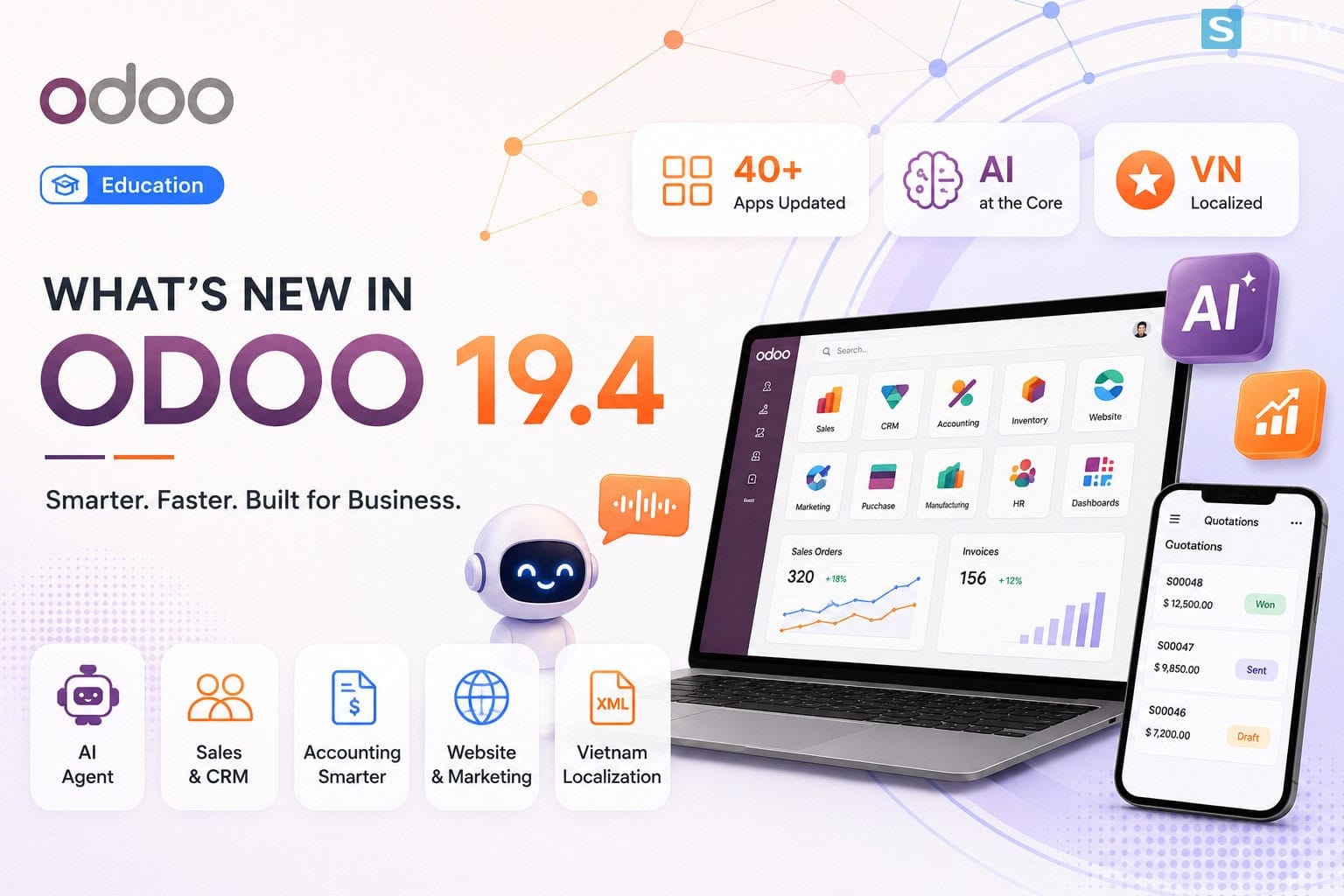
Table of contents
Release highlight
AI Agent: the standout of 19.4
The detail worth noting isn’t “Odoo has AI now,” it’s how Odoo implemented it: the system automatically picks the most suitable AI model for each task, instead of forcing users to understand and choose a provider themselves. For anyone who has watched CRM projects stall out from sheer complexity, that detail matters far more than whether AI exists at all. Odoo also added the ability to connect a database to external tools via the MCP (Model Context Protocol) standard, the same direction several other major platforms are heading, according to the official Odoo release notes.
Two details that are easy to skip past but carry real operational value: users can now issue voice commands directly to the AI agent, and conversation history is kept for 30 days for later reference. This is the kind of feature that never makes a review’s headline, yet it’s exactly what decides whether a salesperson actually uses the AI agent every day. On the marketing side, Odoo added an AI assistant that writes social media content and can post Stories directly to Facebook and Instagram from within the system.
Sales
Sales and CRM
The most valuable feature here isn’t “faster quoting,” it’s that sales reps can now see a customer’s current subscription right on the lead screen, then generate a renewal or upsell quote without opening a separate screen. This is exactly the kind of small detail that decides whether a CRM actually gets used day to day or just sits idle after go-live, because it removes a screen switch that seems harmless but is a common reason reps skip updating their data in the first place.
The commission logic is worth a closer look too: it can now be calculated on the amount actually paid rather than the order value, and managers can earn commission based on their whole team’s results. That’s a far more accurate reflection of real operations than calculating commission off the signed contract value, which tends to distort things when customers pay late or in installments. One more small but useful change: sales order lines no longer need to be tied to a specific product, you can add a line with just a description, which fits businesses selling custom service packages.
Overall, Odoo’s direction in CRM mirrors what most major platforms are doing: pulling sales data and operational data closer together, so reps can decide faster from a single screen.
Accounting
Accounting: less manual data entry
This is a feature an experienced controller will recognize the value of instantly: when entering a bill, whether typed manually or imported from a file, the system now pre-fills details like product, account, and tax rate based on the history of similar bills. The clever part is that any line you’ve already edited manually stays untouched, the system only fills in what’s still missing rather than overwriting your work, a design choice that shows Odoo understands accountants don’t trust AI blindly.
Odoo also improved duplicate-invoice detection, splitting it into two warning levels: red for cases that are almost certainly duplicates and need immediate correction, and yellow for cases that warrant a closer look before posting. Splitting the warning into two tiers instead of one generic flag is a small detail, but it shows the team actually listened to real user feedback rather than bolting on a vague warning and leaving people to guess.
Website & Marketing
Website and social marketing
The most valuable detail here isn’t a prettier interface, it’s that websites built on Odoo now automatically get structured data embedded in the HTML, improving the odds of showing up in Google’s Rich Results without anyone needing to touch code to configure it. This is the kind of “invisible” improvement an SEO specialist will appreciate far more than a casual user, since it fixes a technical gap that’s usually overlooked when a website gets built quickly. The website setup wizard also now suggests a style direction via AI (luxury, eco-friendly, and so on) right from the initial setup step, based on the type of business you declare.
Localization
Vietnam-specific: tax reporting update
This is the one item whose value really lands only if you’ve personally sat down to file monthly tax reports: the system now supports exporting the 01/GTGT report and Appendix 142 as XML files, ready to import straight into HTKK software or submit directly through the General Department of Taxation’s e-portal, instead of re-entering everything by hand each filing period. Tax tag labels in the system were also renamed to be clearer and more intuitive.
It’s a single small line buried in a long release notes page, easy to skim past. But for anyone who has spent years advising on implementations, this is often the detail that decides whether a Vietnamese business is willing to upgrade early, because it affects a task that repeats every single month, not a feature that just sits there for show.
New Odoo Features
CRM & ERP
Digital Transformation
Sonix Vietnam
Weighing Odoo, Salesforce, or another CRM/ERP platform?
Sonix tracks updates across the whole CRM/ERP ecosystem, not just Salesforce, so we can give advice that actually fits how your business operates.
💬 Running Odoo, or comparing platforms right now?
Leave a question in the comments, Sonix will follow up with you.
Sonix – Your success is our happiness.
Leave us your comment