

 Tiếng Việt
 日本語
At many SMBs, the purchasing process still runs through email, Zalo messages, and a handful of disconnected spreadsheets: someone sends a purchase request, someone else calls a supplier for a quote, and then an invoice lands on the accountant’s desk with no one quite sure whether the quantity received actually matches the order. When everything lives in different places, discrepancies only surface on reconciliation day.
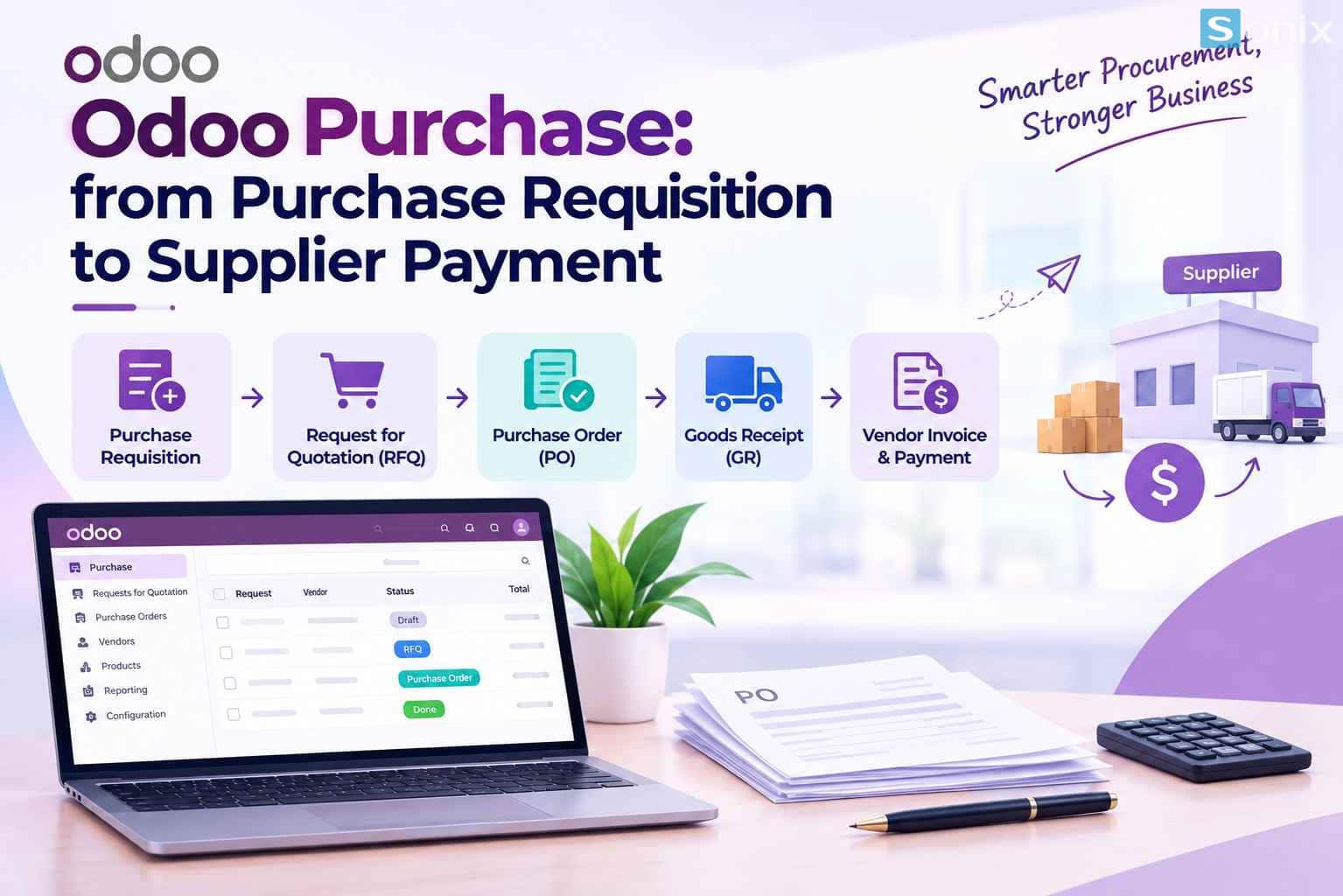
This article walks through the full lifecycle of a purchase order in Odoo – from the moment a department raises a purchase request, to the moment the vendor gets paid – and shows how the system keeps data under control at each step to close the gaps that usually lead to loss.
Table of Contents
💡 Insight: Most vendor-payable discrepancies Sonix has resolved didn’t come from data-entry mistakes – they came from three documents (the purchase order, the goods receipt, and the invoice) being created in three different places with no one cross-checking them before payment.
THE PROCESS
5 Steps in Odoo’s Purchase Process
Purchase Request
The requesting department creates a purchase request directly in the system, specifying the item, quantity, and reason for the purchase. The request is routed automatically to the right approver based on the configured approval hierarchy, instead of sitting in an email inbox waiting for a reply.
Request for Quotation (RFQ) and Vendor Selection
Once a request is approved, the system generates a request for quotation to one or more vendors. Each vendor’s past pricing history shows up right on screen, so buyers can compare offers without digging through old email threads.
Confirmed Purchase Order
The chosen quotation converts into an official purchase order, complete with payment terms and expected delivery date. The purchase order becomes the reference point every downstream check is measured against.
Goods Receipt and Stock Reconciliation
When goods arrive, the warehouse team confirms the actual quantity received directly on the receipt linked to the purchase order. If the received quantity differs from what was ordered, the system flags the discrepancy for resolution before the invoice can be approved.
Vendor Bill and Payment
The vendor’s invoice is automatically matched against the purchase order and the goods receipt using three-way matching. Only once all three agree does the bill get approved and scheduled for payment.
CONTROLS
Data Control Points at Each Step
The real value of bringing all 5 steps onto a single system isn’t that it “looks more professional” – it’s that each step automatically inherits data from the one before it, so errors get caught right where they happen instead of drifting all the way to payment.
| Step | Risk When Done Manually | How Odoo Controls It |
|---|---|---|
| Purchase request | Sent by email, easily lost or forgotten | Automatic approval routing based on configured permissions |
| Vendor quotation | No pricing history to compare against, risk of overpaying | Purchase price history stored per vendor and per item |
| Purchase order | Order and payment terms drift out of sync with the contract | Payment terms locked to the order, no need to recall them later |
| Goods receipt | Short or excess shipments go unnoticed until it’s too late | Quantity discrepancies flagged directly on the receipt |
| Payment | Invoices get approved even when they don’t match what was received | Three-way match (order – receipt – invoice) before approval |
BENEFITS
Benefits of a Closed-Loop Process on One System
When all 5 steps sit on the same data flow, accounts payable no longer has to trace every email to verify whether an invoice is valid – the system has already cross-checked it. Purchasing managers also get a single view of every order that’s pending approval, pending delivery, or pending payment, instead of piecing it together manually at month-end.
If you’d like to see this workflow running on your own industry data, take a look at Sonix’s Odoo implementation service.
If your company’s purchasing process still runs across several disconnected tools, now is a good time to review where the biggest leak is – before it shows up on a payables report.
KEY TAKEAWAYS
| Key Point | What It Means for Your Business |
|---|---|
| The purchase process has 5 tightly linked steps | From request to payment, each step inherits data from the one before it. |
| Three-way matching is the most critical control point | Order, receipt, and invoice are reconciled before payment is approved. |
| Payables discrepancies usually start with scattered documents | Consolidating documents into one system catches errors earlier. |
| Vendor pricing history supports better buying decisions | Buyers can compare prices without digging through old emails. |
How long does it take your company to go from purchase request to vendor payment?
Book a 30-minute discovery call so Sonix can review your current process with you and pinpoint the easiest win with Odoo.
Hundreds of businesses using Odoo in Vietnam started their journey this way.
Sonix – Your success is our success.
Leave us your comment