

 Tiếng Việt
Many small and medium-sized businesses (SMBs) rush into signing a Salesforce implementation contract with the mindset that ‘buying premium software will automatically make everything run smoothly.’ The result? Delayed projects, resistant teams, or worse — an expensive CRM that ends up being nothing more than a glorified contact book nobody bothers to open. The problem rarely lies with Salesforce itself, but rather with the fact that the company internally was never truly ready to embrace a major shift in how it operates.
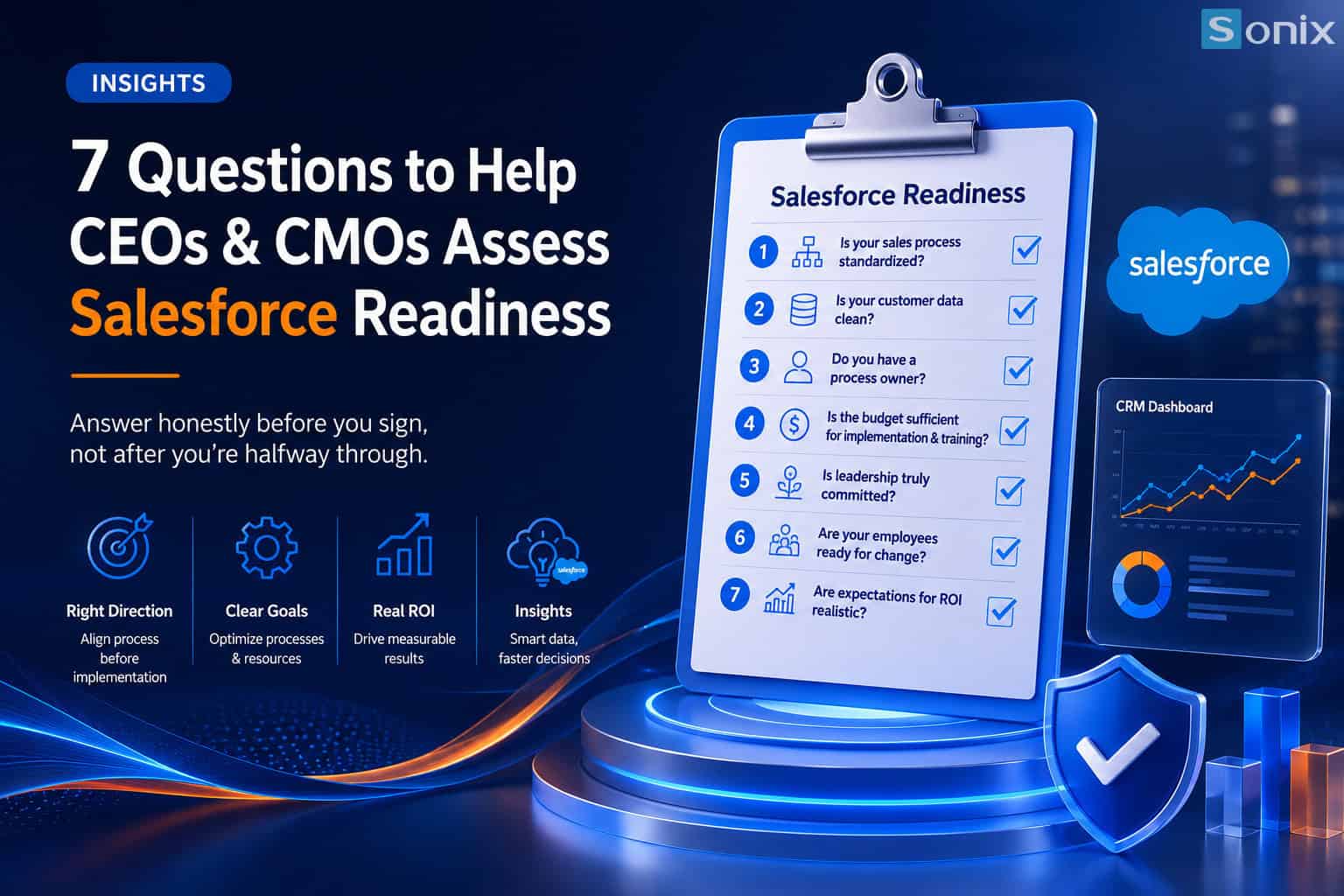
According to research from Gartner, up to 60% of CRM projects fail to deliver expected results due to insufficient preparation in terms of processes and people. Below are 7 core questions to help CEOs and CMOs honestly assess their own organization. Answer them as truthfully as possible before signing on the dotted line — not halfway through the project.
— Why Does Readiness Matter?
Even a world-class CRM system cannot rescue a chaotic workflow. Clearly answering these 7 questions before deciding to implement Salesforce will help your company save hundreds of millions in rework costs, shorten your Go-live timeline, and most importantly, ensure the highest possible employee adoption rate.
7 Questions to Assess Your Implementation Readiness
- Has your sales process been standardized before implementing Salesforce?
- Has your existing customer data been cleaned?
- Who will serve as the Process Owner for this project?
- Does your Salesforce implementation budget account for hidden costs and training?
- Is leadership truly committed to driving change?
- Is your sales team mentally prepared for the Salesforce implementation project?
- Are your company’s ROI expectations realistic?
QUESTION 1
1. Has your sales process been standardized before implementing Salesforce?
Salesforce is an acceleration engine, but your sales process is the steering wheel. It does not create magic on its own — it simply automates and digitizes what you are already doing. If every sales rep on your team is nurturing leads based on personal instinct, with no agreed-upon steps from Lead -> Qualification -> Proposal -> Deal Close, then introducing software will only make that chaos happen faster and cost more.
Deciding to implement Salesforce without a backbone process in place is the single most common mistake. Before you begin, your company needs to clearly map out each Sales Stage on paper — even if it is not yet perfect.
QUESTION 2
2. Has your existing customer data been cleaned?
There is an ironclad rule in the data world: ‘Garbage in, Garbage out.’ Duplicate phone numbers, missing emails, misspelled company names, and data scattered across dozens of individual sales reps’ Excel files are a chronic condition in SMB organizations.
If you import that data ‘landfill’ directly into Salesforce without going through a Data Cleansing step, your Dashboard reports will generate inaccurate forecasts and become completely unreliable. Categorizing, deduplicating, and cleaning data is a time-intensive process and must be built into the project roadmap from day one.
QUESTION 3
3. Who will serve as the Process Owner for this project?
An IT project without a clear owner tends to drift aimlessly after just a few weeks of initial excitement. Your company needs one specific individual who is accountable throughout the entire project — it does not have to be the CEO, and it should not be left entirely to the IT department (since IT typically lacks deep expertise in the art of closing sales). The ideal Process Owner is usually the Chief Sales Officer (CSO) or Head of Operations.
This person will be the final decision-maker when disputes arise over process flows, will work directly with the consulting team, and will ensure the project does not stall. If you have not yet identified this person, that is a red flag signaling the project is not ready to move forward.
QUESTION 4
4. Does your Salesforce implementation budget account for hidden costs and training?
Many businesses make the mistake of assuming the project budget equals only the annual License fee. In reality, the total cost of a Salesforce implementation always includes three core components: License fees, Implementation Services fees (for your partner to configure the system to match your specific processes), and post-Go-live Training and Maintenance fees.
Many projects run out of steam in the final stretch simply because the budget is exhausted, leaving no funds for proper end-user training — and a powerful system ends up sitting on the shelf, unused.
QUESTION 5
5. Is leadership truly committed to driving change?
Digital transformation is a cultural challenge, and it must start from the top down. Employees will always look to leadership’s actual behavior to decide whether they should take the new system seriously. If the Director still asks staff to export reports to Excel ‘because it is easier to read,’ or approves discount levels via messaging apps instead of clicking ‘Approve’ in Salesforce, the project has already failed internally. Leaders must be the first adopters and must firmly refuse to allow any workflows that bypass the CRM.
QUESTION 6
6. Is your sales team mentally prepared for the Salesforce implementation project?
According to sales management research published by Harvard Business Review, the biggest barrier to CRM adoption is the sales team’s fear of being monitored. To them, a new system means being scrutinized on every call and every email, and spending time on data entry instead of meeting clients.
To overcome this barrier, management needs to communicate internally using the ‘WIIFM — What’s In It For Me’ principle. Demonstrate that implementing Salesforce helps them automatically calculate commissions, never miss a scheduled meeting, and avoid disputes over client ownership with colleagues — rather than positioning the software as a micro-management tool.
QUESTION 7
7. Are your company’s ROI expectations realistic?
A successful Salesforce implementation is a marathon, not a sprint. It does not generate a sudden revenue spike within weeks of going live. If the board expects to see a dramatic business uplift in the very first month, they will almost certainly be disappointed and develop a distorted view of the system’s effectiveness.
A realistic ROI roadmap typically unfolds in two phases: Phase 1 (the first 3–6 months) is the Adoption Phase, during which employees build consistent usage habits; Phase 2 (from month 6 onward) is when the system has accumulated enough historical data to generate intelligent reports, optimize customer touchpoints, and truly drive revenue growth.
In summary, purchasing a CRM is easy — but truly mastering it requires a fundamental rethinking of your management approach, demanding alignment across processes, data, and company culture. These 7 questions serve as a mirror reflecting the operational health of your organization. If you can confidently answer ‘Ready’ to most of them, your business has already secured 80% of the ingredients needed for success in the digital era.
Salesforce Readiness
CRM for SMEs
Digital Transformation
Best Practices
Still unsure about any of these 7 questions?
Let Sonix walk through your internal processes with you — Free consultation, no commitment, just 30 minutes to find out exactly whether your company is truly ready to implement Salesforce.
Sonix — Your success is our happiness.
Leave us your comment