

 Tiếng Việt
For many SMBs in Vietnam, the sales process still revolves around Excel spreadsheets, Zalo messages, and the memory of individual sales reps leading to delayed quotes, lost leads, and management never knowing exactly where the pipeline stands. This article is a case study on shortening the sales cycle with Odoo CRM: from a chaotic status quo to a measurable pipeline, based on a real deployment model that the Sonix team has applied for SMB clients in the commercial sector.
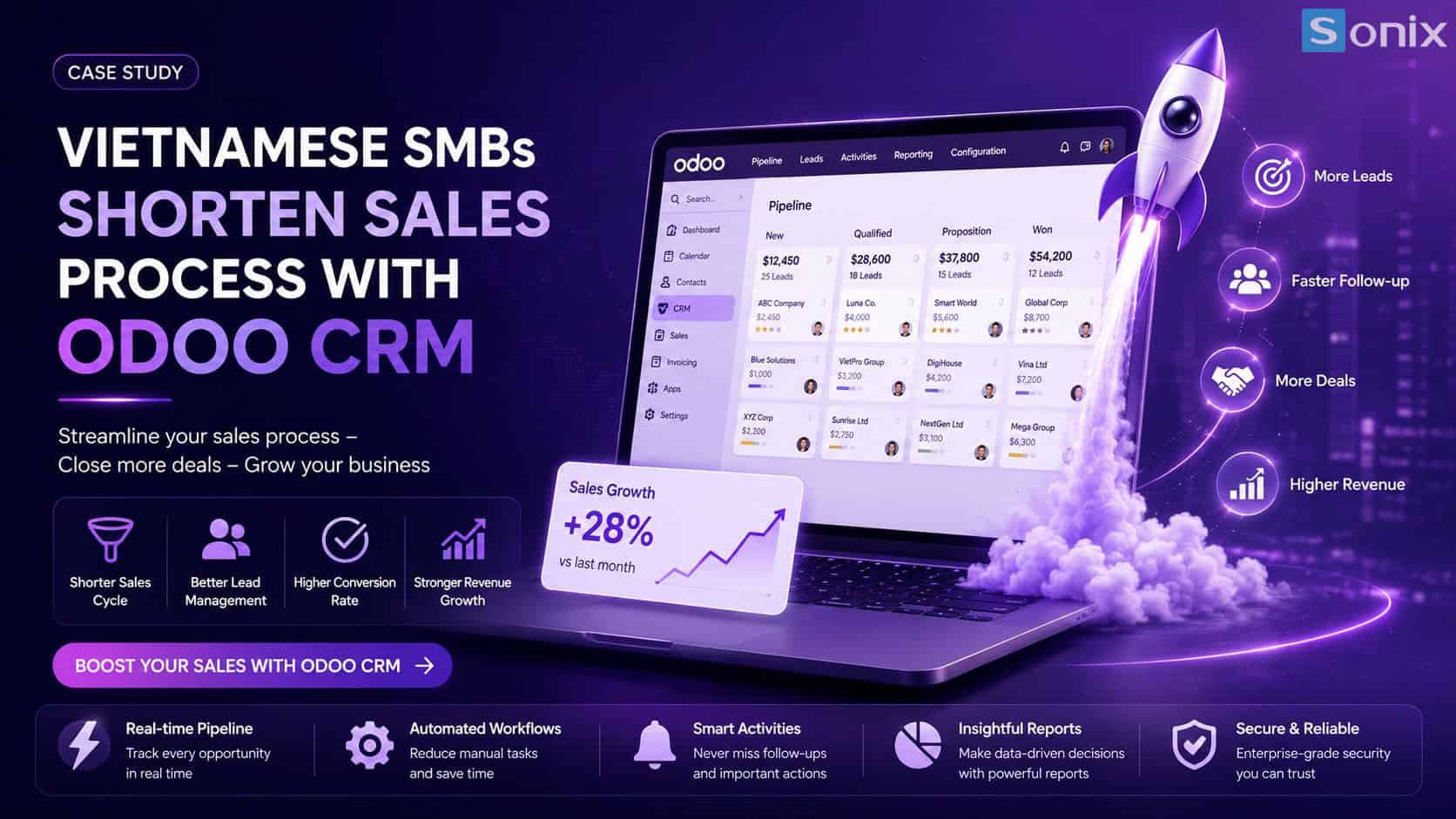
Before and after implementing Odoo CRM for the SMB sales process
Table of Contents
💡 Shortening the sales cycle is not about ‘buying CRM software’ it is about redesigning how a lead moves from the first touchpoint to a signed contract, then letting the system send reminders instead of relying on sales reps to remember.
Current State
The Problem: A Manual Sales Process That Drags On
A Typical Commercial SMB
The company in this case study is an industrial equipment distributor with around 30 staff, including 6 sales reps managing B2B accounts. Before implementation, each rep maintained their own customer list in a personal Excel file, sent quotes via email with no standard template, and tracked which clients were awaiting a response almost entirely from memory.
Three Core Bottlenecks
During the Sonix discovery phase, three bottlenecks appeared repeatedly across most SMBs with a similar model: new leads were not assigned immediately, causing slow response times; quotes had no version control, making it easy to send outdated pricing; and management had no real-time pipeline report to support decision-making.
Leads Falling Through the Cracks
No lead assignment rules meant customers waited days for a response.
No Shared Pipeline
Every rep had their own Excel file, leaving management with no visibility into total open opportunities.
Implementation
The Solution: Deploying Odoo CRM with a Standardized Pipeline
Redesigning the Pipeline into 5 Stages
The Sonix consulting team worked with leadership to standardize the pipeline into 5 stages: New Lead → Qualified → Quotation → Negotiation → Closed Won. Each stage has clear criteria for advancement, preventing opportunities from stalling in an undefined state.
Automating Repetitive Steps
Three key automations were configured in Odoo CRM: automatic lead assignment by territory, follow-up reminders when an opportunity has had no activity for 3 days, and quotation creation directly from the opportunity to ensure pricing is always synced with the latest price list.
5
Standardized pipeline stages
6 weeks
Implementation time to go-live
6/6
Sales reps using CRM daily after go-live
Results
The Results: Numbers That Speak for Themselves
After three months of operation, the most notable difference was not an immediate jump in revenue, but rather the speed and transparency of the process the two factors that determine whether revenue growth is sustainable in the long run.
| Metric | Before Odoo CRM | After Odoo CRM |
|---|---|---|
| New lead response time | 2–3 days | Within a few hours |
| Quotation creation time | Half a day (manual drafting) | A few minutes (from template) |
| Pipeline visibility | No consolidated report | Real-time dashboard |
| Opportunities lost with no clear status | Happened frequently | Nearly eliminated, thanks to automated follow-up reminders |
Big Picture
Key Lessons for Vietnamese SMBs
This case study is not unique to one industry. Any SMB selling across multiple channels phone, Zalo, website, trade shows faces the same challenge: customer data is scattered and no one takes ownership of keeping it updated. The biggest lesson is that CRM only delivers results when paired with a clear process, not when it is simply used as a place to ‘copy over’ information that already exists in Excel.
A common mistake is deploying CRM with too many data fields from the start, causing sales reps to resist data entry and abandon the system within weeks. A more effective approach is to start with a minimal, immediately measurable pipeline, then expand gradually based on the team’s real-world needs.
| Pipeline Stage | What Needs to Be Standardized | Risk If Skipped |
|---|---|---|
| New Lead | Automatic assignment rules | Slow response, leads lost to competitors |
| Qualified | Lead qualification criteria | Sales reps waste time on low-potential leads |
| Quotation | Quote template synced with price list | Sending outdated pricing, damaging credibility |
| Negotiation → Closed Won | Automated follow-up reminders | Opportunities go cold and disappear from the pipeline |
| Takeaway | What It Means for Your Business |
|---|---|
| CRM is a process, not just software | Standardize your pipeline before configuring the system not the other way around. |
| Start minimal, scale gradually | Fewer fields means easier adoption sales reps will log data consistently. |
| Automated follow-up is the key | Reduce forgotten opportunities without adding headcount. |
| Real-time dashboards change how decisions are made | Leadership can intervene early instead of only seeing results at month-end. |
Is your business losing leads because of a fragmented sales process?
Comment ‘CRM’ if you would like to see a sample pipeline demo for your industry. Or book a free consultation and let the Sonix team help you redesign your sales process with Odoo CRM.
Sonix — Your success is our happiness.
Leave us your comment