

 Tiếng Việt
 日本語
A service agency and a retail chain have almost nothing in common in their day-to-day work: one manages billable hours and project progress, the other manages goods and stock at every point of sale. Yet when it comes to choosing a management platform, both often arrive at the same answer: Odoo.
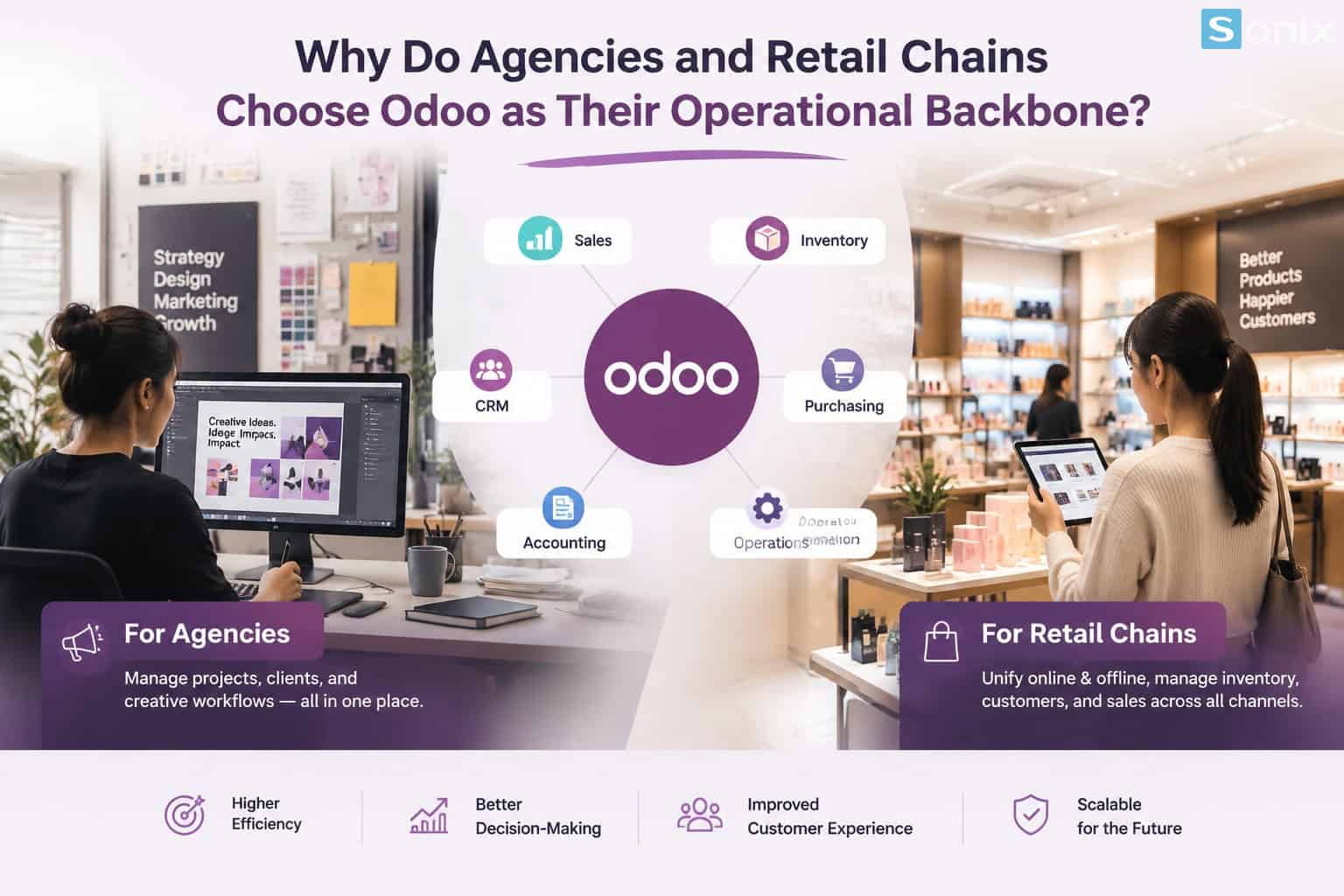
This article explains why both Agencies and Retail Chains choose Odoo as their operational backbone: four core reasons, what each model actually gets out of it, and what to watch for so that choosing Odoo doesn’t turn into yet another software project that stays on paper.
Table of Contents
💡 Insight: Agencies and retailers don’t choose Odoo because it has the most features. They choose it because each can start from its own biggest pain point (billable hours or stock) on the same platform, then connect finance, purchasing, and reporting step by step without ever switching systems.
1 platform
One shared database for sales, operations, and accounting
4 reasons
Why both Agencies and Retail Chains choose Odoo
Step by step
Roll out module by module, expand when your business is ready
PART 1
Why Agencies and Retailers Choose Odoo: One Shared Pain of Fragmented Data
On the surface, the two models look very different. But ask their leaders what keeps them up at night and the answers share a single root: information lives in too many places.
| Common symptom | Service agency | Retail chain |
|---|---|---|
| Where does the data live? | Timesheets, quotation files, standalone task-management tools | Sales software, per-store stock files, accounting books |
| Operational impact | Missed billable hours, late invoices | Stock mismatches between stores, surprise stock-outs |
| Management impact | No clear view of which projects are actually profitable | No clear view of which stores and products are actually profitable |
| Current workaround | Manually compiling data at month-end to bill clients | Manual reconciliation at the end of each shift or period |
Different in content, identical in nature: both are stitching data together by hand instead of letting it flow on its own. This is exactly where Odoo makes the difference.
PART 2
Reason 1: Odoo Is One Unified Platform, Not a Patchwork of Tools
Odoo’s modules share a single database. A customer created in CRM appears in quotations, invoices, and accounting without being re-entered. For small and mid-sized businesses, this means fewer handoffs between systems, less manual data entry, and fewer places for numbers to drift apart.
🎯 For Agencies: from opportunity to invoice in one flow
CRM, Sales, Project, Timesheet, and Invoicing connect one after another. Hours logged on a task become the data for invoicing and project margin, with no copying into another file.
🏪 For Retail: the counter, the warehouse, and accounting see the same numbers
Point of Sale, Inventory, and Purchase share data. Every transaction at the counter updates stock, and stock drives purchase suggestions, instead of each department keeping its own version of the numbers.
📊 For both: accounting is no longer the “stitch it by hand” final step
When sales, billable hours, stock movements, and payments all flow into the accounting module, leaders can see profit and receivables much earlier than waiting for a month-end report.
PART 3
Reason 2: Roll Out Odoo Module by Module, Start Small and Expand Gradually
Odoo is built in modules, which means a business doesn’t have to buy and deploy everything on day one. This suits SMBs especially well, where team resources and time are limited.
- Agencies can start with Project and Timesheet to control billable hours, then add Sales, Invoicing, and CRM once the process is stable.
- Retailers can start with Inventory and Point of Sale to get stock under control, then add Barcode, Purchase, and accounting once stores are comfortable with the workflow.
- Both avoid the “install everything just to be safe” trap that leaves staff reluctant to use the system and the platform bloated.
A step-by-step approach also lets the team see results early: an agency sees its hours captured completely, a store sees stock that finally matches. Those first wins are the motivation for the whole company to keep going.
PART 4
Reasons 3 and 4: Odoo Adapts to Your Processes and Fits SMB Budgets
The last two reasons look different, but they answer the same question: “Will this system grow with my business?”
| Reason | What Agencies get | What Retailers get |
|---|---|---|
| Reason 3: Configurable to your process | Project stages, quotation templates, and billing methods (by milestone or by hour) set up the way the agency already works | Replenishment rules, per-store price lists, and internal stock transfer flows set up for a multi-store chain |
| Reason 4: Fits SMB budgets | Deploy only the modules you need, expand as the team grows | Add stores and modules at the pace the chain expands |
| What they share | A system that adapts to how the business operates, rather than forcing the business to change its way of working to fit the software | |
On cost, Odoo comes in two editions, Community and Enterprise, and the official modules, features, and pricing plans may change over time. Some features (for example, the Barcode and Planning apps) belong to the Enterprise edition, so confirm the feature scope for each edition before finalizing your solution and budget.
ACTION PLAN
What to Consider Before Choosing Odoo as Your Operational Backbone
Odoo is a powerful platform, but it is not magic. Results depend on how it is implemented, and there are three things worth doing before you begin:
- Pinpoint your priority pain point: Agencies choose between billable hours and invoicing, retailers choose between stock control and the checkout counter. Doing one well first beats doing the whole system poorly.
- Standardize your process before digitizing it: software can’t fix a process that isn’t clear. Agree on who does what, when, and where the data goes.
- Choose a partner who understands your model: an implementation partner familiar with Agency or Retail operations will help you configure things correctly from the start and train your team to use the system for real.
If you’d like help setting your priorities and a roadmap that fits, Sonix can support you. Learn more about our Odoo implementation services.
KEY TAKEAWAYS
| Key point | What it means for leaders |
|---|---|
| One platform, one database | Billable hours, sales, stock, and accounting share data instead of being stitched together by hand. |
| Module-by-module rollout | Start from the biggest pain point and expand once the team is comfortable. |
| Flexible to your processes | The system adapts to how your Agency or Retail business already operates. |
| Needs a partner and clear processes | Odoo is a powerful tool, but results come from how it is implemented. |
Ready to choose the operational backbone for your business?
Book a 30-minute discovery call so Sonix can help you decide which Odoo modules to implement first and a roadmap that fits your Agency or Retail model.
Sonix – Our customers’ success is our joy.
Leave us your comment