

 Tiếng Việt
 日本語
日本語Most people new to Salesforce get confused right from the first four terms: Lead, Account, Contact, Opportunity. They sound similar, all related to “customers,” but they represent four completely different concepts in the system.
This post explains all four concepts through one running example: an office furniture distribution company. Getting these four concepts right is the first step toward reading most Salesforce documentation and features. This is also the opening post for the Salesforce 101 series, running regularly every Monday.
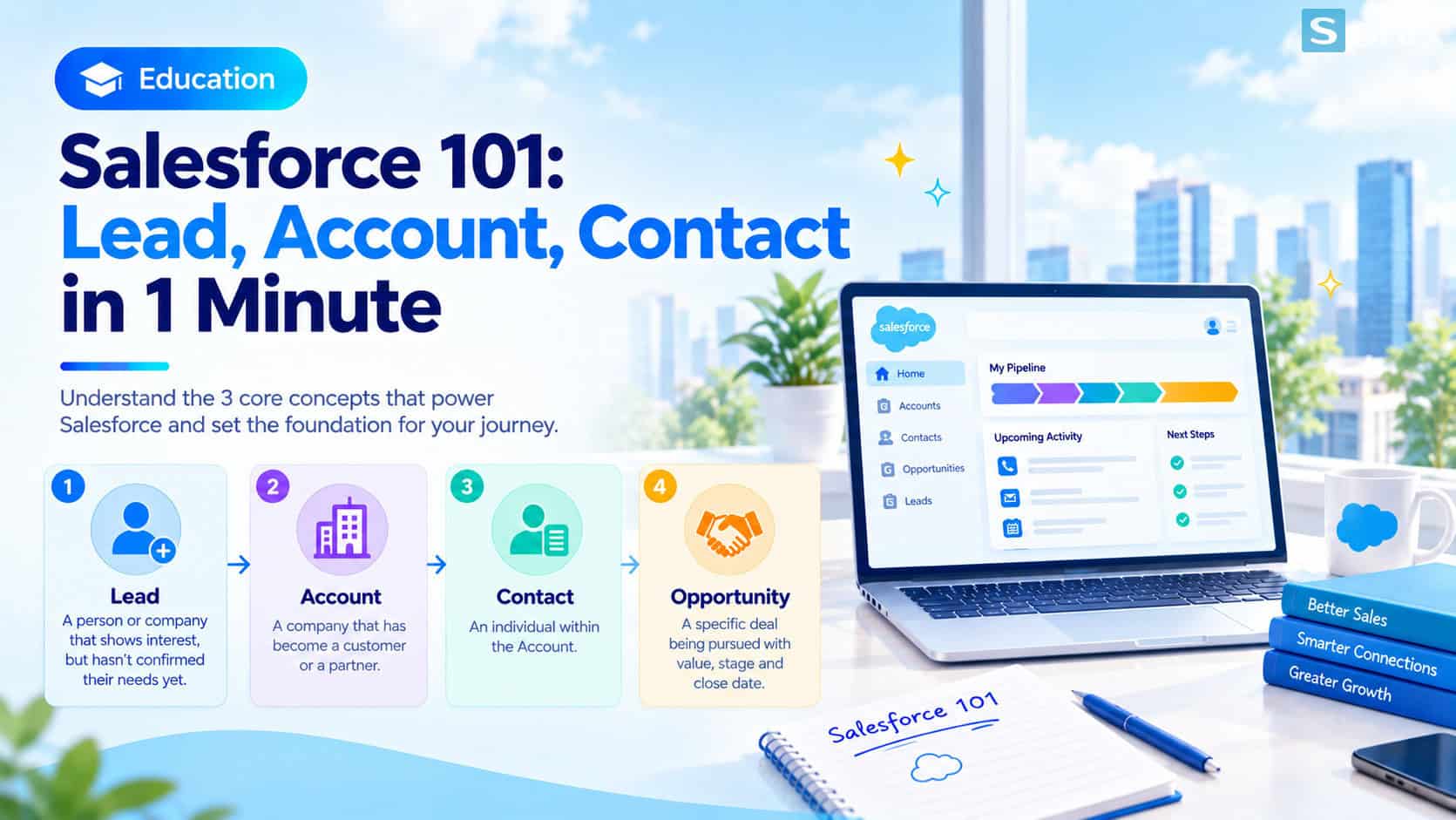 Salesforce 101: Lead, Account, Contact, Opportunity in one minute
Table of Contents
Concept 01
Lead: Someone Or A Company With Unconfirmed Need
A Lead is the first step in the journey, representing a person or company who’s shown some sign of interest, but nothing confirmed yet about their actual need. Information at this stage is usually minimal: maybe just a name and a phone number.
Example: a company just left their phone number on an office furniture distributor’s website, after browsing the desk and chair product page. No one has called yet to confirm what they actually need, how much, or whether there’s budget. This is still just a Lead.
Concept 02
Account: A Company That’s Become A Customer Or Partner
Once a Lead is confirmed to have a real need and starts working officially, it converts into an Account, representing the organization (company, store, or sometimes an individual in a B2C model) the business is doing or has done business with.
Example: after a confirmation call, the company that left their number at the Lead stage turns out to be a business expanding its office, genuinely needing to buy desks and chairs. At this point, that company becomes an Account in the system, with full details like company name, address, industry.
Concept 03
Contact: A Specific Person Inside That Account
An Account rarely has just one point of contact. A Contact represents each specific individual working at that Account, and each person may play a different role in the buying process.
Example: at the company that just became an Account above, the person directly handling the order is Nam, head of procurement. Nam gets logged as a Contact, linked to that company’s Account, with his own email, phone number, and job title.
Concept 04
Opportunity: A Specific Deal Being Pursued
Opportunity is where a deal’s actual value gets tracked: dollar amount, specific product, current stage in the sales process, and likelihood of closing. An Account can have multiple Opportunities at once or over time.
Example: after talking with Nam, the sales team determines this company needs 50 sets of office furniture, currently at the quoting stage. This is an Opportunity, linked to the company’s Account and to Nam as the Contact, with a specific value and awaiting close.
Summary
How These Four Concepts Connect
In the exact order they appeared in the example: a Lead (the phone number left on the website) gets its need confirmed and becomes an Account (the company expanding its office). Inside that Account sits one or more Contacts (Nam, head of procurement). And from the relationship with that Account and Contact, one or more Opportunities get created (the 50-set furniture order currently being quoted).
Once this sequence clicks, most screens and reports in Salesforce become much easier to understand, since nearly every other feature is built on top of these four foundational concepts. If you want to see these four concepts show up directly on a real interface, the Salesforce Sales Cloud setup guide in 10 minutes is a good place to practice hands-on.
Save this post as a quick reference for these four foundational concepts. This is the opening piece for Sonix’s Salesforce 101 series, running regularly every Monday, explaining each Salesforce term with real-world examples.
Which Salesforce term would you like explained next?
Book a free consultation if you’re just getting started with Salesforce and want a guide from the very first concepts.
Sonix: Your success is our happiness.
Leave us your comment